VoicERA Launched On BHASHINI National Infrastructure
ECONOMY & POLICY

VoicERA Launched On BHASHINI National Infrastructure

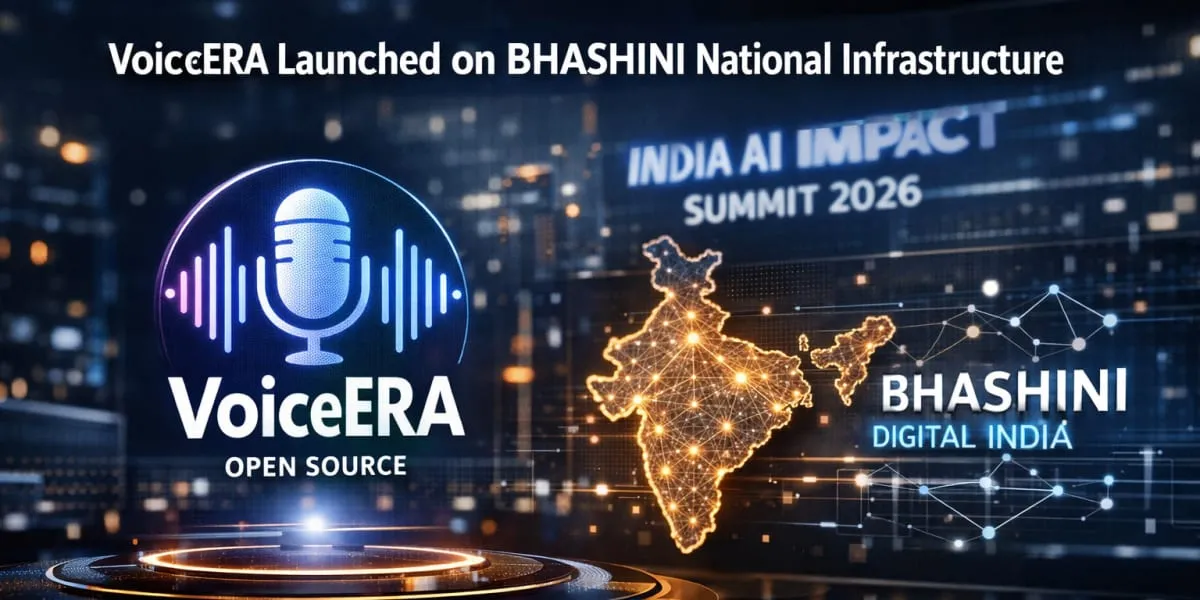
The Digital India BHASHINI Division (DIBD), under the Digital India Corporation (DIC) of the Ministry of Electronics and Information Technology (MeitY), launched VoicERA at the India AI Impact Summit 2026. The launch was led by Amitabh Nag, Chief Executive Officer of the Digital India BHASHINI Division, in collaboration with EkStep Foundation, COSS, IIIT Bengaluru and AI4Bharat. The initiative was presented as a major milestone in India’s Digital Public Infrastructure.

VoicERA is an open source, end to end voice artificial intelligence stack deployed on the BHASHINI National Language Infrastructure, serving as a national execution layer for multilingual voice and language AI. The platform has been designed to be open, pluggable, interoperable, cloud deployable and on premise ready, enabling secure and scalable deployment of voice systems across government departments, research institutions and innovation ecosystems. By modularising the voice stack the project seeks to reduce duplication of effort and remove vendor lock in.

The integration expands BHASHINI’s capabilities from translation and language technologies to real time speech systems, conversational AI and multilingual telephony at population scale. Departments are expected to rapidly onboard voice enabled citizen services across agriculture advisories, education support, livelihood services, grievance redressal, citizen feedback and scheme discovery. The design aims to support inclusive access and sovereign control over voice technologies.

Officials described the launch as the beginning of a new phase of Digital Public Infrastructure in which voice becomes a primary interface for citizens to engage with the State, emphasising dignity and access through a shared national foundation. Stakeholders noted that VoicERA is intended as a digital public good for voice, enabling interoperable execution ready deployment without the need to rebuild entire technology stacks. Live demonstrations are available at the BHASHINI Pavilion and at the EkStep Pavilion in Bharat Mandapam.

The Digital India BHASHINI Division (DIBD), under the Digital India Corporation (DIC) of the Ministry of Electronics and Information Technology (MeitY), launched VoicERA at the India AI Impact Summit 2026. The launch was led by Amitabh Nag, Chief Executive Officer of the Digital India BHASHINI Division, in collaboration with EkStep Foundation, COSS, IIIT Bengaluru and AI4Bharat. The initiative was presented as a major milestone in India’s Digital Public Infrastructure. VoicERA is an open source, end to end voice artificial intelligence stack deployed on the BHASHINI National Language Infrastructure, serving as a national execution layer for multilingual voice and language AI. The platform has been designed to be open, pluggable, interoperable, cloud deployable and on premise ready, enabling secure and scalable deployment of voice systems across government departments, research institutions and innovation ecosystems. By modularising the voice stack the project seeks to reduce duplication of effort and remove vendor lock in. The integration expands BHASHINI’s capabilities from translation and language technologies to real time speech systems, conversational AI and multilingual telephony at population scale. Departments are expected to rapidly onboard voice enabled citizen services across agriculture advisories, education support, livelihood services, grievance redressal, citizen feedback and scheme discovery. The design aims to support inclusive access and sovereign control over voice technologies. Officials described the launch as the beginning of a new phase of Digital Public Infrastructure in which voice becomes a primary interface for citizens to engage with the State, emphasising dignity and access through a shared national foundation. Stakeholders noted that VoicERA is intended as a digital public good for voice, enabling interoperable execution ready deployment without the need to rebuild entire technology stacks. Live demonstrations are available at the BHASHINI Pavilion and at the EkStep Pavilion in Bharat Mandapam.

Next Story
Infrastructure Urban

Centre Examines Duty Relief Under MOOWR For Battery Storage Imports

The finance ministry is examining whether to continue customs warehousing benefits under the Manufacture and Other Operations in Warehouse Regulations, 2019 framework for imported battery energy storage systems. It plans consultations with the ministries of power and new and renewable energy to decide on the future scope of duty and GST deferment for such imports. The review follows concerns from the renewable energy sector that the current approach is creating an uneven playing field. Under the regulations, companies may import goods without paying customs duty or goods and services tax upfro..

Next Story
Infrastructure Urban

Jamshedpur MP Seeks Rs 4,820 Million Plan For Tatanagar Platforms

Member of Parliament Bidyut Baran Mahato held a meeting with Vikas Jain, Executive Director (Public Grievances) of the Railway Board, following a special session of Parliament to press for accelerated rail infrastructure work around Jamshedpur and Tatanagar. The discussions addressed a range of projects that the ministry is prioritising for the area. Final Location Surveys for the construction of the fourth and fifth railway lines between Pandrasali and Kandra and for the development of a satellite station near Tatanagar have already been approved, clearing the way for detailed planning. Mahat..

Next Story
Infrastructure Energy

Final Batch Of Two 3,300 HP Locomotives Reach Mozambique

The final batch of two 3,300 horsepower (hp) locomotives manufactured by Banaras Locomotive Works (BLW) has reached Mozambique, marking completion of an export consignment. The locomotives arrived at Maputo harbour and were cleared for onward movement to the national rail operator. The shipment closes a programme that began with earlier consignments delivered over the past months. Banaras Locomotive Works, a production unit of Indian Railways, built the locomotives under a contract with the Mozambican rail authority and managed the final inspections and commissioning preparations prior to disp..

Advertisement

Subscribe to Our Newsletter

Get daily newsletters around different themes from Construction world.

STAY CONNECTED

Advertisement

Advertisement

Advertisement