


CAQM Revokes GRAP Stage II in Delhi-NCR
ECONOMY & POLICY

CAQM Revokes GRAP Stage II in Delhi-NCR

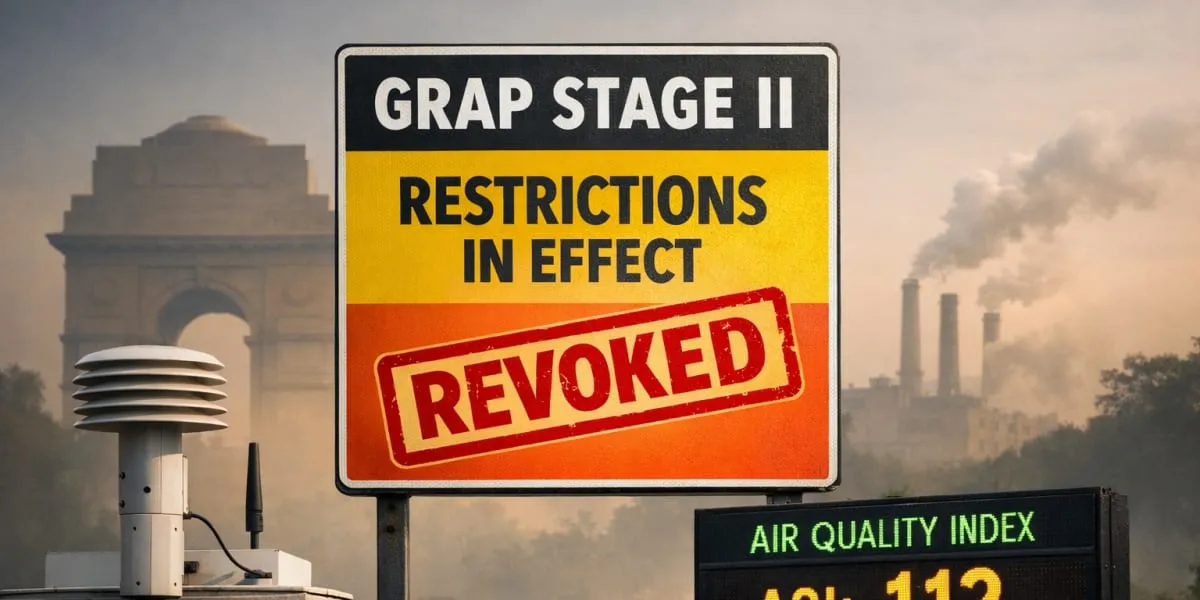
The Sub-Committee on the Graded Response Action Plan of the Commission for Air Quality Management in NCR and Adjoining Areas (CAQM) revoked all Stage-II actions across the entire National Capital Region with immediate effect after noting a consistent improvement in Delhi's daily average air quality index. The measure followed the invocation of Stage-II on 19 October 2025 when the average index began to exhibit an increasing trend. The Sub-Committee emphasised that monitoring arrangements would remain active to guard against any reversal.

Data from the Central Pollution Control Board (CPCB) showed a downward trend in the daily average air quality index for Delhi, with readings of 261 on 16 February 2026, 249 on 17 February 2026 and 214 on 18 February 2026 at four pm. The bulletin from the CPCB was a principal input in the Sub-Committee's evaluation of prevailing conditions.

During its review the Sub-Committee considered forecasts of meteorological conditions and air quality prepared by the India Meteorological Department (IMD) and the Indian Institute of Tropical Meteorology (IITM), and noted that favourable weather had contributed to the observed improvement. The forecasts indicated that the index was likely to remain in the poor to moderate category in the coming days, and the Sub-Committee accordingly decided to revoke all actions under Stage-II.

Measures under Stage-I of the GRAP will continue to remain in force and were to be implemented, monitored and reviewed by concerned agencies listed in the extant GRAP to ensure that air quality levels do not deteriorate. Implementing agencies were directed to maintain strict vigil and intensify measures under Stage-I. The Sub-Committee will continue to closely monitor the air quality scenario and review the situation from time to time.

The Sub-Committee on the Graded Response Action Plan of the Commission for Air Quality Management in NCR and Adjoining Areas (CAQM) revoked all Stage-II actions across the entire National Capital Region with immediate effect after noting a consistent improvement in Delhi's daily average air quality index. The measure followed the invocation of Stage-II on 19 October 2025 when the average index began to exhibit an increasing trend. The Sub-Committee emphasised that monitoring arrangements would remain active to guard against any reversal. Data from the Central Pollution Control Board (CPCB) showed a downward trend in the daily average air quality index for Delhi, with readings of 261 on 16 February 2026, 249 on 17 February 2026 and 214 on 18 February 2026 at four pm. The bulletin from the CPCB was a principal input in the Sub-Committee's evaluation of prevailing conditions. During its review the Sub-Committee considered forecasts of meteorological conditions and air quality prepared by the India Meteorological Department (IMD) and the Indian Institute of Tropical Meteorology (IITM), and noted that favourable weather had contributed to the observed improvement. The forecasts indicated that the index was likely to remain in the poor to moderate category in the coming days, and the Sub-Committee accordingly decided to revoke all actions under Stage-II. Measures under Stage-I of the GRAP will continue to remain in force and were to be implemented, monitored and reviewed by concerned agencies listed in the extant GRAP to ensure that air quality levels do not deteriorate. Implementing agencies were directed to maintain strict vigil and intensify measures under Stage-I. The Sub-Committee will continue to closely monitor the air quality scenario and review the situation from time to time.

Next Story
Infrastructure Urban

Coal Minister Inaugurates Projects and Reviews WCL in Nagpur

G. Kishan Reddy, Coal Minister, inaugurated several key infrastructure projects and reviewed operations of Western Coalfields Limited (WCL) at a programme in Nagpur. The minister opened new facilities aimed at strengthening production capacity and logistics and undertook a comprehensive review of mining, transportation and safety arrangements. He assessed project readiness and operational planning with senior WCL officials and emphasised the need for timely completion and strict adherence to statutory norms. During the visit the minister inspected mining works, mechanisation initiatives, pithe..

Next Story
Infrastructure Transport

Modi To Inaugurate Redeveloped Kakinada Railway Station

Prime Minister Narendra Modi is scheduled to inaugurate the redeveloped Kakinada railway station in Andhra Pradesh on March 31. The ceremony will mark the completion of a redevelopment initiative intended to upgrade the station's infrastructure and services. The event will be presented as a milestone in efforts to modernise regional rail facilities. The redevelopment focuses on improved passenger amenities, enhanced accessibility and better circulation within the station complex. Upgrades are reported to encompass modernised waiting areas, upgraded sanitation facilities and signage, and measur..

Next Story
Infrastructure Energy

Kerala Able to Meet Peak Electricity Demand, Minister Says

Kerala will be able to meet peak electricity demand and there will be no power cuts, the state energy minister Krishnankutty has said. He provided assurance that supply arrangements and operational measures are in place to handle peak loads and to maintain stability across the grid. The statement followed routine assessments by the state electricity department and other agencies tasked with monitoring system health and reserve margins. The minister indicated that the administration has intensified monitoring of demand patterns and generation output to pre-empt stress on the network. He said co..

Advertisement

Subscribe to Our Newsletter

Get daily newsletters around different themes from Construction world.

STAY CONNECTED

Advertisement

Advertisement

Advertisement