India Eyes Growth In Sodium Ion Batteries As TRL Reached
ECONOMY & POLICY

India Eyes Growth In Sodium Ion Batteries As TRL Reached

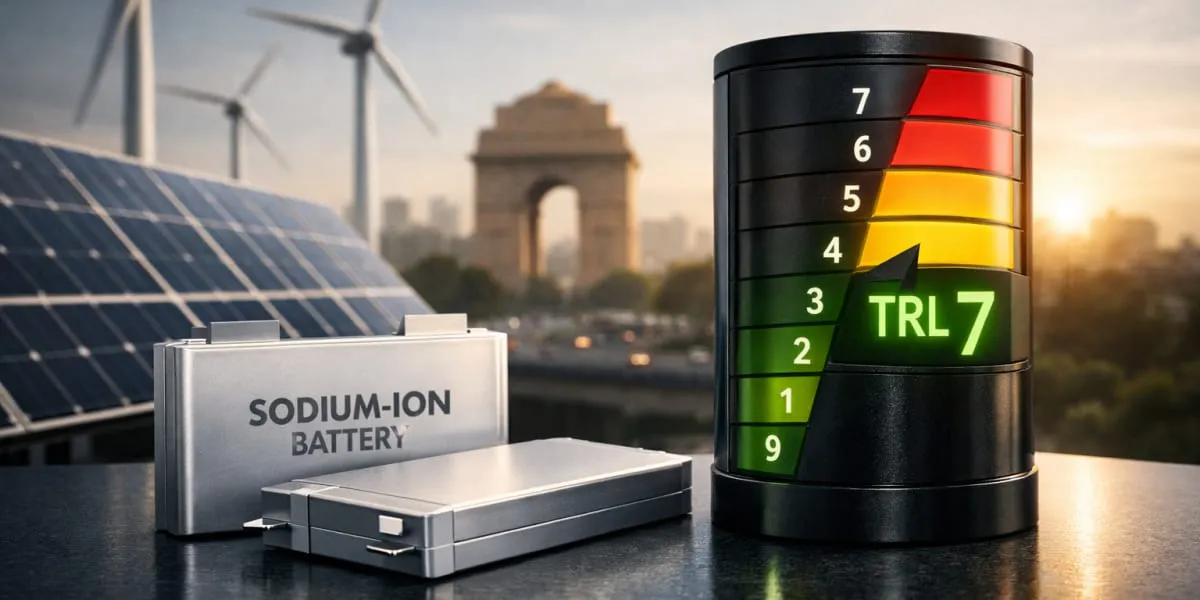
Renewable Energy Secretary Santosh Kumar Sarangi said India is poised to see significant growth in sodium ion battery technology after researchers achieved Technology Readiness Level (TRL) seven and above, noting that reaching TRL seven typically allows progression from pilot projects to commercial production in two to three years. He made the remarks on the sidelines of the BloombergNEF summit in New Delhi. Technology Readiness Level (TRL) is a scale used to assess the maturity of a technology, with TRL seven indicating a system prototype demonstrated in an operational environment.

He said the government expects alternative battery technologies to play an increasing role as India expands energy storage to support a growing share of renewable energy. On vanadium flow batteries he noted domestic manufacturers are developing supply capacity and cited an order placed by NTPC Green Energy Limited for 100 megawatts (MW) of capacity as evidence of demand. He added that rising volumes should help bring down prices and transform the economics of longer duration storage.

Sarangi referred to estimates from the Central Electricity Authority (CEA) that India would have about 411 gigawatt-hours (GWh) of energy storage by 2031-32 and said the country was on track to meet that requirement earlier. He said the current deployed level of storage remained lower but that tenders and placements indicated that around 156 GWh of battery energy storage systems were under process and implementation. That pipeline, he suggested, reflected significant near-term capacity development.

He said the government is addressing battery recycling under existing e-waste rules and will add further detail if required. He also told delegates the administration is working on a new scheme to support domestic polysilicon manufacturing because capacity expected under the earlier Production Linked Incentive scheme was likely to be limited. To bolster energy security and manufacturing resilience he said India would look at adding at least 30 gigawatt (GW) of polysilicon capacity by 2030.

Renewable Energy Secretary Santosh Kumar Sarangi said India is poised to see significant growth in sodium ion battery technology after researchers achieved Technology Readiness Level (TRL) seven and above, noting that reaching TRL seven typically allows progression from pilot projects to commercial production in two to three years. He made the remarks on the sidelines of the BloombergNEF summit in New Delhi. Technology Readiness Level (TRL) is a scale used to assess the maturity of a technology, with TRL seven indicating a system prototype demonstrated in an operational environment. He said the government expects alternative battery technologies to play an increasing role as India expands energy storage to support a growing share of renewable energy. On vanadium flow batteries he noted domestic manufacturers are developing supply capacity and cited an order placed by NTPC Green Energy Limited for 100 megawatts (MW) of capacity as evidence of demand. He added that rising volumes should help bring down prices and transform the economics of longer duration storage. Sarangi referred to estimates from the Central Electricity Authority (CEA) that India would have about 411 gigawatt-hours (GWh) of energy storage by 2031-32 and said the country was on track to meet that requirement earlier. He said the current deployed level of storage remained lower but that tenders and placements indicated that around 156 GWh of battery energy storage systems were under process and implementation. That pipeline, he suggested, reflected significant near-term capacity development. He said the government is addressing battery recycling under existing e-waste rules and will add further detail if required. He also told delegates the administration is working on a new scheme to support domestic polysilicon manufacturing because capacity expected under the earlier Production Linked Incentive scheme was likely to be limited. To bolster energy security and manufacturing resilience he said India would look at adding at least 30 gigawatt (GW) of polysilicon capacity by 2030.

Related Stories

Gold Stories

Next Story
Real Estate

Gradiant expands Coimbatore engineering centre

Gradiant has expanded its Global Engineering Center (GEC) in Coimbatore, more than doubling its engineering workforce from approximately 100 to over 200 professionals as it strengthens its global project execution capabilities.The expanded centre will bring together multidisciplinary expertise across process engineering, detailed design and project engineering, enabling the India team to take on greater responsibility for the engineering and design of Gradiant’s international projects.According to Govind Alagappan, COO, Gradiant, Coimbatore’s engineering talent and industrial heritage make..

Next Story
Infrastructure Urban

Domestic Firms Choose Locally Designed Reactors to Cut Delays

Domestic companies in the nuclear sector are choosing locally designed reactors to avoid time consuming approvals and supply chain bottlenecks that can delay project execution. The shift reflects an emphasis on reducing dependence on foreign designs and accelerating construction schedules by aligning design, manufacturing and regulatory processes within national frameworks. Industry participants expect that locally designed systems will allow closer coordination with regulators and vendors, shortening lead times for certification and component delivery. Localisation is projected to stimulate t..

Next Story
Infrastructure Urban

Kadiyam Kavya Seeks Separate Railway Division For Kazipet

Warangal Member of Parliament Kadiyam Kavya has urged the establishment of a separate railway division based at Kazipet and submitted a representation to the South Central Railway (SCR) general manager at the headquarters in Secunderabad. She highlighted Kazipet's role as a major railway hub and argued that the junction has not seen development commensurate with its strategic importance. The representative action aimed to press for administrative reorganisation to address local operational and developmental needs. She noted that creation of an independent Kazipet division has been a long stand..

Advertisement

Subscribe to Our Newsletter

Get daily newsletters around different themes from Construction world.

STAY CONNECTED

Advertisement