Union Minister Launches Second Tranche of Exploration Licence Blocks
ECONOMY & POLICY

Union Minister Launches Second Tranche of Exploration Licence Blocks

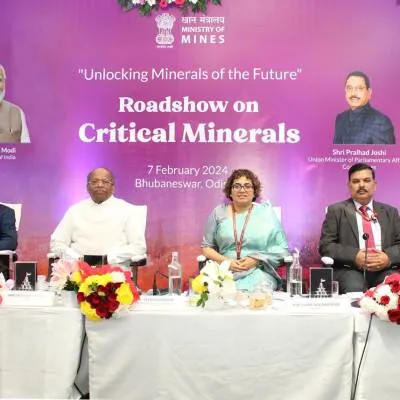
Union Minister for Coal and Mines G. Kishan Reddy launched the second tranche of auction of Exploration Licence blocks in New Delhi, advancing the Government's efforts to strengthen the mineral exploration ecosystem. He emphasised the need to reduce dependence on mineral imports by accelerating domestic exploration and by encouraging greater participation of the private sector alongside government agencies. The Minister said the Government is committed to building a structured, transparent and technology-driven exploration framework to unlock untapped mineral potential.

He underlined the strategic importance of critical minerals and stated that a robust and efficient exploration regime will be pivotal to achieving the vision of Viksit Bharat 2047 and enhancing self-reliance in the mineral sector. He described the measures as transformative reforms that aim to enhance transparency, efficiency and investment in mining. He noted the mining sector is witnessing changes designed to improve governance and business opportunities.

At the event, the Geological Survey of India (GSI) launched the Next-Generation (NG) Portal, a cloud-enabled platform that integrates data acquisition, analysis, visualisation and dissemination with AI and machine learning tools. The portal is interoperable with the National Geoscience Data Repository (NGDR) and is expected to strengthen transparency, efficiency and data-driven decision making in mineral exploration. The launch and roadshow were attended by Piyush Goyal, Secretary, Ministry of Mines, and Sanjay Lohia, Additional Secretary, Ministry of Mines. Presentations outlined the exploration licence blocks under the second tranche and explained the exploration licence regime, tender process and the e-auction mechanism.

The second tranche follows an encouraging response to the first and comprises 11 blocks of critical and deep-seated minerals spread across eight States. The Exploration Licence regime introduced under the MMDR Amendment Act 2023 and the Mineral Auction Amendment Rules 2023 was said to have strengthened transparency, improved ease of doing business and expanded opportunities for participation by both private and public sector players. A scheme for partial reimbursement of exploration expenses for holders of exploration licences was also presented.

Union Minister for Coal and Mines G. Kishan Reddy launched the second tranche of auction of Exploration Licence blocks in New Delhi, advancing the Government's efforts to strengthen the mineral exploration ecosystem. He emphasised the need to reduce dependence on mineral imports by accelerating domestic exploration and by encouraging greater participation of the private sector alongside government agencies. The Minister said the Government is committed to building a structured, transparent and technology-driven exploration framework to unlock untapped mineral potential. He underlined the strategic importance of critical minerals and stated that a robust and efficient exploration regime will be pivotal to achieving the vision of Viksit Bharat 2047 and enhancing self-reliance in the mineral sector. He described the measures as transformative reforms that aim to enhance transparency, efficiency and investment in mining. He noted the mining sector is witnessing changes designed to improve governance and business opportunities. At the event, the Geological Survey of India (GSI) launched the Next-Generation (NG) Portal, a cloud-enabled platform that integrates data acquisition, analysis, visualisation and dissemination with AI and machine learning tools. The portal is interoperable with the National Geoscience Data Repository (NGDR) and is expected to strengthen transparency, efficiency and data-driven decision making in mineral exploration. The launch and roadshow were attended by Piyush Goyal, Secretary, Ministry of Mines, and Sanjay Lohia, Additional Secretary, Ministry of Mines. Presentations outlined the exploration licence blocks under the second tranche and explained the exploration licence regime, tender process and the e-auction mechanism. The second tranche follows an encouraging response to the first and comprises 11 blocks of critical and deep-seated minerals spread across eight States. The Exploration Licence regime introduced under the MMDR Amendment Act 2023 and the Mineral Auction Amendment Rules 2023 was said to have strengthened transparency, improved ease of doing business and expanded opportunities for participation by both private and public sector players. A scheme for partial reimbursement of exploration expenses for holders of exploration licences was also presented.

Next Story
Technology

AI-Enabled Workflows Lift Profitability and Productivity

Organisations modernising frontline workflows with artificial intelligence, automation and real-time data are reporting stronger financial performance, higher productivity and improved employee engagement, according to a global study by Zebra Technologies and Oxford Economics.The research covered 1,000 senior leaders across retail, manufacturing, transportation and logistics in the US, Mexico, the UK, Germany, India, Japan, Australia and New Zealand.In transportation and logistics, 54 per cent of companies that improved picking and packing operations reported faster operational performance, wh..

Next Story
Real Estate

India Leads Global AI Readiness but Implementation Lags

Indian companies lead global averages across all eight artificial intelligence readiness indicators tracked by JLL, but only 19 per cent have started making changes to their workplaces, according to the JLL 2026 Future of Work Survey.The study found that 77 per cent of Indian business leaders expect AI to change their office requirements, creating a 58-percentage-point gap between awareness and implementation. The survey covered more than 2,200 CEOs, CFOs and real estate leaders across 21 countries during the first quarter of 2026.Despite concerns over automation, 58 per cent of Indian leaders..

Next Story
Equipment

Three WOLFF Cranes Build Riyadh Cable-Stayed Bridges

Three WOLFF 180 B luffing jib cranes are supporting the construction of two cable-stayed bridges alongside the existing Wadi Laban Bridge in Riyadh, Saudi Arabia. The project is being developed for the Royal Commission for Riyadh City and executed by the ICRC joint venture comprising IC Ictas and Al Rashid Trading & Contracting Company.The cranes are handling lifting operations including formwork, reinforcement, concrete placement, work platforms, surveying equipment and other construction materials. Each crane is fitted with a 40 m jib, reaches a hook height of 157 m and offers a maximum ..

Advertisement

Subscribe to Our Newsletter

Get daily newsletters around different themes from Construction world.

STAY CONNECTED

Advertisement

Advertisement

Advertisement