+
Yulu Raises USD 93 Million Series C To Expand EV Fleet
ECONOMY & POLICY

Yulu Raises USD 93 Million Series C To Expand EV Fleet

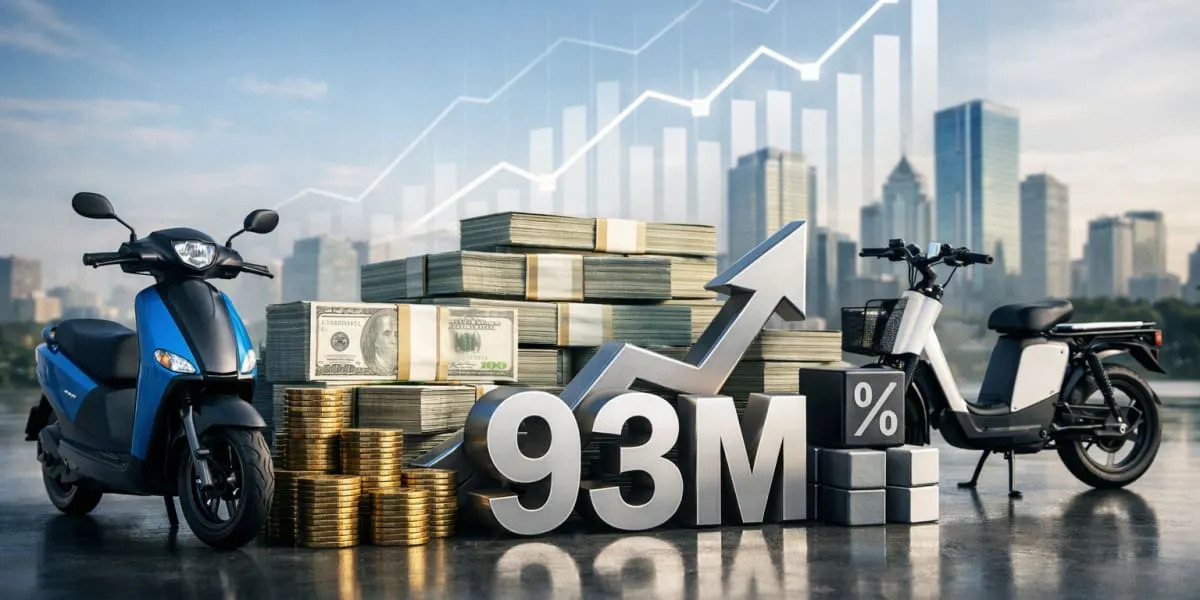
Bengaluru-based electric mobility company Yulu has raised USD 93 million (mn) in a Series C funding round comprising USD 63 million (mn) in equity and USD 30 million (mn) in debt, with the equity component led by GEF Capital Partners. The company said the financing will support an acceleration of fleet growth and new service launches. The round combines debt and equity to balance capital efficiency and operational scaling.

Yulu plans to expand its electric vehicle fleet to 200,000 vehicles over the next two years and to enter additional hyperlocal mobility use cases. The firm intends to introduce a full-sized, higher-speed electric scooter called Yulu Express, designed for longer-haul e-commerce deliveries, bike taxis and express parcel services, and about a third of the planned fleet will consist of the new model. The company also sees the capital as support for a potential public market listing.

The business operates an electric vehicle ecosystem that includes purpose-built hardware, proprietary technology and energy infrastructure, and has strategic partnerships with Bajaj Auto and Magna International. It currently operates a fleet of around 50,000 vehicles and logs about 1.6 mn zero-emission miles each week while powering more than 750,000 deliveries a day. The mix of owned and partner operations underpins its service footprint.

Yulu operates in 12 Indian cities, running its own operations in Bengaluru, Mumbai, Delhi NCR and Hyderabad and partnering with franchisees in eight other markets, with a target of reaching roughly 20 cities within the next year including Chennai and Pune. About 95 per cent of revenue comes from renting electric bikes to gig workers on weekly subscriptions, with the remainder from a station-based rental service in Bengaluru. The company said this is likely to be its final equity fundraising before an eventual public listing, with future fleet expansion to be financed primarily through debt and lease financing, and that it achieved positive earnings before interest, tax, depreciation and amortisation last financial year and expects to move towards profitability before interest and taxes next year.

Bengaluru-based electric mobility company Yulu has raised USD 93 million (mn) in a Series C funding round comprising USD 63 million (mn) in equity and USD 30 million (mn) in debt, with the equity component led by GEF Capital Partners. The company said the financing will support an acceleration of fleet growth and new service launches. The round combines debt and equity to balance capital efficiency and operational scaling. Yulu plans to expand its electric vehicle fleet to 200,000 vehicles over the next two years and to enter additional hyperlocal mobility use cases. The firm intends to introduce a full-sized, higher-speed electric scooter called Yulu Express, designed for longer-haul e-commerce deliveries, bike taxis and express parcel services, and about a third of the planned fleet will consist of the new model. The company also sees the capital as support for a potential public market listing. The business operates an electric vehicle ecosystem that includes purpose-built hardware, proprietary technology and energy infrastructure, and has strategic partnerships with Bajaj Auto and Magna International. It currently operates a fleet of around 50,000 vehicles and logs about 1.6 mn zero-emission miles each week while powering more than 750,000 deliveries a day. The mix of owned and partner operations underpins its service footprint. Yulu operates in 12 Indian cities, running its own operations in Bengaluru, Mumbai, Delhi NCR and Hyderabad and partnering with franchisees in eight other markets, with a target of reaching roughly 20 cities within the next year including Chennai and Pune. About 95 per cent of revenue comes from renting electric bikes to gig workers on weekly subscriptions, with the remainder from a station-based rental service in Bengaluru. The company said this is likely to be its final equity fundraising before an eventual public listing, with future fleet expansion to be financed primarily through debt and lease financing, and that it achieved positive earnings before interest, tax, depreciation and amortisation last financial year and expects to move towards profitability before interest and taxes next year.

Related Stories

Gold Stories

Next Story
Real Estate

BMC OC Amnesty Scheme Requires Key Approvals from Mumbai Societies

The Brihanmumbai Municipal Corporation (BMC) has clarified that housing societies applying under its Occupation Certificate (OC) amnesty scheme must possess key approvals linked to the original construction. The requirements include a valid Intimation of Disapproval (IOD), an approved building plan and a Commencement Certificate (CC), along with a No Objection Certificate (NOC) from the developer or original construction applicant. The Standard Operating Procedure (SOP) makes clear that the absence of an OC alone will not qualify a building for relief. Societies must establish that their build..

Next Story
Real Estate

Gurugram Emerges as Luxury Senior Living Hub

Gurugram is emerging as a potential hub for luxury senior living, supported by available land, healthcare infrastructure, connectivity and a concentration of affluent professionals, high-net-worth individuals and non-resident Indians. These factors could give the city an advantage over land-constrained metros such as Mumbai. A report by the Association of Senior Living India (ASLI) and JLL estimates that India’s organised senior living market could represent a $10.1 bn opportunity by 2030. The sector had about 25,050 organised units as of June 2026, while penetration stood at only 1.5 per ce..

Next Story
Real Estate

Corrosion Costs India’s Infrastructure Rs. 142 bn Annually

Corrosion costs India an estimated Rs. 1.42 tn annually, equivalent to 4.3 per cent of gross domestic product, according to a report by the Confederation of Indian Industry and the National Research Institute. Infrastructure accounts for Rs. 142 bn of the annual burden, making it the sector with the largest absolute cost among those examined. The report, presented at the CII Annual Infrastructure Summit 2026, said the infrastructure-sector cost equals about 2.9 per cent of the sector’s gross domestic product. It estimated that effective measures could generate maximum savings of Rs. 495.8 bn..

Advertisement

Subscribe to Our Newsletter

Get daily newsletters around different themes from Construction world.

STAY CONNECTED

Advertisement

SPECIAL OFFER
QR Code