Cabinet Approves Upgradation Of NH-347B Corridor In Madhya Pradesh
ROADS & HIGHWAYS

Cabinet Approves Upgradation Of NH-347B Corridor In Madhya Pradesh

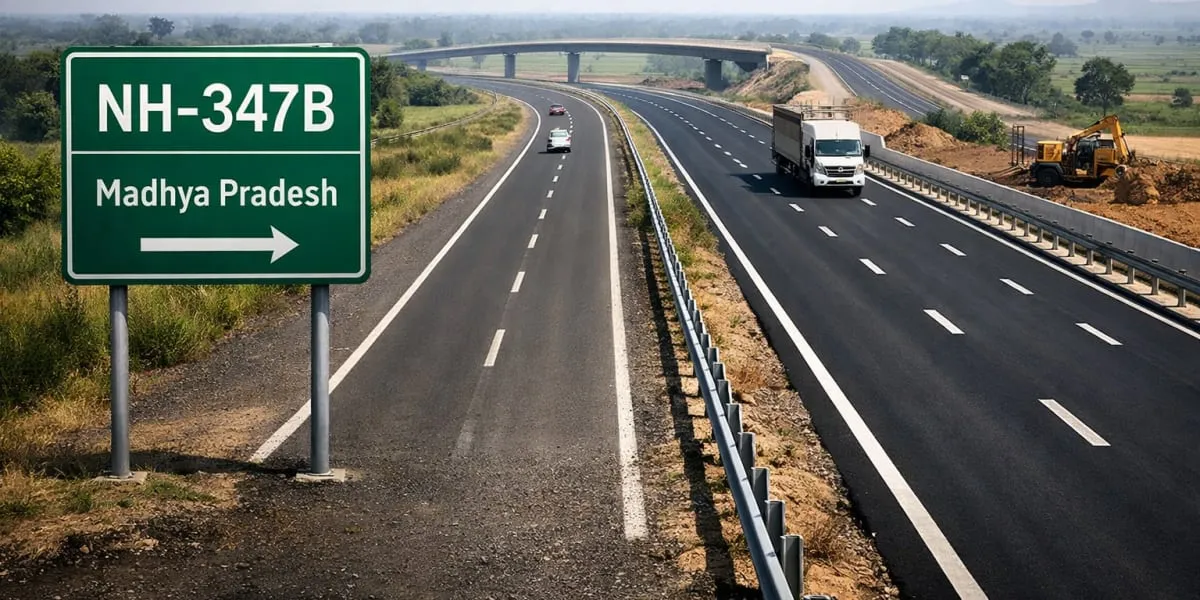
The Cabinet Committee on Economic Affairs, chaired by the Prime Minister, approved the upgradation and widening of sections of National Highway 347B in Madhya Pradesh covering a total length of 233.653 km. The project comprises conversion of an existing intermediate lane to a two-lane with paved shoulder standard for 125.01 km of the Hiwarkhedi-Roshni-Ashapur-Rudhy section and widening of an existing two-lane to four-lane for 108.643 km between Deshgaon and Julwaniya on a Hybrid Annuity Mode. The total capital cost is Rs 44,156 million (mn).

Total civil cost is Rs 27,050.8 mn and land acquisition cost is Rs 4,327.7 mn, forming the overall outlay for the 233.653 km corridor. An extended Greenfield bypass of 16.20 km in Khargone district will be developed and additional bypasses of 70.39 km and 54.273 km are planned for the respective sections. The upgrade aims to address severe geometric deficiencies, sharp curves and congestion in built-up areas across Betul, Khandwa, Khargone and Barwani districts.

The upgraded corridor is intended to increase average travel speeds, reduce travel time and improve road safety, fuel efficiency and vehicle operating costs, thereby supporting regional mobility and socio-economic development. It will provide seamless connectivity to six PM Gati-Shakti economic nodes including a textile cluster, two mega food parks, an industrial park and two super thermal power plants, as well as five social nodes covering two aspirational districts and three tribal districts. The route will also link five logistic nodes including two major railway stations, two airports and one multimodal logistic park in Indore.

The project is expected to generate direct employment of one point nine five million (mn) person-days and indirect employment of two point three mn person-days. Implementation on Hybrid Annuity Mode will be overseen by the relevant agencies and is intended to facilitate faster movement of goods and passengers across the region. The approval follows standard procedures and seeks to enhance integration of road infrastructure with wider economic nodes and transport networks.

The Cabinet Committee on Economic Affairs, chaired by the Prime Minister, approved the upgradation and widening of sections of National Highway 347B in Madhya Pradesh covering a total length of 233.653 km. The project comprises conversion of an existing intermediate lane to a two-lane with paved shoulder standard for 125.01 km of the Hiwarkhedi-Roshni-Ashapur-Rudhy section and widening of an existing two-lane to four-lane for 108.643 km between Deshgaon and Julwaniya on a Hybrid Annuity Mode. The total capital cost is Rs 44,156 million (mn). Total civil cost is Rs 27,050.8 mn and land acquisition cost is Rs 4,327.7 mn, forming the overall outlay for the 233.653 km corridor. An extended Greenfield bypass of 16.20 km in Khargone district will be developed and additional bypasses of 70.39 km and 54.273 km are planned for the respective sections. The upgrade aims to address severe geometric deficiencies, sharp curves and congestion in built-up areas across Betul, Khandwa, Khargone and Barwani districts. The upgraded corridor is intended to increase average travel speeds, reduce travel time and improve road safety, fuel efficiency and vehicle operating costs, thereby supporting regional mobility and socio-economic development. It will provide seamless connectivity to six PM Gati-Shakti economic nodes including a textile cluster, two mega food parks, an industrial park and two super thermal power plants, as well as five social nodes covering two aspirational districts and three tribal districts. The route will also link five logistic nodes including two major railway stations, two airports and one multimodal logistic park in Indore. The project is expected to generate direct employment of one point nine five million (mn) person-days and indirect employment of two point three mn person-days. Implementation on Hybrid Annuity Mode will be overseen by the relevant agencies and is intended to facilitate faster movement of goods and passengers across the region. The approval follows standard procedures and seeks to enhance integration of road infrastructure with wider economic nodes and transport networks.

Next Story
Infrastructure Urban

Cabinet Approves Two Year Scheme To Replace Old Trucks And Buses

The Union Cabinet, chaired by the Prime Minister, approved a two-year scheme to reduce air pollution in the Delhi–NCR region and promote cleaner mobility. The programme will be funded through the National Capital Region Planning Board under the Ministry of Housing and Urban Affairs and implemented by the Ministry of Road Transport and Highways and the Ministry of Petroleum and Natural Gas, with participating States and Union Territories of Delhi, Haryana, Rajasthan and Uttar Pradesh. The total financial outlay has been set at Rs 95.85 billion (bn), with the Central Government contributing Rs..

Next Story
Infrastructure Transport

Bengaluru Suburban Rail And Metro To Share 500-Metre Corridor

Bengaluru suburban rail and the Metro will share a 500-metre corridor at Benniganahalli, a decision that planners say will reduce capital expenditure and urban disruption. The consolidation of alignments across the short stretch is intended to avoid duplication of elevated structures and station facilities while cutting land acquisition needs. Authorities put the maximum savings at Rs 1.69 bn (1,690 mn). The arrangement also aims to streamline construction interfaces between the two systems. The shared corridor will require coordinated design of track beds, piers and passenger access so that s..

Next Story
Infrastructure Urban

DRDO And IAF Complete Successful RudraM-II Flight Tests

The Defence Research and Development Organisation (DRDO) and the Indian Air Force (IAF) have conducted successful flight tests of the RudraM-II air-to-surface missile from an airborne platform. The trials were carried out under extreme release conditions with a critical trajectory that established the capability of all subsystems. The series of releases tested the missile's guidance, seeker and propulsion elements in an operationally representative environment. The missiles, released from the aircraft, were guided to a predefined target with pinpoint accuracy and all test objectives were fully..

Advertisement

Subscribe to Our Newsletter

Get daily newsletters around different themes from Construction world.

STAY CONNECTED

Advertisement

Advertisement

Advertisement