+
NHAI Makes 80 Per Cent Plantation And 90 Per Cent Survival Mandatory
ROADS & HIGHWAYS

NHAI Makes 80 Per Cent Plantation And 90 Per Cent Survival Mandatory

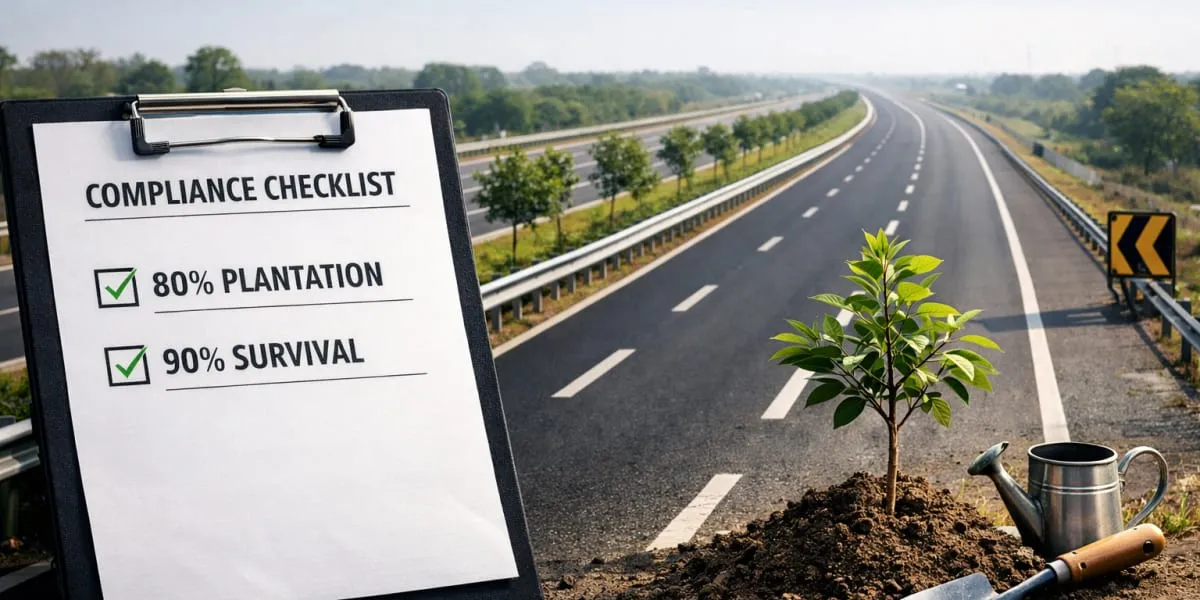
The National Highways Authority of India (NHAI) has made plantation compliance a prerequisite for issuance of the Provisional Certificate of Completion (PCC) or declaration of the Provisional Commercial Operation Date (PCOD) for new highway stretches. The authority has issued guidelines requiring that plantation obligations be substantially met before a road can be certified as substantially completed and safe for commercial use. The measure aims to ensure adequate greenery along newly developed highway corridors.

Under the rules, plantation must cover at least 80 per cent of the available right of way (RoW) earmarked for vegetation before PCC or PCOD is issued, and the planted saplings must show a minimum 90 per cent survival rate at the time of inspection. The independent engineers or the authority's engineers are required to certify that these thresholds have been achieved when recommending completion certification. The guidelines further state that casualty replacement must be undertaken with plants of commensurate age and growth to preserve uniformity of the plantation.

The NHAI has linked plantation maintenance to payments during the operation and maintenance (O&M) period, making the release of O&M or annuity payments contingent on maintaining the stipulated 90 per cent survival rate. Appropriate financial withholdings provided under contracts or concession agreements will remain until outstanding plantation targets are fulfilled. This arrangement is intended to hold highway concessionaires and contractors accountable for long term upkeep of median and avenue plantations.

Regional officers will verify that plantation work conforms to contractual provisions, the standards prescribed by the Ministry of Road Transport and Highways (MoRTH) and NHAI, and the Green Highways Policy 2015. Officials indicated that reviews of national highway projects had found plantation and landscaping were often not accorded due importance at the time of recommending completion certificates, prompting the stricter compliance framework. The guidelines are expected to strengthen environmental sustainability and aesthetics and to ensure that planting obligations are not overlooked before projects are declared substantially complete.

The National Highways Authority of India (NHAI) has made plantation compliance a prerequisite for issuance of the Provisional Certificate of Completion (PCC) or declaration of the Provisional Commercial Operation Date (PCOD) for new highway stretches. The authority has issued guidelines requiring that plantation obligations be substantially met before a road can be certified as substantially completed and safe for commercial use. The measure aims to ensure adequate greenery along newly developed highway corridors. Under the rules, plantation must cover at least 80 per cent of the available right of way (RoW) earmarked for vegetation before PCC or PCOD is issued, and the planted saplings must show a minimum 90 per cent survival rate at the time of inspection. The independent engineers or the authority's engineers are required to certify that these thresholds have been achieved when recommending completion certification. The guidelines further state that casualty replacement must be undertaken with plants of commensurate age and growth to preserve uniformity of the plantation. The NHAI has linked plantation maintenance to payments during the operation and maintenance (O&M) period, making the release of O&M or annuity payments contingent on maintaining the stipulated 90 per cent survival rate. Appropriate financial withholdings provided under contracts or concession agreements will remain until outstanding plantation targets are fulfilled. This arrangement is intended to hold highway concessionaires and contractors accountable for long term upkeep of median and avenue plantations. Regional officers will verify that plantation work conforms to contractual provisions, the standards prescribed by the Ministry of Road Transport and Highways (MoRTH) and NHAI, and the Green Highways Policy 2015. Officials indicated that reviews of national highway projects had found plantation and landscaping were often not accorded due importance at the time of recommending completion certificates, prompting the stricter compliance framework. The guidelines are expected to strengthen environmental sustainability and aesthetics and to ensure that planting obligations are not overlooked before projects are declared substantially complete.

Related Stories

Gold Stories

Next Story
Building Material

Aditya Birla Group Launches Ultravolt Wires And Cables Business

Aditya Birla Group has entered the wires and cables market through Ultravolt, extending UltraTech's move from building materials into building solutions. The shift builds on UltraTech Building Solutions, a multi-category platform that already addresses customers across different stages of construction and extends beyond cement into ready-mix concrete, waterproofing, tile-fixing solutions and mortars. The company intends to enter with scale, seeking presence across 100,000 retailers in more than 500 districts and availability through 5,000 plus UltraTech Building Solutions (UBS) outlets. The po..

Next Story
Infrastructure Transport

Tamil Nadu Shortlists Two Sites For Second Chennai Airport

The Tamil Nadu government has shortlisted two sites near Chennai for a proposed second airport, and officials have submitted the findings of a preliminary study to the Airports Authority of India (AAI). The locations are Cheyyur in Chengalpattu district, about 100 km south of Chennai, and Manellore near Gummidipundi in Tiruvallur district, about 50 km north-northwest of the city. Both sites were identified within a week after the administration decided to drop the earlier Parandur plan on environmental grounds. State officials recommended that the AAI carry out feasibility studies and indicate..

Next Story
Infrastructure Urban

Hyundai Motor India Targets 30 Per Cent Rural Sales

Hyundai Motor India Ltd expects rural markets to account for 30 per cent of its total sales within three to four years, the managing director and chief executive officer Tarun Garg said. The company is planning two new products in the segment, a mid-size sport utility vehicle and a compact electric sport utility vehicle, which are expected to support the push into smaller towns and villages. HMIL is intensifying its rural focus through network expansion and targeted aftersales services. In the first quarter of the fiscal year, rural contribution reached 25.9 per cent, up from 22.6 per cent in ..

Advertisement

Subscribe to Our Newsletter

Get daily newsletters around different themes from Construction world.

STAY CONNECTED

Advertisement

SPECIAL OFFER
QR Code