+
BMRCL launches first U-girder on Outer Ring Road
RAILWAYS & METRO RAIL

BMRCL launches first U-girder on Outer Ring Road

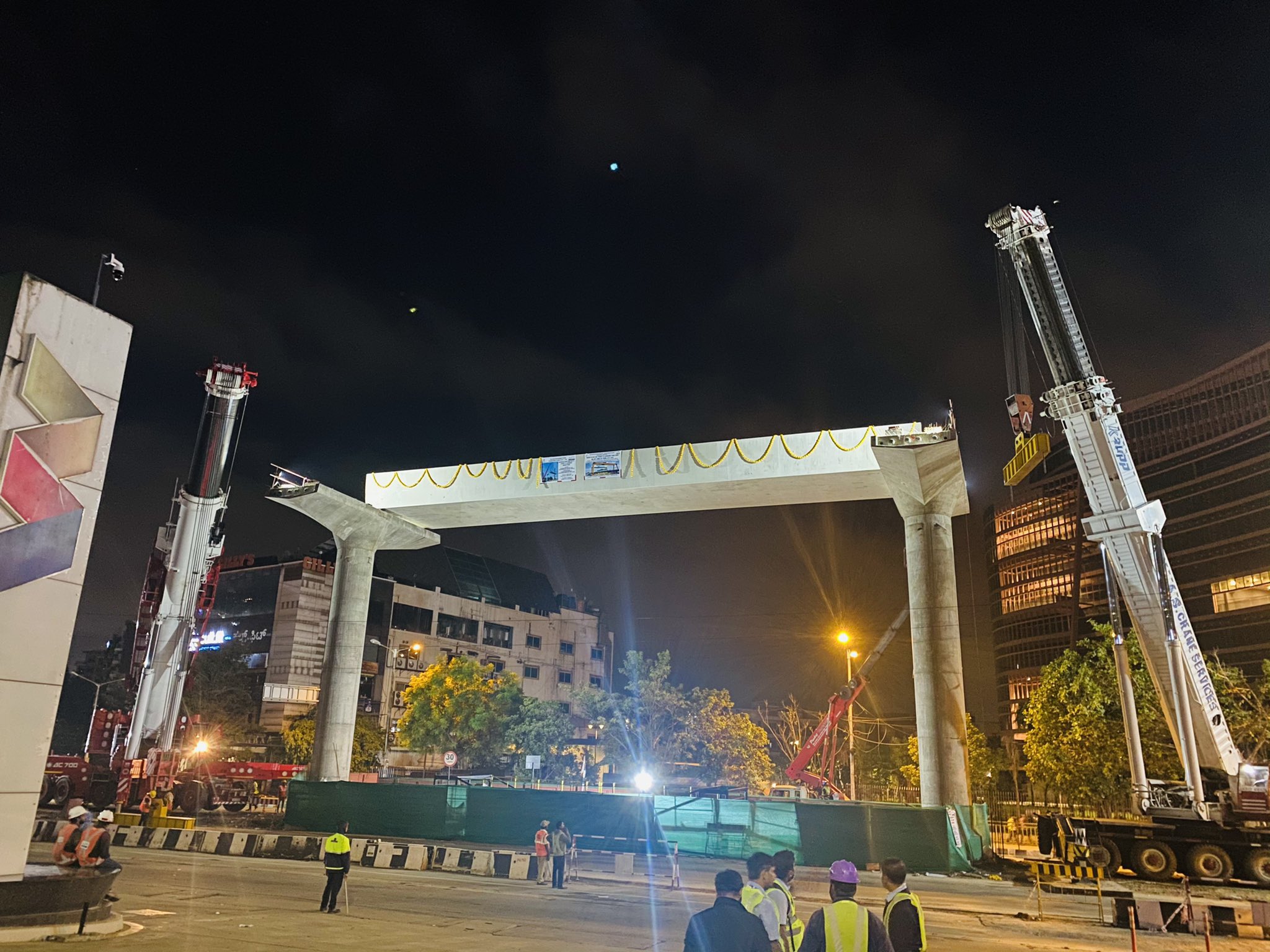
The Namma Metro's first U-girder was installed at Doddanekundi on Outer Ring Road (ORR) early on Sunday morning.

Bangalore Metro Rail Corporation Limited (BMRCL), along with contractor Shankaranarayana Constructions (SNC), began work on erecting the U-girder near Bagmane World Technology Centre in Doddanekundi on ORR. The first U-girder was established on top of pillars between 473 and 474 at about 4 am.

The U-girder was transported on a 43 m long trailer to the pier area from Lowry Junction close to KR Puram at 2.25 am. Traffic police had barricaded the road area to enable the work.

Each U-girder is 4.6 m wide, 28 m long, and weighs 165 metric tonnes (mt). It is lifted and installed with two hydraulic cranes, one with a capacity of 700 mt and another with 400 mt.

This is the first time U-girders are being utilised in Bengaluru to speed up the metro construction work.

BMRCL decided to employ U-girders for building the viaduct on Silk Board-KR Puram (19.5 km) on Outer Ring Road and KR Puram-Kempegowda International Airport (36 km) areas.

The U-girders will be used for nearly 80% of the corridor's length in the ORR-KIA route. The U-girders will involve casting the whole span of a viaduct between two piers in a single piece, whereas box-girders will have many parts between two piers. One U-girder between two pillars can be erected overnight, against 5-6 days needed in case of box girders.

Experts said U-girders would also save time as well as lower construction expenses. The much longer U-girders drastically decrease construction time. However, due to their length, they need absolute precision during construction. Also, their length makes ferrying them from the casting yard to the location a difficult task.

Image Source

Also read: RITES submits DPR for Namma Metro's phase 3 corridors to BMRCL

The Namma Metro's first U-girder was installed at Doddanekundi on Outer Ring Road (ORR) early on Sunday morning. Bangalore Metro Rail Corporation Limited (BMRCL), along with contractor Shankaranarayana Constructions (SNC), began work on erecting the U-girder near Bagmane World Technology Centre in Doddanekundi on ORR. The first U-girder was established on top of pillars between 473 and 474 at about 4 am. The U-girder was transported on a 43 m long trailer to the pier area from Lowry Junction close to KR Puram at 2.25 am. Traffic police had barricaded the road area to enable the work. Each U-girder is 4.6 m wide, 28 m long, and weighs 165 metric tonnes (mt). It is lifted and installed with two hydraulic cranes, one with a capacity of 700 mt and another with 400 mt. This is the first time U-girders are being utilised in Bengaluru to speed up the metro construction work. BMRCL decided to employ U-girders for building the viaduct on Silk Board-KR Puram (19.5 km) on Outer Ring Road and KR Puram-Kempegowda International Airport (36 km) areas. The U-girders will be used for nearly 80% of the corridor's length in the ORR-KIA route. The U-girders will involve casting the whole span of a viaduct between two piers in a single piece, whereas box-girders will have many parts between two piers. One U-girder between two pillars can be erected overnight, against 5-6 days needed in case of box girders. Experts said U-girders would also save time as well as lower construction expenses. The much longer U-girders drastically decrease construction time. However, due to their length, they need absolute precision during construction. Also, their length makes ferrying them from the casting yard to the location a difficult task. Image Source Also read: RITES submits DPR for Namma Metro's phase 3 corridors to BMRCL

Next Story
Infrastructure Urban

ABB to Invest Rs 6.25 Billion to Expand India Manufacturing

ABB recently announced plans to invest approximately Rs 6.25 billion ($75 million) in India during 2026 to expand its manufacturing footprint and research and development capabilities. The investment follows more than $35 million spent in 2025 and reflects the company’s continued focus on strengthening its ‘local-for-local’ strategy in the country.The investment will support ABB’s Electrification, Motion and Automation businesses and expand manufacturing capacity for infrastructure sectors such as renewable energy, metro rail, data centres and industrial applications. Approximately 300..

Next Story
Equipment

Six WOLFF Cranes Handle 60,000 m³ Concrete for German Hospital

Six WOLFF tower cranes are playing a key role in constructing a new hospital complex in Memmingen, Germany, supporting large-scale material handling for the project. The facility is being built on a 7.7-hectare site and will feature six floors, around 480 beds and a gross floor area exceeding 75,000 sq m.Building shell works began recently in February 2025. One WOLFF 6531.12 Cross crane supported early site preparation before being dismantled in autumn 2025, while five remaining cranes continue operations. Over an average deployment period of 16 months, the cranes are expected to move approxim..

Next Story
Equipment

REC Funds Rs 115.6 Million CSR Support for Bihar Eye Hospital

REC recently committed Rs 115.6 million under its Corporate Social Responsibility (CSR) programme for the procurement of clinical and non-clinical equipment at Sankara Eye Hospital in Saharsa, Bihar. The initiative aims to strengthen healthcare infrastructure and improve access to specialised eye care services in the region.A Memorandum of Agreement (MoA) was recently signed between Pradeep Fellows, Executive Director (CSR), REC Limited, and Wg Cdr V. Shankar (Retd), Trustee and Executive Director of Sankara Eye Hospital, at the REC office in the SCOPE Complex, New Delhi.The support is expecte..

Advertisement

Subscribe to Our Newsletter

Get daily newsletters around different themes from Construction world.

STAY CONNECTED

Advertisement

Advertisement

Advertisement