Kochi Metro Records 1.375 mn Rise In Passengers In FY26
RAILWAYS & METRO RAIL

Kochi Metro Records 1.375 mn Rise In Passengers In FY26

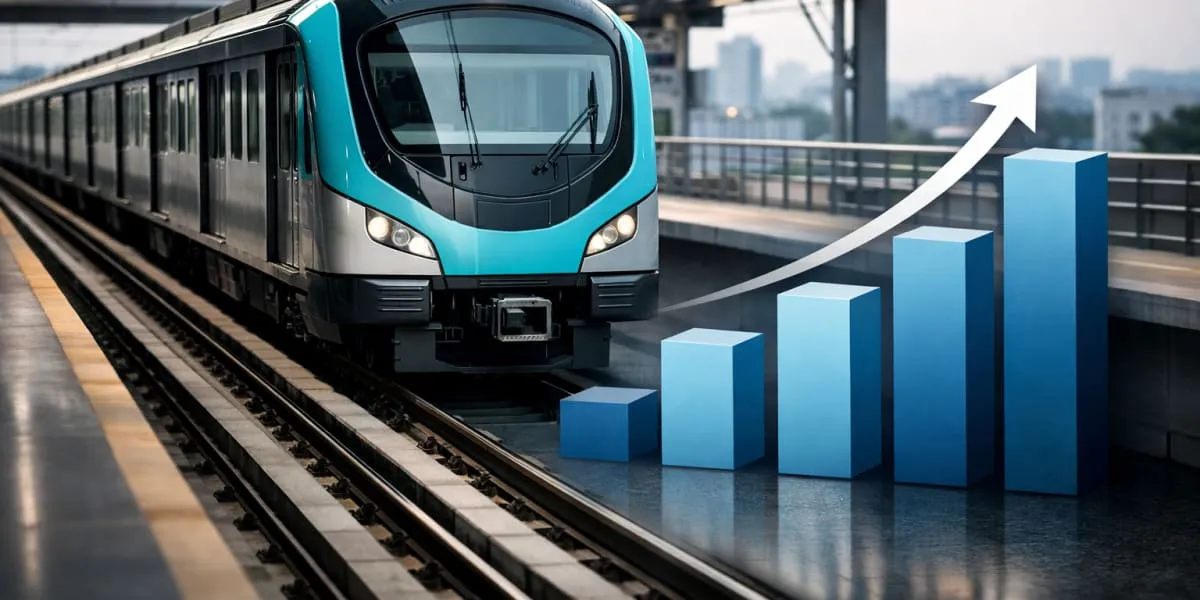
Kochi Metro recorded a marginal rise in ridership in the financial year 2025-26, carrying 1.375 mn more passengers than in the previous year. The service carried 36.8 million (mn) passengers in 2025-26 compared with 35.5 mn in 2024-25, representing a year-on-year increase of 3.9 per cent. The growth was described as distributed rather than concentrated in isolated spikes.

A month-wise analysis shows steady gains across quarters. In the first quarter, ridership increased from 8.57 mn to 8.84 mn, while the second quarter rose from 9.13 mn to 9.51 mn. These trends indicated broad-based improvement rather than a single surge.

The October to December period remained the strongest in both years, with quarterly totals moving from 9.4 mn to 9.7 mn and December alone recording over 3.2 mn passengers in both years. The sustained peak was linked to arts and cultural events including the Kochi Muziris Biennale and coinciding school holidays, which attracted domestic and foreign visitors. Tourism and local festivities were cited as significant factors.

In the final quarter, from January to March, ridership rose from 8.35 mn to 8.77 mn, with March showing a clearer increase to over 2.8 mn passengers compared with 2.57 mn in the prior year. February figures were broadly in line with the previous year at about 2.68 mn versus 2.62 mn. Operational changes implemented during the year were credited with the gains.

The metro extended services until 11 pm from 15 February, and the feeder bus service introduced in January 2025 completed its first full year, carrying more than 1.4 mn passengers across six routes. Fare incentives such as the ten to fifteen per cent discount on mobile QR tickets introduced on 26 January also encouraged commuting by metro. Overall the data show incremental monthly increases and officials expect further gains as new corridors are developed.

Kochi Metro recorded a marginal rise in ridership in the financial year 2025-26, carrying 1.375 mn more passengers than in the previous year. The service carried 36.8 million (mn) passengers in 2025-26 compared with 35.5 mn in 2024-25, representing a year-on-year increase of 3.9 per cent. The growth was described as distributed rather than concentrated in isolated spikes. A month-wise analysis shows steady gains across quarters. In the first quarter, ridership increased from 8.57 mn to 8.84 mn, while the second quarter rose from 9.13 mn to 9.51 mn. These trends indicated broad-based improvement rather than a single surge. The October to December period remained the strongest in both years, with quarterly totals moving from 9.4 mn to 9.7 mn and December alone recording over 3.2 mn passengers in both years. The sustained peak was linked to arts and cultural events including the Kochi Muziris Biennale and coinciding school holidays, which attracted domestic and foreign visitors. Tourism and local festivities were cited as significant factors. In the final quarter, from January to March, ridership rose from 8.35 mn to 8.77 mn, with March showing a clearer increase to over 2.8 mn passengers compared with 2.57 mn in the prior year. February figures were broadly in line with the previous year at about 2.68 mn versus 2.62 mn. Operational changes implemented during the year were credited with the gains. The metro extended services until 11 pm from 15 February, and the feeder bus service introduced in January 2025 completed its first full year, carrying more than 1.4 mn passengers across six routes. Fare incentives such as the ten to fifteen per cent discount on mobile QR tickets introduced on 26 January also encouraged commuting by metro. Overall the data show incremental monthly increases and officials expect further gains as new corridors are developed.

Next Story
Technology

AI-Enabled Workflows Lift Profitability and Productivity

Organisations modernising frontline workflows with artificial intelligence, automation and real-time data are reporting stronger financial performance, higher productivity and improved employee engagement, according to a global study by Zebra Technologies and Oxford Economics.The research covered 1,000 senior leaders across retail, manufacturing, transportation and logistics in the US, Mexico, the UK, Germany, India, Japan, Australia and New Zealand.In transportation and logistics, 54 per cent of companies that improved picking and packing operations reported faster operational performance, wh..

Next Story
Real Estate

India Leads Global AI Readiness but Implementation Lags

Indian companies lead global averages across all eight artificial intelligence readiness indicators tracked by JLL, but only 19 per cent have started making changes to their workplaces, according to the JLL 2026 Future of Work Survey.The study found that 77 per cent of Indian business leaders expect AI to change their office requirements, creating a 58-percentage-point gap between awareness and implementation. The survey covered more than 2,200 CEOs, CFOs and real estate leaders across 21 countries during the first quarter of 2026.Despite concerns over automation, 58 per cent of Indian leaders..

Next Story
Equipment

Three WOLFF Cranes Build Riyadh Cable-Stayed Bridges

Three WOLFF 180 B luffing jib cranes are supporting the construction of two cable-stayed bridges alongside the existing Wadi Laban Bridge in Riyadh, Saudi Arabia. The project is being developed for the Royal Commission for Riyadh City and executed by the ICRC joint venture comprising IC Ictas and Al Rashid Trading & Contracting Company.The cranes are handling lifting operations including formwork, reinforcement, concrete placement, work platforms, surveying equipment and other construction materials. Each crane is fitted with a 40 m jib, reaches a hook height of 157 m and offers a maximum ..

Advertisement

Subscribe to Our Newsletter

Get daily newsletters around different themes from Construction world.

STAY CONNECTED

Advertisement

Advertisement

Advertisement