Land Shortage Delayed Five Tamil Nadu Railway Projects
RAILWAYS & METRO RAIL

Land Shortage Delayed Five Tamil Nadu Railway Projects

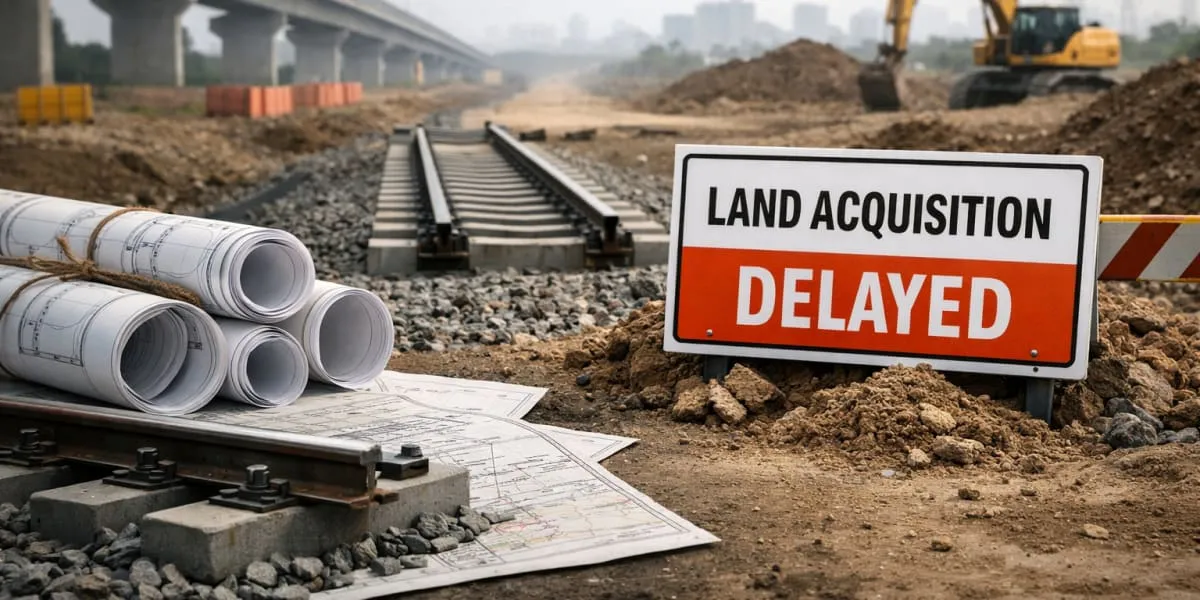
The Union Ministry of Railways has attributed the failure to launch five proposed railway line projects in Tamil Nadu to a lack of land acquisition, the minister reported in the Lok Sabha while responding to a question on Perambalur connectivity. The statement identified land acquisition delays as the principal bottleneck in implementing projects already under execution and in the pipeline. The minister set out the details while referring to interactions with state authorities over the issue.

The five projects listed were the Tindivanam–Tiruvannamalai new line (71 km), the Attipattu–Puttur new line (88 km), the Morappur–Dharmapuri new line (93 km), the Mannargudi–Pattukottai new line (204 km), and the Thanjavur–Pattukottai new line (152 km). For the Tindivanam–Tiruvannamalai section, around 276 hectares are required and only 33 hectares have been acquired to date. For the Morappur–Dharmapuri section 93 hectares are required and 47 hectares have been acquired, while the state government has not acquired any land so far for the remaining three projects.

The minister said that ongoing railway projects in the state require a total of 4,612 hectares of land and that the Tamil Nadu government has acquired 1,178 hectares, or 26 per cent, of that requirement. He also listed major projects under execution, including the Tambaram–Chengalpattu fourth line, a 30 km project estimated at Rs 7.57 billion (bn), the Arakkonam–Chengalpattu doubling, 68 km at Rs 9.93 bn, the Erode–Karur doubling, 67 km at Rs 9.86 bn, and the Tirupati–Katpadi doubling, 105 km at Rs 12.16 bn. These figures were presented to illustrate the scale of investment that is affected by land delays.

On the demand for a new line to Perambalur, a Final Location Survey for the Namakkal–Ariyalur new line via Perambalur, covering 116 km, has been sanctioned to prepare a detailed project report. The minister noted that sanctioning a railway project requires consultations with stakeholders and approvals from agencies such as NITI Aayog and the Ministry of Finance, and that the proposal will be processed accordingly. He reiterated that resolution of land acquisition issues will be critical to timely delivery of these projects.

The Union Ministry of Railways has attributed the failure to launch five proposed railway line projects in Tamil Nadu to a lack of land acquisition, the minister reported in the Lok Sabha while responding to a question on Perambalur connectivity. The statement identified land acquisition delays as the principal bottleneck in implementing projects already under execution and in the pipeline. The minister set out the details while referring to interactions with state authorities over the issue. The five projects listed were the Tindivanam–Tiruvannamalai new line (71 km), the Attipattu–Puttur new line (88 km), the Morappur–Dharmapuri new line (93 km), the Mannargudi–Pattukottai new line (204 km), and the Thanjavur–Pattukottai new line (152 km). For the Tindivanam–Tiruvannamalai section, around 276 hectares are required and only 33 hectares have been acquired to date. For the Morappur–Dharmapuri section 93 hectares are required and 47 hectares have been acquired, while the state government has not acquired any land so far for the remaining three projects. The minister said that ongoing railway projects in the state require a total of 4,612 hectares of land and that the Tamil Nadu government has acquired 1,178 hectares, or 26 per cent, of that requirement. He also listed major projects under execution, including the Tambaram–Chengalpattu fourth line, a 30 km project estimated at Rs 7.57 billion (bn), the Arakkonam–Chengalpattu doubling, 68 km at Rs 9.93 bn, the Erode–Karur doubling, 67 km at Rs 9.86 bn, and the Tirupati–Katpadi doubling, 105 km at Rs 12.16 bn. These figures were presented to illustrate the scale of investment that is affected by land delays. On the demand for a new line to Perambalur, a Final Location Survey for the Namakkal–Ariyalur new line via Perambalur, covering 116 km, has been sanctioned to prepare a detailed project report. The minister noted that sanctioning a railway project requires consultations with stakeholders and approvals from agencies such as NITI Aayog and the Ministry of Finance, and that the proposal will be processed accordingly. He reiterated that resolution of land acquisition issues will be critical to timely delivery of these projects.

Related Stories

Gold Stories

Next Story
Infrastructure Urban

KONE Opens India's First Digital Experience Centre in Pune

KONE, a global elevator and escalator manufacturer, has inaugurated its first Digital Experience Centre (DEC) in India, located in Pune. The facility aims to showcase how artificial intelligence (AI), connectivity and data-driven technologies can enhance customer experiences and improve building operations.The centre was inaugurated by Jussi Herlin, Executive Vice Chair, KONE Corporation; Philippe Delorme, President and CEO, KONE; and Nandan Nilekani, Co-founder and Chairman of the Board, Infosys.Designed as an interactive customer environment, the facility demonstrates digital solutions cover..

Next Story
Infrastructure Urban

CII GreenCo Launches Circularity Guidelines for Indian Industry

The Confederation of Indian Industry (CII) GreenCo Council has launched the CII GreenCo Circularity Guidelines – Pilot Version at the 17th CII GreenCo Waste & Resource Management Summit 2026 in Chennai. The initiative aims to strengthen resource efficiency, waste reduction and circular economy practices across Indian manufacturing and process industries.The guidelines introduce a structured framework with circularity indices covering raw materials, consumables, packaging and other resource inputs. These indicators will help industries assess existing practices, identify opportunities to ..

Next Story
Infrastructure Energy

Global Electronics Association Launches IPC-1783-CO2E Standard

The Global Electronics Association has introduced IPC-1783-CO2E, a new international standard aimed at improving consistency, transparency and comparability in product carbon footprint reporting across the electronics manufacturing industry.The standard, titled International Standard for Data Collection and Reporting of CO2 Equivalent (CO2e) Emissions for the Electronics Manufacturing Supply Chain, provides industry-specific guidance for collecting, estimating and reporting carbon emissions data.With increasing regulatory requirements and customer expectations, electronics manufacturers face c..

Advertisement

Subscribe to Our Newsletter

Get daily newsletters around different themes from Construction world.

STAY CONNECTED

Advertisement

SPECIAL OFFER
QR Code