More Than Seventy Per Cent Land For West Bengal Rail Projects Pending
RAILWAYS & METRO RAIL

More Than Seventy Per Cent Land For West Bengal Rail Projects Pending

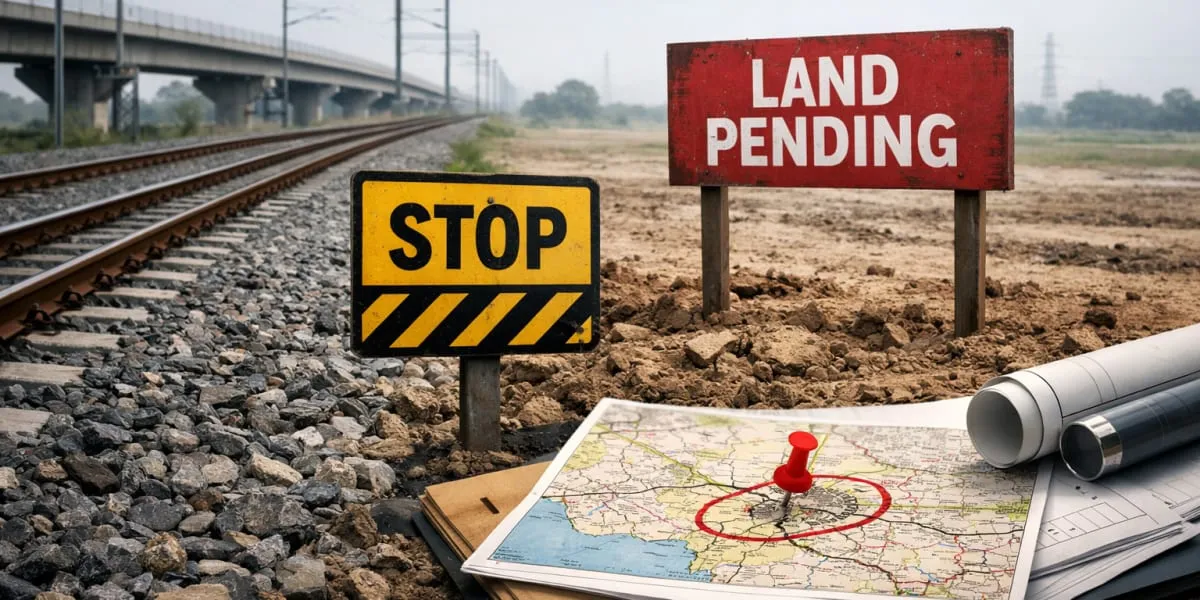
Nearly 73 per cent of land required for 63 sanctioned railway projects in West Bengal remains unacquired, the Centre told Parliament, and acquisition has accelerated since May 2026. Projects require 4,696 hectares; 1,273 hectares, or 27 per cent, have been acquired and 3,423 hectares remain pending. The Centre attributed recent progress to improved coordination with Bharatiya Janata Party government.

The reply highlighted progress in delayed schemes. For the 33 km Kaliyaganj–Buniadpur new line that needs 168 hectares, an award for 46 hectares in Uttar Dinajpur was published on July 9 and preliminary notification issued for 122 hectares in Dakshin Dinajpur. In the Naihati–Ranaghat third line, involving 13 hectares, an ownership dispute was resolved, preliminary notification for 16 mouzas has been published and land acquisition awards have been issued for eight mouzas.

Preliminary notification has been issued for the 22 hectare Sainthia bypass. The Competent Authority for Land Acquisition was appointed on May 29 for proposed rail flyovers at Rukni–Anara and Gourinathdham, each needing 35 hectares, and acquisition commenced. For the Nabadwipghat–Nabadwipdham new line requiring 107 hectares the state government has initiated reassessment of land costs.

The Centre said a task force chaired by the chief secretary has been constituted to monitor connectivity projects and resolve implementation issues. Temporary traffic diversion at Chingrighata crossing was permitted in May 2026, enabling Metro viaduct work launched and completed at the site. The reply declined to give revised completion timelines, noting delivery depends on land acquisition, forest clearance, shifting of utility services, statutory approvals, geological and topographical conditions, law and order and the number of workable months each year.

The House was informed that the 63 projects, comprising 14 new lines, four gauge conversions and 45 doubling or multi tracking projects, cover 5,148 km at an estimated cost of Rs 834.33 billion (bn). Of these, 1,721 km have been commissioned and Rs 279.49 billion (bn) has been spent; budget allocation for 2026–27 stands at Rs 142.05 billion (bn) compared with an average annual allocation of Rs 43.8 billion (bn) during 2009–14.

Nearly 73 per cent of land required for 63 sanctioned railway projects in West Bengal remains unacquired, the Centre told Parliament, and acquisition has accelerated since May 2026. Projects require 4,696 hectares; 1,273 hectares, or 27 per cent, have been acquired and 3,423 hectares remain pending. The Centre attributed recent progress to improved coordination with Bharatiya Janata Party government. The reply highlighted progress in delayed schemes. For the 33 km Kaliyaganj–Buniadpur new line that needs 168 hectares, an award for 46 hectares in Uttar Dinajpur was published on July 9 and preliminary notification issued for 122 hectares in Dakshin Dinajpur. In the Naihati–Ranaghat third line, involving 13 hectares, an ownership dispute was resolved, preliminary notification for 16 mouzas has been published and land acquisition awards have been issued for eight mouzas. Preliminary notification has been issued for the 22 hectare Sainthia bypass. The Competent Authority for Land Acquisition was appointed on May 29 for proposed rail flyovers at Rukni–Anara and Gourinathdham, each needing 35 hectares, and acquisition commenced. For the Nabadwipghat–Nabadwipdham new line requiring 107 hectares the state government has initiated reassessment of land costs. The Centre said a task force chaired by the chief secretary has been constituted to monitor connectivity projects and resolve implementation issues. Temporary traffic diversion at Chingrighata crossing was permitted in May 2026, enabling Metro viaduct work launched and completed at the site. The reply declined to give revised completion timelines, noting delivery depends on land acquisition, forest clearance, shifting of utility services, statutory approvals, geological and topographical conditions, law and order and the number of workable months each year. The House was informed that the 63 projects, comprising 14 new lines, four gauge conversions and 45 doubling or multi tracking projects, cover 5,148 km at an estimated cost of Rs 834.33 billion (bn). Of these, 1,721 km have been commissioned and Rs 279.49 billion (bn) has been spent; budget allocation for 2026–27 stands at Rs 142.05 billion (bn) compared with an average annual allocation of Rs 43.8 billion (bn) during 2009–14.

Related Stories

Gold Stories

Next Story
Infrastructure Urban

KONE Opens India's First Digital Experience Centre in Pune

KONE, a global elevator and escalator manufacturer, has inaugurated its first Digital Experience Centre (DEC) in India, located in Pune. The facility aims to showcase how artificial intelligence (AI), connectivity and data-driven technologies can enhance customer experiences and improve building operations.The centre was inaugurated by Jussi Herlin, Executive Vice Chair, KONE Corporation; Philippe Delorme, President and CEO, KONE; and Nandan Nilekani, Co-founder and Chairman of the Board, Infosys.Designed as an interactive customer environment, the facility demonstrates digital solutions cover..

Next Story
Infrastructure Urban

CII GreenCo Launches Circularity Guidelines for Indian Industry

The Confederation of Indian Industry (CII) GreenCo Council has launched the CII GreenCo Circularity Guidelines – Pilot Version at the 17th CII GreenCo Waste & Resource Management Summit 2026 in Chennai. The initiative aims to strengthen resource efficiency, waste reduction and circular economy practices across Indian manufacturing and process industries.The guidelines introduce a structured framework with circularity indices covering raw materials, consumables, packaging and other resource inputs. These indicators will help industries assess existing practices, identify opportunities to ..

Next Story
Infrastructure Energy

Global Electronics Association Launches IPC-1783-CO2E Standard

The Global Electronics Association has introduced IPC-1783-CO2E, a new international standard aimed at improving consistency, transparency and comparability in product carbon footprint reporting across the electronics manufacturing industry.The standard, titled International Standard for Data Collection and Reporting of CO2 Equivalent (CO2e) Emissions for the Electronics Manufacturing Supply Chain, provides industry-specific guidance for collecting, estimating and reporting carbon emissions data.With increasing regulatory requirements and customer expectations, electronics manufacturers face c..

Advertisement

Subscribe to Our Newsletter

Get daily newsletters around different themes from Construction world.

STAY CONNECTED

Advertisement

SPECIAL OFFER
QR Code