Mumbai To Get India's First Travelator Skywalk Linking Transit
RAILWAYS & METRO RAIL

Mumbai To Get India's First Travelator Skywalk Linking Transit

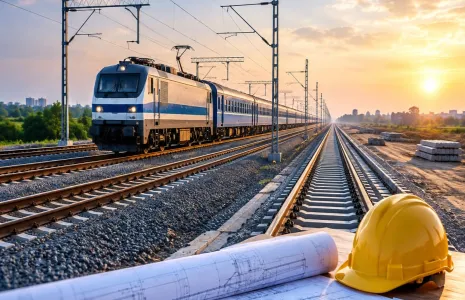
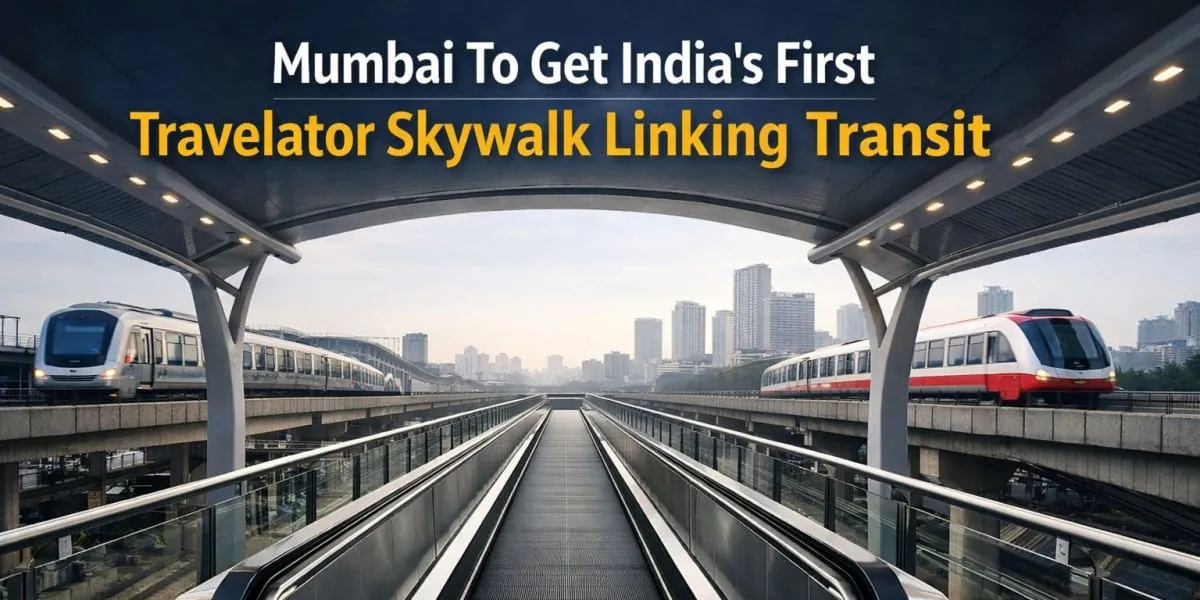
The Mumbai Metropolitan Region Development Authority (MMRDA) has completed nearly 90 per cent of a first-of-its-kind multimodal elevated pedestrian corridor at Mahalaxmi that will include moving walkways. The authority said the project is designed to ease transfers between Metro, Monorail and suburban railway services at a busy interchange. Work on the facility comes as the city expands its Metro network and seeks better integration with other modes.

The corridor will connect the Sant Gadge Maharaj Chowk Monorail station, the Mahalaxmi Metro station on the Aqua Line and the Mahalaxmi station on the Western Railway suburban network. The 283-metre-long skywalk will be fitted with six travelators that together span 176 metres and enable level transfers without descending to congested streets. The bridge has been designed to carry heavy commuter volumes while improving accessibility.

The 11-metre-wide structure will include two passenger lifts to assist senior citizens, persons with disabilities and travellers with luggage, and is expected to handle around 4,500 passengers every hour. Officials said the interchange will particularly benefit journeys between south Mumbai, Worli and the central suburbs by reducing walking distances. The facility aims to shorten overall transfer times and simplify mode changes across services.

Construction required complex relocations of underground utilities, officials said, including an 1,800-mm-diameter storm-water drain while keeping nearby water supply and sewer pipelines operational. Work was coordinated closely with the Mumbai Traffic Police to minimise disruption along the Sane Guruji Marg corridor and to maintain traffic flow. Engineers described the assignment as one of the authority's more challenging urban infrastructure tasks.

Planners have long argued that integrated interchange facilities are critical to making public transport more convenient and encouraging commuters to shift away from private vehicles. The MMRDA said the skywalk will allow passengers to switch modes without negotiating multiple staircases or relying on autorickshaws and taxis. Officials indicated the corridor could be made operational once remaining finishing works are completed and safety checks are concluded.

The Mumbai Metropolitan Region Development Authority (MMRDA) has completed nearly 90 per cent of a first-of-its-kind multimodal elevated pedestrian corridor at Mahalaxmi that will include moving walkways. The authority said the project is designed to ease transfers between Metro, Monorail and suburban railway services at a busy interchange. Work on the facility comes as the city expands its Metro network and seeks better integration with other modes. The corridor will connect the Sant Gadge Maharaj Chowk Monorail station, the Mahalaxmi Metro station on the Aqua Line and the Mahalaxmi station on the Western Railway suburban network. The 283-metre-long skywalk will be fitted with six travelators that together span 176 metres and enable level transfers without descending to congested streets. The bridge has been designed to carry heavy commuter volumes while improving accessibility. The 11-metre-wide structure will include two passenger lifts to assist senior citizens, persons with disabilities and travellers with luggage, and is expected to handle around 4,500 passengers every hour. Officials said the interchange will particularly benefit journeys between south Mumbai, Worli and the central suburbs by reducing walking distances. The facility aims to shorten overall transfer times and simplify mode changes across services. Construction required complex relocations of underground utilities, officials said, including an 1,800-mm-diameter storm-water drain while keeping nearby water supply and sewer pipelines operational. Work was coordinated closely with the Mumbai Traffic Police to minimise disruption along the Sane Guruji Marg corridor and to maintain traffic flow. Engineers described the assignment as one of the authority's more challenging urban infrastructure tasks. Planners have long argued that integrated interchange facilities are critical to making public transport more convenient and encouraging commuters to shift away from private vehicles. The MMRDA said the skywalk will allow passengers to switch modes without negotiating multiple staircases or relying on autorickshaws and taxis. Officials indicated the corridor could be made operational once remaining finishing works are completed and safety checks are concluded.

Next Story
Infrastructure Transport

Adani Eyes UK Port Operator Associated British Ports

Adani Ports and Special Economic Zone is evaluating a potential bid for Associated British Ports, the United Kingdom’s largest port operator, people aware of the discussions told Moneycontrol. A spokesperson said the company does not comment on market speculation and continuously evaluates opportunities that align with its long-term strategy. The spokesperson added that the approach aims to create sustainable value for stakeholders. The discussions remain at an early stage and may not result in a formal offer. Associated British Ports operates 21 ports across England, Scotland and Wales, inc..

Next Story
Infrastructure Urban

NPCIL Seeks Bids For Engineering And 3D Design Of Bharat Small Reactors

The Nuclear Power Corporation of India (NPCIL) has floated a tender for plant engineering and three-dimensional (3D) modelling of its 220 megawatt (MW) Bharat Small Reactors (BSRs). The reactors are based on proven 220 megawatt (MW) pressurised heavy water reactor (PHWR) technology and bids are to be submitted by August 10. The move marks a further step in India's plan to expand nuclear power capacity. The scope calls for generic design and engineering for civil, process, mechanical, piping, electrical and control and instrumentation systems, together with ventilation and air conditioning, pip..

Next Story
Infrastructure Urban

Supreme Court Quashes 2021 OM Allowing Retrospective Clearances

The Supreme Court quashed the 2021 Office Memorandum allowing retrospective environmental clearances for projects commenced without approval. A bench of Chief Justice Surya Kant and Justices Joymalya Bagchi and Vipul M Pancholi delivered a unanimous verdict applying prospectively to protect projects that had already received retrospective clearances from demolition and punitive measures. The court cited examples such as an AIIMS in Odisha, a greenfield airport in Vijayanagar in Karnataka and several common effluent treatment plants central to pollution control. The court held that post-facto c..

Advertisement

Subscribe to Our Newsletter

Get daily newsletters around different themes from Construction world.

STAY CONNECTED

Advertisement

Advertisement

Advertisement