Railways And Army Launch Framework To Boost Post-Service Jobs
RAILWAYS & METRO RAIL

Railways And Army Launch Framework To Boost Post-Service Jobs

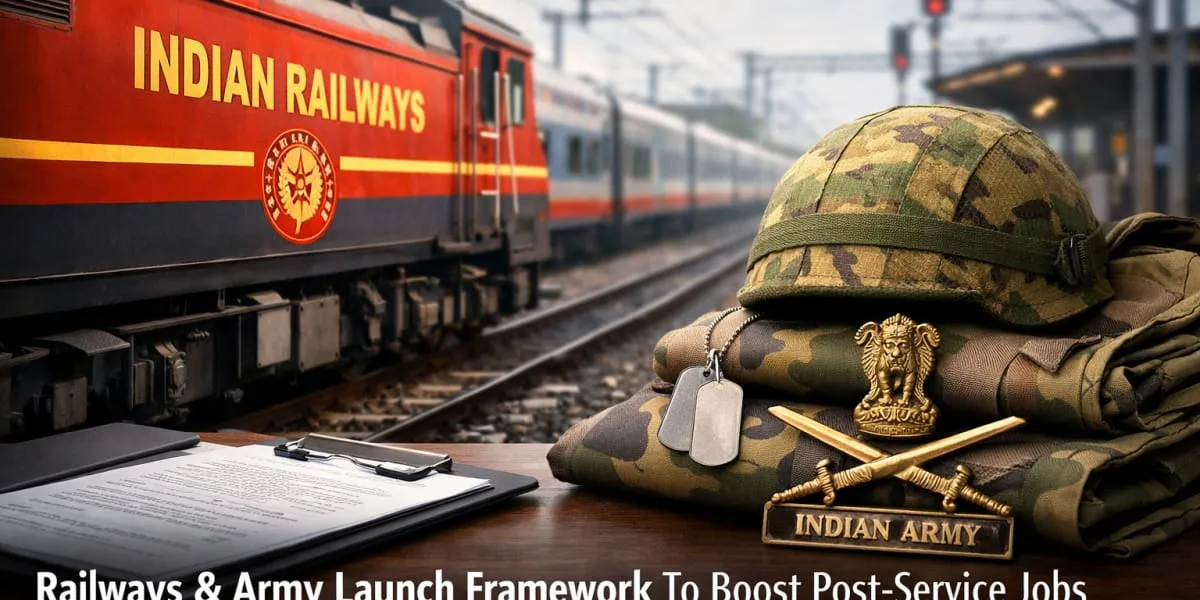
Indian Railways and the Indian Army have launched a Framework of Cooperation to expand post-retirement employment for Agniveers and serving Army personnel transitioning to civilian life. Driven by senior leadership from the Army and the Ministry of Railways, the initiative aims to smooth the shift to civilian careers and increase awareness of job prospects within the railways while establishing a support system for retiring personnel.

Welfare and resettlement of retired armed forces personnel are a component of Indian Railways policy. The railways have provisioned 10 per cent horizontal reservation in Level-2 and above posts and 20 per cent in Level-1 posts for ex-servicemen, with an additional five per cent in Level-2 and above and 10 per cent in Level-1 posts for ex-Agniveers. In 2024 and 2025 a total of 14,788 posts were reserved, including 6,485 in Level-1 and 8,303 in Level-2 and above, with recruitment through Railway Recruitment Centres and Railway Recruitment Boards.

The ministry has moved to accelerate engagement by recruiting ex-servicemen as pointsmen on a contract basis until regular recruitment is completed. More than 5,000 Level-1 posts are being processed at zonal and divisional levels and nine divisions have signed memorandums of understanding with Army organisations to hire pointsmen. The framework encourages Army recruiting organisations to work with railway divisions to expedite filling vacancies and support transitions to civilian employment.

The cooperation draws on skills, discipline and technical competence developed during service and regards veterans contributions as important to nation building. Many soldiers retire at a comparatively young age with operational and managerial experience, and the framework aims to channel those capabilities into strategic infrastructure and security coordination. Projects such as the Dedicated Freight Corridors and the Udhampur–Srinagar–Baramulla Rail Link are identified as enhancing rapid deployment capabilities, while memorandums with Gati Shakti Vishwavidyalaya are expected to promote skill sharing. The framework offers a structured approach to long term collaboration and support for veterans.

Indian Railways and the Indian Army have launched a Framework of Cooperation to expand post-retirement employment for Agniveers and serving Army personnel transitioning to civilian life. Driven by senior leadership from the Army and the Ministry of Railways, the initiative aims to smooth the shift to civilian careers and increase awareness of job prospects within the railways while establishing a support system for retiring personnel. Welfare and resettlement of retired armed forces personnel are a component of Indian Railways policy. The railways have provisioned 10 per cent horizontal reservation in Level-2 and above posts and 20 per cent in Level-1 posts for ex-servicemen, with an additional five per cent in Level-2 and above and 10 per cent in Level-1 posts for ex-Agniveers. In 2024 and 2025 a total of 14,788 posts were reserved, including 6,485 in Level-1 and 8,303 in Level-2 and above, with recruitment through Railway Recruitment Centres and Railway Recruitment Boards. The ministry has moved to accelerate engagement by recruiting ex-servicemen as pointsmen on a contract basis until regular recruitment is completed. More than 5,000 Level-1 posts are being processed at zonal and divisional levels and nine divisions have signed memorandums of understanding with Army organisations to hire pointsmen. The framework encourages Army recruiting organisations to work with railway divisions to expedite filling vacancies and support transitions to civilian employment. The cooperation draws on skills, discipline and technical competence developed during service and regards veterans contributions as important to nation building. Many soldiers retire at a comparatively young age with operational and managerial experience, and the framework aims to channel those capabilities into strategic infrastructure and security coordination. Projects such as the Dedicated Freight Corridors and the Udhampur–Srinagar–Baramulla Rail Link are identified as enhancing rapid deployment capabilities, while memorandums with Gati Shakti Vishwavidyalaya are expected to promote skill sharing. The framework offers a structured approach to long term collaboration and support for veterans.

Next Story
Real Estate

Pecan Realty Completes Rs 1.5 Billion Transactions

Pecan Realty has recently completed four institutional transactions worth over Rs 1.5 billion over the past two years, strengthening its position as an execution-led real estate platform. The deals include resolution-led acquisitions, structured finance transactions and capital partnerships across its development portfolio.The transactions covered acquisitions through the National Company Law Tribunal process and helped provide repayment or exits to both private and public sector lenders. The company said the deals demonstrate its ability to resolve complex project situations, work with instit..

Next Story
Real Estate

SNN Estates Expands North Bengaluru Housing Project

SNN Estates has announced an expansion of its SNN Estates Felicity residential project in North Bengaluru following strong buyer demand, with 75 per cent of the first-phase inventory sold within three days of launch.The developer will add 76 apartments in the new phase, taking the project's estimated revenue potential to around Rs 1,000 crore upon completion of Phase 2.Spread across 6.5 acres in Rachenahalli, near Manyata Tech Park, the project comprises 604 apartments in 1.5, 2, 2.5, 3 and 4 BHK configurations. The development includes a 50,000-sq-ft clubhouse with amenities such as sports co..

Next Story
Infrastructure Urban

SCG Drives ASEAN Industrial Transformation Strategy

SCG is strengthening its focus on ASEAN as a key growth region by advancing industrial transformation, enhancing competitiveness and building resilient regional value chains. Thammasak Sethaudom, President and Chief Executive Officer, SCG, highlighted the need for industries to continuously develop capabilities, strengthen resilience and deepen regional cooperation to achieve sustainable long-term growth.SCG views ASEAN as an important growth engine alongside China, supported by favourable demographics, trade connectivity and investment flows. With ASEAN’s GDP projected to grow by around 4.7..

Advertisement

Subscribe to Our Newsletter

Get daily newsletters around different themes from Construction world.

STAY CONNECTED

Advertisement

Advertisement

Advertisement