+
South Coast Railway Executes Rs 545 bn Works With Rs 709 bn Pipeline
RAILWAYS & METRO RAIL

South Coast Railway Executes Rs 545 bn Works With Rs 709 bn Pipeline

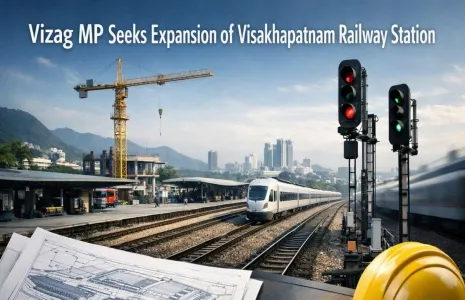
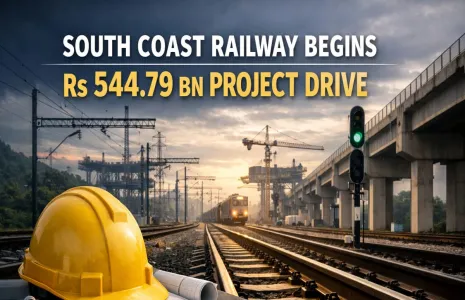
Since its formation on June one, South Coast Railway has emerged as a top-performing zone, executing five new railway line projects and 24 multi-tracking works with investments of approximately Rs 544.79 billion (bn), while projects worth nearly Rs 708.65 billion (bn) are in the pipeline. The administration said it is constructing more than 300 road over bridges and road under bridges to improve safety and connectivity. The release noted sanctions including a Rs 3 billion remodelling of the Visakhapatnam yard with additional lines, platforms and electronic interlocking.

It added that a Rs 12.05 billion quadrupling project between Guntakal and Ballari and Rs 200 million (mn) in crowd management facilities at Tirupati have been approved. The zone has commissioned yard remodelling at Narsapur-Vijayawada and Garudaballi-Visakhapatnam and installed Kavach on nearly 100 locomotives, with the first 100 km section planned for commissioning by the end of 2026. Operating from June one, the zone has focused on building infrastructure, manpower deployment and control systems.

The zone comprises four divisions covering nearly 3,532 route kilometres and 6,455 track kilometres and has an anticipated originating revenue of Rs 155 billion (bn) and freight loading exceeding 100 million tonnes (mn t) annually. Senior officials inspected nearly 1,700 route kilometres to assess infrastructure, review works and strengthen safety standards. Passenger-centred development has included inauguration of three redeveloped Amrit Bharat stations and redevelopment works at 70 additional stations.

Operational performance included originating passenger revenue of Rs 6.71 billion (bn), handling 29.4 million originating passengers and registering an annual growth rate of three per cent that resulted in overall originating earnings of Rs 24.93 billion (bn). The zone converted four train-on-demand services into regular trains, operated 76 special trains carrying nearly 86,000 passengers and attached 408 additional coaches. Initiatives to enhance passenger amenities included sleeping pods at Vijayawada station and premium catering services at Visakhapatnam.

Since its formation on June one, South Coast Railway has emerged as a top-performing zone, executing five new railway line projects and 24 multi-tracking works with investments of approximately Rs 544.79 billion (bn), while projects worth nearly Rs 708.65 billion (bn) are in the pipeline. The administration said it is constructing more than 300 road over bridges and road under bridges to improve safety and connectivity. The release noted sanctions including a Rs 3 billion remodelling of the Visakhapatnam yard with additional lines, platforms and electronic interlocking. It added that a Rs 12.05 billion quadrupling project between Guntakal and Ballari and Rs 200 million (mn) in crowd management facilities at Tirupati have been approved. The zone has commissioned yard remodelling at Narsapur-Vijayawada and Garudaballi-Visakhapatnam and installed Kavach on nearly 100 locomotives, with the first 100 km section planned for commissioning by the end of 2026. Operating from June one, the zone has focused on building infrastructure, manpower deployment and control systems. The zone comprises four divisions covering nearly 3,532 route kilometres and 6,455 track kilometres and has an anticipated originating revenue of Rs 155 billion (bn) and freight loading exceeding 100 million tonnes (mn t) annually. Senior officials inspected nearly 1,700 route kilometres to assess infrastructure, review works and strengthen safety standards. Passenger-centred development has included inauguration of three redeveloped Amrit Bharat stations and redevelopment works at 70 additional stations. Operational performance included originating passenger revenue of Rs 6.71 billion (bn), handling 29.4 million originating passengers and registering an annual growth rate of three per cent that resulted in overall originating earnings of Rs 24.93 billion (bn). The zone converted four train-on-demand services into regular trains, operated 76 special trains carrying nearly 86,000 passengers and attached 408 additional coaches. Initiatives to enhance passenger amenities included sleeping pods at Vijayawada station and premium catering services at Visakhapatnam.

Related Stories

Gold Stories

Next Story
Infrastructure Urban

KONE Opens India's First Digital Experience Centre in Pune

KONE, a global elevator and escalator manufacturer, has inaugurated its first Digital Experience Centre (DEC) in India, located in Pune. The facility aims to showcase how artificial intelligence (AI), connectivity and data-driven technologies can enhance customer experiences and improve building operations.The centre was inaugurated by Jussi Herlin, Executive Vice Chair, KONE Corporation; Philippe Delorme, President and CEO, KONE; and Nandan Nilekani, Co-founder and Chairman of the Board, Infosys.Designed as an interactive customer environment, the facility demonstrates digital solutions cover..

Next Story
Infrastructure Urban

CII GreenCo Launches Circularity Guidelines for Indian Industry

The Confederation of Indian Industry (CII) GreenCo Council has launched the CII GreenCo Circularity Guidelines – Pilot Version at the 17th CII GreenCo Waste & Resource Management Summit 2026 in Chennai. The initiative aims to strengthen resource efficiency, waste reduction and circular economy practices across Indian manufacturing and process industries.The guidelines introduce a structured framework with circularity indices covering raw materials, consumables, packaging and other resource inputs. These indicators will help industries assess existing practices, identify opportunities to ..

Next Story
Infrastructure Energy

Global Electronics Association Launches IPC-1783-CO2E Standard

The Global Electronics Association has introduced IPC-1783-CO2E, a new international standard aimed at improving consistency, transparency and comparability in product carbon footprint reporting across the electronics manufacturing industry.The standard, titled International Standard for Data Collection and Reporting of CO2 Equivalent (CO2e) Emissions for the Electronics Manufacturing Supply Chain, provides industry-specific guidance for collecting, estimating and reporting carbon emissions data.With increasing regulatory requirements and customer expectations, electronics manufacturers face c..

Advertisement

Subscribe to Our Newsletter

Get daily newsletters around different themes from Construction world.

STAY CONNECTED

Advertisement

SPECIAL OFFER
QR Code