Community Rainwater Conservation Boosts Water Security In Prakasam
WATER & WASTE

Community Rainwater Conservation Boosts Water Security In Prakasam

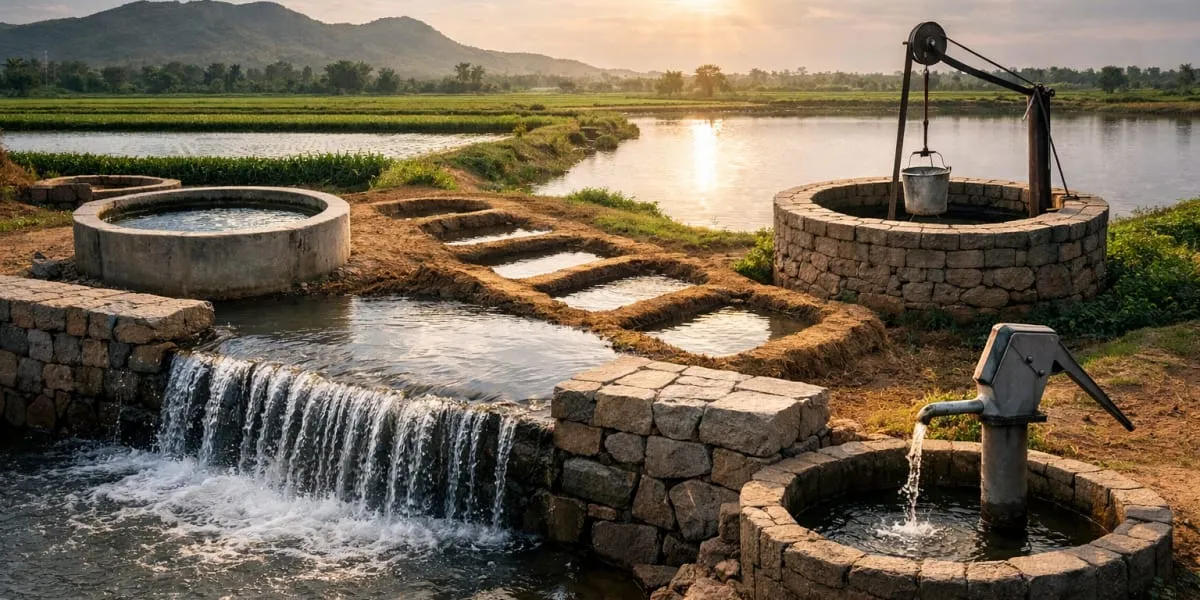
Villages in the Prakasam district of Andhra Pradesh have emerged as models of water resilience through community-led rainwater conservation initiatives under the Jal Sanchay Jan Bhagidari campaign of the Ministry of Jal Shakti. The initiative has improved groundwater availability, strengthened livelihoods and reduced distress migration across villages including Murugummi, Marella and Thangella. The report describes collective action by farmers, women, youth and local institutions to secure long-term water access.

Previously the villages faced acute water scarcity owing to erratic rainfall, declining groundwater levels and recurring borewell failures which adversely affected agriculture and livelihoods. Community mobilisation through Gram Sabhas, door to door awareness campaigns, Kalajathas, workshops and field demonstrations led to adoption of practices such as water budgeting, crop planning and groundwater sharing. These measures fostered a strong sense of ownership and enabled local institutions to coordinate resource use and maintenance.

Adopting a ridge to valley approach, the programme promoted a range of rainwater harvesting measures to capture, store and recharge rainwater. Storage capacities are expressed here in million (mn) cubic metres, with Murugummi reporting a cumulative capacity of 0.811 mn from 71 structures and protective irrigation for 264.5 hectares. Marella recorded 1.004 mn from 53 structures while renovation of ponds contributed about 0.595 mn. Thangella reported 0.589 mn from 71 structures and revival of traditional water bodies added around 0.398 mn.

These interventions have enhanced access to water for domestic and agricultural purposes, benefiting approximately 5,900 people and expanding protective irrigation that supports a majority of farming households. Improved water availability has supported dairy activities, restored soil moisture and enabled more stable cropping patterns, thereby strengthening livelihoods and reducing distress migration. Recognition at the national level has followed, with Murugummi receiving the Second Best Village Panchayat Award at the sixth National Water Awards, 2024, Marella selected among 30 top villages and Thangella nominated for national recognition. The experience demonstrates a replicable model for sustainable water management founded on community ownership and people's participation.

Villages in the Prakasam district of Andhra Pradesh have emerged as models of water resilience through community-led rainwater conservation initiatives under the Jal Sanchay Jan Bhagidari campaign of the Ministry of Jal Shakti. The initiative has improved groundwater availability, strengthened livelihoods and reduced distress migration across villages including Murugummi, Marella and Thangella. The report describes collective action by farmers, women, youth and local institutions to secure long-term water access. Previously the villages faced acute water scarcity owing to erratic rainfall, declining groundwater levels and recurring borewell failures which adversely affected agriculture and livelihoods. Community mobilisation through Gram Sabhas, door to door awareness campaigns, Kalajathas, workshops and field demonstrations led to adoption of practices such as water budgeting, crop planning and groundwater sharing. These measures fostered a strong sense of ownership and enabled local institutions to coordinate resource use and maintenance. Adopting a ridge to valley approach, the programme promoted a range of rainwater harvesting measures to capture, store and recharge rainwater. Storage capacities are expressed here in million (mn) cubic metres, with Murugummi reporting a cumulative capacity of 0.811 mn from 71 structures and protective irrigation for 264.5 hectares. Marella recorded 1.004 mn from 53 structures while renovation of ponds contributed about 0.595 mn. Thangella reported 0.589 mn from 71 structures and revival of traditional water bodies added around 0.398 mn. These interventions have enhanced access to water for domestic and agricultural purposes, benefiting approximately 5,900 people and expanding protective irrigation that supports a majority of farming households. Improved water availability has supported dairy activities, restored soil moisture and enabled more stable cropping patterns, thereby strengthening livelihoods and reducing distress migration. Recognition at the national level has followed, with Murugummi receiving the Second Best Village Panchayat Award at the sixth National Water Awards, 2024, Marella selected among 30 top villages and Thangella nominated for national recognition. The experience demonstrates a replicable model for sustainable water management founded on community ownership and people's participation.

Next Story
Technology

AI-Enabled Workflows Lift Profitability and Productivity

Organisations modernising frontline workflows with artificial intelligence, automation and real-time data are reporting stronger financial performance, higher productivity and improved employee engagement, according to a global study by Zebra Technologies and Oxford Economics.The research covered 1,000 senior leaders across retail, manufacturing, transportation and logistics in the US, Mexico, the UK, Germany, India, Japan, Australia and New Zealand.In transportation and logistics, 54 per cent of companies that improved picking and packing operations reported faster operational performance, wh..

Next Story
Real Estate

India Leads Global AI Readiness but Implementation Lags

Indian companies lead global averages across all eight artificial intelligence readiness indicators tracked by JLL, but only 19 per cent have started making changes to their workplaces, according to the JLL 2026 Future of Work Survey.The study found that 77 per cent of Indian business leaders expect AI to change their office requirements, creating a 58-percentage-point gap between awareness and implementation. The survey covered more than 2,200 CEOs, CFOs and real estate leaders across 21 countries during the first quarter of 2026.Despite concerns over automation, 58 per cent of Indian leaders..

Next Story
Equipment

Three WOLFF Cranes Build Riyadh Cable-Stayed Bridges

Three WOLFF 180 B luffing jib cranes are supporting the construction of two cable-stayed bridges alongside the existing Wadi Laban Bridge in Riyadh, Saudi Arabia. The project is being developed for the Royal Commission for Riyadh City and executed by the ICRC joint venture comprising IC Ictas and Al Rashid Trading & Contracting Company.The cranes are handling lifting operations including formwork, reinforcement, concrete placement, work platforms, surveying equipment and other construction materials. Each crane is fitted with a 40 m jib, reaches a hook height of 157 m and offers a maximum ..

Advertisement

Subscribe to Our Newsletter

Get daily newsletters around different themes from Construction world.

STAY CONNECTED

Advertisement

Advertisement

Advertisement