India Hosts ITU Study Tour On Regulating E-Waste And Engaging Tech Companies
WATER & WASTE

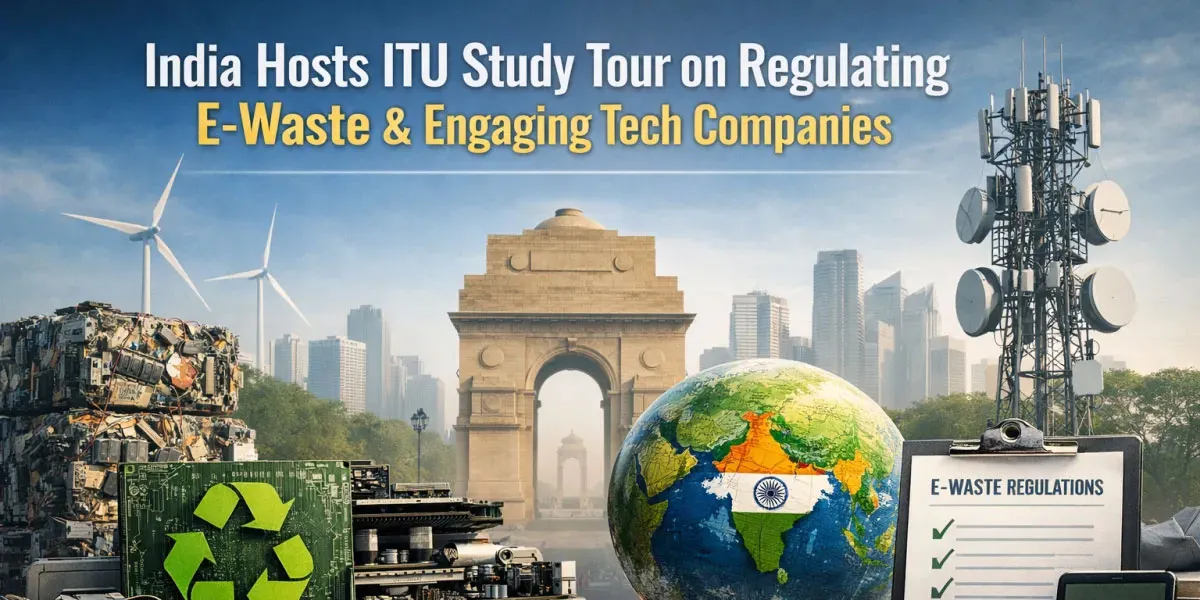
India Hosts ITU Study Tour On Regulating E-Waste And Engaging Tech Companies

The India edition of the International Exchange Initiative on Regulating E-waste and Engaging Tech Companies began in New Delhi on nine February 2026. Organised by the International Telecommunication Union with support from APC Colombia and in collaboration with India’s Department of Telecommunications, the five-day study tour aims to strengthen e-waste governance and advance a circular economy.

India was presented as a hub for global knowledge exchange, combining rapid digital growth with sustainability and regulation. The programme noted nearly 1 billion (bn) internet users and UPI processing over 12 bn monthly transactions, framing the scale of electricals and electronics use and the resulting waste challenge. Delegations from Colombia, the Dominican Republic, India, Malaysia, Nigeria and South Africa joined Indian policymakers, industry and recycling practitioners.

The three-day technical workshop focused on regulatory frameworks and governance, circular economy approaches in the electronics and telecommunications sectors and standardisation and skill development. Sessions emphasised extended producer responsibility, digital compliance systems, coordination among producers and recyclers, integration of the informal sector and workforce capacity building. The programme combined expert presentations, country case studies and group work to support practical implementation and policy learning.

Speakers underlined that international cooperation, strong regulation and industry innovation are essential for scalable and sustainable solutions and characterised the study tour as a platform for trust building and long-term collaboration. On 12 February participants will visit Greenscape Eco Management Pvt. Ltd. in Alwar for exposure to recycling operations and on 13 February the tour will conclude at the ITU Area Office and Innovation Centre at the C-DOT Campus in New Delhi. The release noted that globally 62 million (mn) tonnes (t) of e-waste are generated annually but only 22.3 per cent is formally collected and recycled, and that of 81 countries with e-waste policies 67 include extended producer responsibility. Key learnings will be shared in a post-tour webinar on 17 March.

The India edition of the International Exchange Initiative on Regulating E-waste and Engaging Tech Companies began in New Delhi on nine February 2026. Organised by the International Telecommunication Union with support from APC Colombia and in collaboration with India’s Department of Telecommunications, the five-day study tour aims to strengthen e-waste governance and advance a circular economy. India was presented as a hub for global knowledge exchange, combining rapid digital growth with sustainability and regulation. The programme noted nearly 1 billion (bn) internet users and UPI processing over 12 bn monthly transactions, framing the scale of electricals and electronics use and the resulting waste challenge. Delegations from Colombia, the Dominican Republic, India, Malaysia, Nigeria and South Africa joined Indian policymakers, industry and recycling practitioners. The three-day technical workshop focused on regulatory frameworks and governance, circular economy approaches in the electronics and telecommunications sectors and standardisation and skill development. Sessions emphasised extended producer responsibility, digital compliance systems, coordination among producers and recyclers, integration of the informal sector and workforce capacity building. The programme combined expert presentations, country case studies and group work to support practical implementation and policy learning. Speakers underlined that international cooperation, strong regulation and industry innovation are essential for scalable and sustainable solutions and characterised the study tour as a platform for trust building and long-term collaboration. On 12 February participants will visit Greenscape Eco Management Pvt. Ltd. in Alwar for exposure to recycling operations and on 13 February the tour will conclude at the ITU Area Office and Innovation Centre at the C-DOT Campus in New Delhi. The release noted that globally 62 million (mn) tonnes (t) of e-waste are generated annually but only 22.3 per cent is formally collected and recycled, and that of 81 countries with e-waste policies 67 include extended producer responsibility. Key learnings will be shared in a post-tour webinar on 17 March.

Next Story
Infrastructure Urban

Centre Disburses Over Rs 24,610 mn in XV Finance Commission Grants

The Union Government has released XV Finance Commission tied grants during the financial year 2025–26 to rural local bodies in Chhattisgarh, Gujarat, Madhya Pradesh, Punjab and Sikkim and has released withheld portions of tied and untied grants to Himachal Pradesh, Odisha and Tripura. The total disbursal exceeded Rs 24,610 mn, with figures expressed in million (mn) thereafter. The releases cover allocations pertaining to different financial years and aim to strengthen rural local governance. State-wise disbursements included Rs 3,324.6 mn for Punjab, Rs 9,432.7 mn for Madhya Pradesh, Rs 3,47..

Next Story
Infrastructure Urban

Centre Releases Over Rs 15 bn as XV FC Grants to Rural Bodies

The Union Government has released over Rs 15 bn in grants recommended by the Fifteenth Finance Commission (XV FC) to strengthen Panchayati Raj Institutions (PRIs) and Rural Local Bodies (RLBs) in six states. The funds comprise tied and untied grants disbursed in FY 2025–26. Telangana received Rs 2.48 bn as the first instalment of untied grants for FY 2025–26, benefitting 12600 Gram Panchayats (GPs). Uttarakhand received Rs 913.1 mn as the second instalment and an additional Rs 18.4 mn of a withheld first instalment was released to a further 216 GPs. Mizoram is included among beneficiary st..

Next Story
Infrastructure Energy

Government Assures Fuel Supplies And Seafarer Safety Amid West Asia Developments

The Government of India has stepped up coordinated measures to maintain stability in critical sectors as developments in West Asia continue to unfold. It has prioritised uninterrupted energy supplies, safeguarded maritime operations and extended consular assistance to nationals. Central authorities are working with State and Union territory administrations to ensure timely information dissemination and operational continuity. Refineries are reported to be operating at high capacity with adequate inventories of petrol and diesel, and domestic LPG production has been increased to support consump..

Advertisement

Subscribe to Our Newsletter

Get daily newsletters around different themes from Construction world.

STAY CONNECTED

Advertisement

Advertisement

Advertisement