Execution challenges prevail in capital-intensive metro-rail projects
RAILWAYS & METRO RAIL

Execution challenges prevail in capital-intensive metro-rail projects

Metro projects are capital-intensive in nature, with a long construction period and traffic build-up requiring several years. 

“All these issues make debt-servicing a challenge,” says Mohammad Athar, Partner, PricewaterhouseCoopers. “Accordingly, metro development corporations have been exploring long-term concessional financing. Multilateral development banks like JICA, ADB and KFW have played an active role in financing several projects across Indian cities. Hence, most projects in India have been implemented under EPC mode and with limited private-sector participation.”

For his part, Keshav Mishra, Director, PricewaterhouseCoopers, shares areas for reducing delivery or implementation challenges in metro-rail projects: “Dedicated land or RoW for construction of projects; reduction of delay in clearance of site for construction; creating space to handle equipment and materials; research on indigenisation of metro technology and products; and enabling transport and traffic management policies to enable multi-modal integration.”

“DMRC has almost completed construction of the third phase of expansion,” shares Anuj Dayal, Executive Director, Corporate Communications, Delhi Metro Rail Corporation. “In 2018-19, over 140 km of new lines have been opened. We have also received approval for the construction of three corridors under the proposed Phase 4 Delhi Metro.” He points out to land acquisition as the main challenge while executing mammoth infrastructure projects within city limits.  

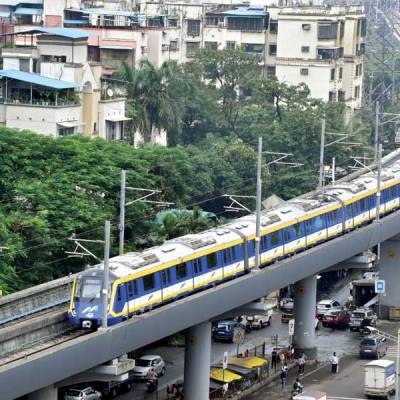
Mumbai Metro Line 3 has successfully completed six tunnel breakthroughs till now. Out of 52 km of tunnelling for the entire project, about 22 km has been completed. Overall, approximately 35 per cent work of the entire project has been completed. The total value of the project is 231.34 billion, of which 57 per cent is funded by JICA and the rest by the Centre and state governments. “This project faced multiple challenges in the beginning related to land and rehabilitation, shifting of utilities, coordination with multiple agencies for various approvals, social and environmental issues and issues related to public perception,” reveals Ashwini Bhide, Managing Director, Mumbai Metro Rail Corporation, while asserting that there have been no challenges as far as funding is concerned. “However, this entire project is technically challenging. So, there are some interface and design-related challenges that are being dealt with judiciously.” 

Nagpur Metro has a total of 38 stations, and is divided into North-South and East-West corridors. To date, it has 141 elevators and 213 escalators. As Sunil Mathur, Director (Rolling Stock & Systems), Maharashtra Metro Rail Corporation, shares, the project had several challenges across various sections. For example, the foundation work needed utmost care while executing by the side of the existing Ram Jhula ROB foundation in such a manner that it did not disturb the soil strata adjoining the existing foundation. Further, the metro alignment near Sitabuldi interchange goes over railway lines, which necessitated the construction of a bridge over this section. One major challenge of Phase 1 was also the viaduct going from the airport to Sitabuldi metro station. This stretch included the 15-year-old Chhatrapati Flyover, which needed to be demolished with public support. However, all these were overcome with iconic construction engineering techniques and solutions (for details on the solutions adopted, log on to www.ConstructionWorld.in). 

As a major contributor to the metro-rail network in India, J Kumar Infraprojects is currently working on a total of nine projects across the Mumbai, Pune and Ahmedabad regions. “We work from foundation to superstructure, i.e. up-to-deck slab in case of elevated metro rail and construction of tunnel in case of underground works,” says Nalin Gupta, Managing Director, J Kumar Infraprojects.

Commenting on Mumbai Metro Line 3, Arbind Kumar Rai, Senior Vice-President, CEC-ITD Cem-TPL JV, says, “The corridor is planned fully underground either on the edge of the existing road or along the median of the road.” With 41 per cent of work completed, he adds that major execution-related challenges included old buildings with no record of foundations, lack of space, the shifting of utilities, and logistics for excavation and concrete.

Tata Projects recently completed Lucknow's 3.68-km Phase 1A (underground) metro extension and Delhi's 9.63-km Dilshad Garden-Ghaziabad New Bus Adda elevated metro extension. The company’s team is currently working on Mumbai Metro Line 4, which involves two packages of elevated viaduct of 12.5 km connecting 14 stations. In addition, it is working on Mumbai Metro Line 3, which is a package involving underground twin tunnels of 6 km and three stations. In recent months, the company has also bagged tunnelling projects for the underground section of Pune Metro – this includes Package 1 of 2.5 km and Package 2 of 2.5 km. “The execution of metro-rail projects in bustling urban areas requires specialised expertise and experience as additional precautions need to be taken to ensure minimal inconvenience to nearby residents and local businesses,” says Rahul Shah, COO-Urban Infrastructure, Tata Projects. “In addition, heavy traffic flow means short-time windows, thereby making completion within stipulated timelines difficult.”
That said, clearly, the metro revolution is on – and how!

SHRIYAL SETHUMADHAVAN

Metro projects are capital-intensive in nature, with a long construction period and traffic build-up requiring several years. “All these issues make debt-servicing a challenge,” says Mohammad Athar, Partner, PricewaterhouseCoopers. “Accordingly, metro development corporations have been exploring long-term concessional financing. Multilateral development banks like JICA, ADB and KFW have played an active role in financing several projects across Indian cities. Hence, most projects in India have been implemented under EPC mode and with limited private-sector participation.”For his part, Keshav Mishra, Director, PricewaterhouseCoopers, shares areas for reducing delivery or implementation challenges in metro-rail projects: “Dedicated land or RoW for construction of projects; reduction of delay in clearance of site for construction; creating space to handle equipment and materials; research on indigenisation of metro technology and products; and enabling transport and traffic management policies to enable multi-modal integration.”“DMRC has almost completed construction of the third phase of expansion,” shares Anuj Dayal, Executive Director, Corporate Communications, Delhi Metro Rail Corporation. “In 2018-19, over 140 km of new lines have been opened. We have also received approval for the construction of three corridors under the proposed Phase 4 Delhi Metro.” He points out to land acquisition as the main challenge while executing mammoth infrastructure projects within city limits.  Mumbai Metro Line 3 has successfully completed six tunnel breakthroughs till now. Out of 52 km of tunnelling for the entire project, about 22 km has been completed. Overall, approximately 35 per cent work of the entire project has been completed. The total value of the project is 231.34 billion, of which 57 per cent is funded by JICA and the rest by the Centre and state governments. “This project faced multiple challenges in the beginning related to land and rehabilitation, shifting of utilities, coordination with multiple agencies for various approvals, social and environmental issues and issues related to public perception,” reveals Ashwini Bhide, Managing Director, Mumbai Metro Rail Corporation, while asserting that there have been no challenges as far as funding is concerned. “However, this entire project is technically challenging. So, there are some interface and design-related challenges that are being dealt with judiciously.” Nagpur Metro has a total of 38 stations, and is divided into North-South and East-West corridors. To date, it has 141 elevators and 213 escalators. As Sunil Mathur, Director (Rolling Stock & Systems), Maharashtra Metro Rail Corporation, shares, the project had several challenges across various sections. For example, the foundation work needed utmost care while executing by the side of the existing Ram Jhula ROB foundation in such a manner that it did not disturb the soil strata adjoining the existing foundation. Further, the metro alignment near Sitabuldi interchange goes over railway lines, which necessitated the construction of a bridge over this section. One major challenge of Phase 1 was also the viaduct going from the airport to Sitabuldi metro station. This stretch included the 15-year-old Chhatrapati Flyover, which needed to be demolished with public support. However, all these were overcome with iconic construction engineering techniques and solutions (for details on the solutions adopted, log on to www.ConstructionWorld.in). As a major contributor to the metro-rail network in India, J Kumar Infraprojects is currently working on a total of nine projects across the Mumbai, Pune and Ahmedabad regions. “We work from foundation to superstructure, i.e. up-to-deck slab in case of elevated metro rail and construction of tunnel in case of underground works,” says Nalin Gupta, Managing Director, J Kumar Infraprojects.Commenting on Mumbai Metro Line 3, Arbind Kumar Rai, Senior Vice-President, CEC-ITD Cem-TPL JV, says, “The corridor is planned fully underground either on the edge of the existing road or along the median of the road.” With 41 per cent of work completed, he adds that major execution-related challenges included old buildings with no record of foundations, lack of space, the shifting of utilities, and logistics for excavation and concrete.Tata Projects recently completed Lucknow's 3.68-km Phase 1A (underground) metro extension and Delhi's 9.63-km Dilshad Garden-Ghaziabad New Bus Adda elevated metro extension. The company’s team is currently working on Mumbai Metro Line 4, which involves two packages of elevated viaduct of 12.5 km connecting 14 stations. In addition, it is working on Mumbai Metro Line 3, which is a package involving underground twin tunnels of 6 km and three stations. In recent months, the company has also bagged tunnelling projects for the underground section of Pune Metro – this includes Package 1 of 2.5 km and Package 2 of 2.5 km. “The execution of metro-rail projects in bustling urban areas requires specialised expertise and experience as additional precautions need to be taken to ensure minimal inconvenience to nearby residents and local businesses,” says Rahul Shah, COO-Urban Infrastructure, Tata Projects. “In addition, heavy traffic flow means short-time windows, thereby making completion within stipulated timelines difficult.”That said, clearly, the metro revolution is on – and how!SHRIYAL SETHUMADHAVAN

Next Story
Infrastructure Energy

Vedanta Aluminium Uses 1.57 bn Units of Green Energy in FY25

Vedanta Aluminium, India’s largest aluminium producer, recently reported consumption of 1.57 billion units of renewable energy in FY25, marking a significant milestone in its 2030 decarbonisation roadmap. The company also achieved an 8.96 per cent reduction in greenhouse gas (GHG) emissions intensity compared to FY21, reinforcing its leadership in India’s low-carbon manufacturing transition. During FY25, Vedanta Aluminium expanded its renewable energy portfolio through long-term power purchase agreements, strengthening its strategy to source nearly 1,500 MW of renewable power over the lon..

Next Story
Real Estate

Oberoi Group to Develop Luxury Resort at Makaibari Tea Estate

EIH Limited, the flagship company of The Oberoi Group, has announced the signing of a management agreement to develop an Oberoi luxury resort at the iconic Makaibari Tea Estate in Darjeeling. The project marks a key milestone in the Group’s long-term strategy of creating distinctive hospitality experiences in rare and environmentally significant locations. Established in 1859, Makaibari is one of the world’s oldest tea estates and is globally recognised for its Himalayan landscape, primary forests and exceptional biodiversity. Spread across 1,236 acres, the estate houses one of the world..

Next Story
Real Estate

GHV Infra Secures Rs 1.09 Bn EPC Order in Jamshedpur

GHV Infra Projects Ltd, a fast-growing EPC company in India’s infrastructure and construction sector, has recently secured a Rs 1.09 billion work order in Jamshedpur, Jharkhand. Awarded by a reputed group entity, the contract covers end-to-end civil construction, mechanical, electrical and plumbing (MEP) systems, along with high-quality finishing works for a large building development. The project will be executed over a 30-month period, with defined benchmarks for quality, safety and timely delivery. The order strengthens GHV Infra’s footprint in Jamshedpur, a key industrial hub known fo..

Advertisement

Subscribe to Our Newsletter

Get daily newsletters around different themes from Construction world.

STAY CONNECTED

Advertisement

Advertisement

Advertisement

Advertisement

Open In App