Let there be Light!
Real Estate

Let there be Light!

Light gives meaning to life. Irrespective of the space, the right kind of lighting doesn’t just create a perfect ambience but enables the very function of life, with all the tasks it entails. And in terms of the technology of light, we’ve come a long way. As Sachin Goregaoker, Director, GA design, says, “With innovations, lighting has transformed into a science that is constantly evolving. With the growth of LED as a major light source and the popularity of automation, lighting has metamorphosed in the world of design. We see fewer fixtures that can multitask to suit various requirements and the ambience of a space can change with the click of a button.” The market According to research firm Million Insights, the global LED lighting market is expected to be valued at $ 108 billion by 2025. Fuelled by technological innovations and inclination to clean, green energy solutions, LEDs deliver high efficiency and reduce costs. And India is taking note. “India has fast adopted technologically advanced power solutions owing to the growing need for conservation of electricity,” says Srinivas Shanbhogue, Vice-President, Retail Business, Schneider Electric India. “Further, the Government’s vision to provide 24×7 electricity to all citizens in a reliable and affordable manner is a real push to the industry. Going by current estimates, India is well-positioned to become the world's first country to use LEDs for all lighting needs by the end of 2019.” According to Sanjay Gupta, Senior Vice-President, Wipro Consumer Lighting and Switches, “The benefits of technology dovetail with the increasing demand for modular switches and energy-efficient lighting. LEDs are a revolutionary advancement and energy-efficient, eco-friendly, dynamic designs have fuelled the growth of the smart lighting switches market.” In the view of Amol Prabhu, Partner, Shashi Prabhu & Associates, “Nearly 50 per cent of energy saving can be done by using LED lights; by adding smart lights and sensors, an additional 20 per cent of energy can be saved. A designer can reduce the LPD of a building by using smart lights.” And Vivek Sharma, Managing Director, Panasonic Life Solutions India, points out that the shift has been accelerated and work is on in earnest to consistently reduce, if not totally eliminate wiring altogether. “If you look at wires, 85 per cent of the cost is of copper, which is not widely available. One way to reduce cost is to reduce the amount of copper and yet be able to conduct. Similarly, Internet of Things [IoT] and automation are developing. The conventional way of turning the switch on and off may eventually be a thing of the past. You can already control lighting with smartphones.” Welcoming the new era with IoT IoT-based smart lighting solutions are enabling Indian offices to save costs on energy and maintenance bills, thereby enhancing productivity and improving comfort levels. Vivek Sharma, Managing Director, Panasonic Life Solutions India, believes the aspiration of consumers and cultural acceptance are accelerating growth of IoT-based applications. “Businesses are leveraging IoT technology to develop smart offices that promote a pleasant and productive work environment while saving costs,” says Srinivas Shanbhogue, Vice-President, Retail Business, Schneider Electric India. “Also, such lighting helps employee well-being and comfort, which have a positive impact on performance.” Elaborating further, Sanjay Gupta, Senior Vice-President, Wipro Consumer Lighting and Switches, explains, “The emergence of IoT and big data, smart and connected digital lighting-based solutions like Power over Ethernet (PoE) are the way forward as they will bring in intelligence and functionality into lighting systems, enhance user experience, and deliver desired outcomes to customers. We have recently associated with Mapiq, a Dutch scale-up and frontrunner, to implement Internet of Lighting (IoL)TM in a smart building proposition. The first smart building in India arising from this partnership is expected to go live before summer 2019 and deliver a superior end-user experience in smart workplaces.”

- DIKSHA JAWLE


Light gives meaning to life. Irrespective of the space, the right kind of lighting doesn’t just create a perfect ambience but enables the very function of life, with all the tasks it entails. And in terms of the technology of light, we’ve come a long way. As Sachin Goregaoker, Director, GA design, says, “With innovations, lighting has transformed into a science that is constantly evolving. With the growth of LED as a major light source and the popularity of automation, lighting has metamorphosed in the world of design. We see fewer fixtures that can multitask to suit various requirements and the ambience of a space can change with the click of a button.” The market According to research firm Million Insights, the global LED lighting market is expected to be valued at $ 108 billion by 2025. Fuelled by technological innovations and inclination to clean, green energy solutions, LEDs deliver high efficiency and reduce costs. And India is taking note. “India has fast adopted technologically advanced power solutions owing to the growing need for conservation of electricity,” says Srinivas Shanbhogue, Vice-President, Retail Business, Schneider Electric India. “Further, the Government’s vision to provide 24×7 electricity to all citizens in a reliable and affordable manner is a real push to the industry. Going by current estimates, India is well-positioned to become the world's first country to use LEDs for all lighting needs by the end of 2019.” According to Sanjay Gupta, Senior Vice-President, Wipro Consumer Lighting and Switches, “The benefits of technology dovetail with the increasing demand for modular switches and energy-efficient lighting. LEDs are a revolutionary advancement and energy-efficient, eco-friendly, dynamic designs have fuelled the growth of the smart lighting switches market.” In the view of Amol Prabhu, Partner, Shashi Prabhu & Associates, “Nearly 50 per cent of energy saving can be done by using LED lights; by adding smart lights and sensors, an additional 20 per cent of energy can be saved. A designer can reduce the LPD of a building by using smart lights.” And Vivek Sharma, Managing Director, Panasonic Life Solutions India, points out that the shift has been accelerated and work is on in earnest to consistently reduce, if not totally eliminate wiring altogether. “If you look at wires, 85 per cent of the cost is of copper, which is not widely available. One way to reduce cost is to reduce the amount of copper and yet be able to conduct. Similarly, Internet of Things [IoT] and automation are developing. The conventional way of turning the switch on and off may eventually be a thing of the past. You can already control lighting with smartphones.” Welcoming the new era with IoT IoT-based smart lighting solutions are enabling Indian offices to save costs on energy and maintenance bills, thereby enhancing productivity and improving comfort levels. Vivek Sharma, Managing Director, Panasonic Life Solutions India, believes the aspiration of consumers and cultural acceptance are accelerating growth of IoT-based applications. “Businesses are leveraging IoT technology to develop smart offices that promote a pleasant and productive work environment while saving costs,” says Srinivas Shanbhogue, Vice-President, Retail Business, Schneider Electric India. “Also, such lighting helps employee well-being and comfort, which have a positive impact on performance.” Elaborating further, Sanjay Gupta, Senior Vice-President, Wipro Consumer Lighting and Switches, explains, “The emergence of IoT and big data, smart and connected digital lighting-based solutions like Power over Ethernet (PoE) are the way forward as they will bring in intelligence and functionality into lighting systems, enhance user experience, and deliver desired outcomes to customers. We have recently associated with Mapiq, a Dutch scale-up and frontrunner, to implement Internet of Lighting (IoL)TM in a smart building proposition. The first smart building in India arising from this partnership is expected to go live before summer 2019 and deliver a superior end-user experience in smart workplaces.” - DIKSHA JAWLE

Next Story
Technology

AI-Enabled Workflows Lift Profitability and Productivity

Organisations modernising frontline workflows with artificial intelligence, automation and real-time data are reporting stronger financial performance, higher productivity and improved employee engagement, according to a global study by Zebra Technologies and Oxford Economics.The research covered 1,000 senior leaders across retail, manufacturing, transportation and logistics in the US, Mexico, the UK, Germany, India, Japan, Australia and New Zealand.In transportation and logistics, 54 per cent of companies that improved picking and packing operations reported faster operational performance, wh..

Next Story
Real Estate

India Leads Global AI Readiness but Implementation Lags

Indian companies lead global averages across all eight artificial intelligence readiness indicators tracked by JLL, but only 19 per cent have started making changes to their workplaces, according to the JLL 2026 Future of Work Survey.The study found that 77 per cent of Indian business leaders expect AI to change their office requirements, creating a 58-percentage-point gap between awareness and implementation. The survey covered more than 2,200 CEOs, CFOs and real estate leaders across 21 countries during the first quarter of 2026.Despite concerns over automation, 58 per cent of Indian leaders..

Next Story
Equipment

Three WOLFF Cranes Build Riyadh Cable-Stayed Bridges

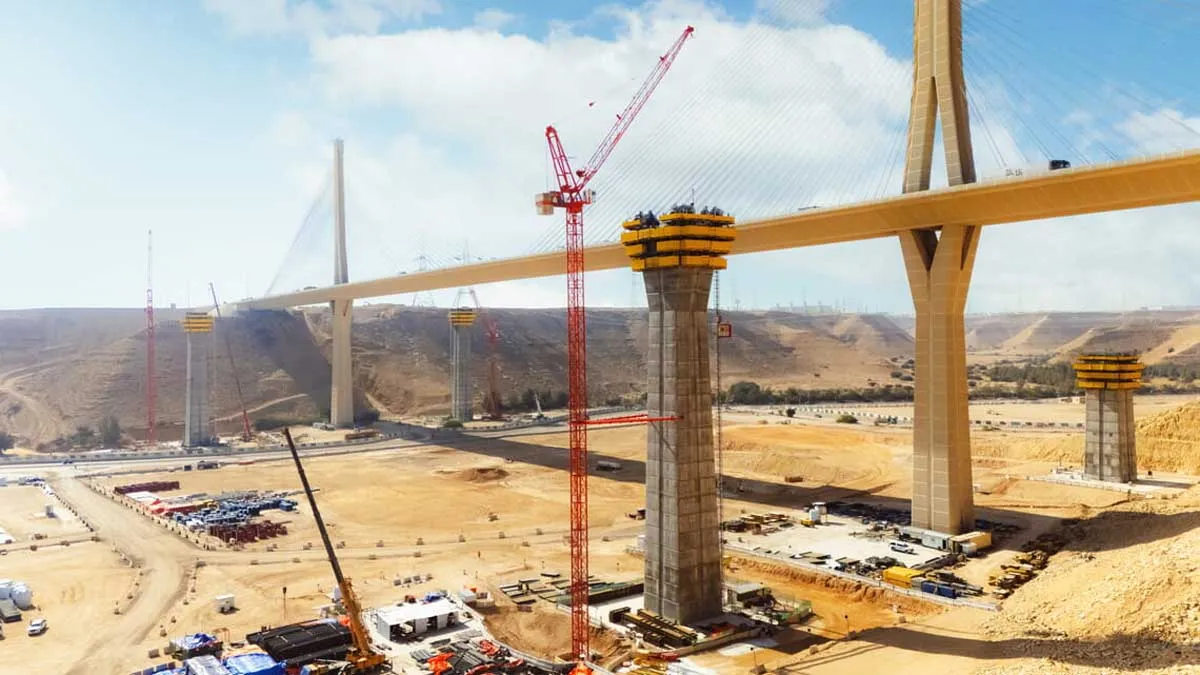
Three WOLFF 180 B luffing jib cranes are supporting the construction of two cable-stayed bridges alongside the existing Wadi Laban Bridge in Riyadh, Saudi Arabia. The project is being developed for the Royal Commission for Riyadh City and executed by the ICRC joint venture comprising IC Ictas and Al Rashid Trading & Contracting Company.The cranes are handling lifting operations including formwork, reinforcement, concrete placement, work platforms, surveying equipment and other construction materials. Each crane is fitted with a 40 m jib, reaches a hook height of 157 m and offers a maximum ..

Advertisement

Subscribe to Our Newsletter

Get daily newsletters around different themes from Construction world.

STAY CONNECTED

Advertisement

Advertisement

Advertisement