

Centre Introduces Bill To Bar State Levies On Mining
COAL & MINING

Centre Introduces Bill To Bar State Levies On Mining

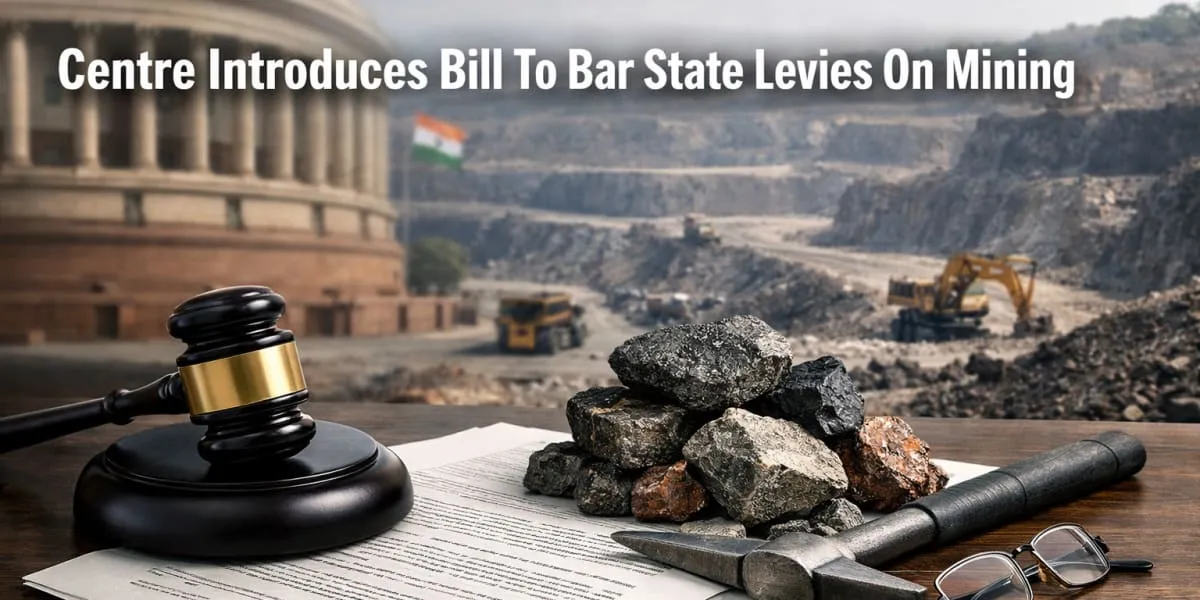
The government introduced an amendment bill in the Lok Sabha that would bar states from imposing taxes or other levies on mining and mineral rights and seek to bring mineral-bearing lands within central regulation under the Mines and Minerals (Development and Regulation) Act of 1957. The measure was moved by the minister of coal and mines, G Kishan Reddy, amid protests from opposition members in the House. The bill was presented as an effort to clarify the scope of Union powers over minerals and to streamline the regulatory environment.

The proposed insertion of a new section 9D would provide that no tax, cess or other levy may be imposed by a state government on mineral rights or mineral-bearing land except in accordance with conditions or restrictions prescribed by the central government. The bill therefore seeks to limit state fiscal measures that are linked to mineral quantity, mineral value or royalty and to vest greater legislative control with the Union. The draft legislation contains definitions and parameters to be prescribed for identifying mineral-bearing land.

The proposal follows a Supreme Court ruling over two years ago that had affirmed states' rights to tax mines and mineral-bearing land, with the court distinguishing royalty paid to the central government from a tax. The government said the amendment aims to reduce the financial burden on mining operations and make them commercially attractive to investors. Officials also argued the change would improve predictability for licences, exploration and extraction activities that are central to mineral development.

Under the current framework, the centre's regulatory remit is largely limited to mining activities such as exploration, extraction, licensing and operations, while the underlying land has remained outside explicit Union control. That distinction, the bill contends, has allowed divergent state interpretations on taxes and levies linked to mineral-bearing land and complicated investor decision making. The measure would define mineral-bearing land in accordance with parameters set by the central government and attempt to harmonise the legal treatment across jurisdictions.

The government introduced an amendment bill in the Lok Sabha that would bar states from imposing taxes or other levies on mining and mineral rights and seek to bring mineral-bearing lands within central regulation under the Mines and Minerals (Development and Regulation) Act of 1957. The measure was moved by the minister of coal and mines, G Kishan Reddy, amid protests from opposition members in the House. The bill was presented as an effort to clarify the scope of Union powers over minerals and to streamline the regulatory environment. The proposed insertion of a new section 9D would provide that no tax, cess or other levy may be imposed by a state government on mineral rights or mineral-bearing land except in accordance with conditions or restrictions prescribed by the central government. The bill therefore seeks to limit state fiscal measures that are linked to mineral quantity, mineral value or royalty and to vest greater legislative control with the Union. The draft legislation contains definitions and parameters to be prescribed for identifying mineral-bearing land. The proposal follows a Supreme Court ruling over two years ago that had affirmed states' rights to tax mines and mineral-bearing land, with the court distinguishing royalty paid to the central government from a tax. The government said the amendment aims to reduce the financial burden on mining operations and make them commercially attractive to investors. Officials also argued the change would improve predictability for licences, exploration and extraction activities that are central to mineral development. Under the current framework, the centre's regulatory remit is largely limited to mining activities such as exploration, extraction, licensing and operations, while the underlying land has remained outside explicit Union control. That distinction, the bill contends, has allowed divergent state interpretations on taxes and levies linked to mineral-bearing land and complicated investor decision making. The measure would define mineral-bearing land in accordance with parameters set by the central government and attempt to harmonise the legal treatment across jurisdictions.

Related Stories

Gold Stories

Next Story
Infrastructure Urban

Sabarmati Riverfront Two Plots Up for Auction at Rs2.24 bn Base Price

Two commercial plots on the western bank of the Sabarmati Riverfront will be auctioned with a base price of Rs 112 crore each, equivalent to Rs 1.12 bn apiece and Rs 2.24 billion in total. The parcels are located adjacent to the Metro Rail Bridge in Ahmedabad and form the first commercial offering after a prolonged pause. The Riverfront Development Corporation has framed the sale as part of a phased commercial release to revive development along the riverfront. The combined base valuation has been set by the corporation to reflect market rates along the riverfront. The corporation has fixed a ..

Next Story
Infrastructure Urban

Andhra Pradesh to Connect Over One Million Streetlights

Andhra Pradesh will undertake a statewide smart streetlighting programme across all 123 Urban Local Bodies (ULBs), bringing around 1.05 million (mn) streetlights under an AI enabled monitoring and management system. The programme will be implemented by Energy Efficiency Services Limited (EESL) with the Commissioner and Director of Municipal Administration under the state Municipal Administration and Urban Development Department. The project aims to convert conventional streetlighting into a digitally managed municipal service monitored and maintained remotely. The initial phase will cover abou..

Next Story
Infrastructure Urban

AMC To Procure Four Machines For Guard Rail Cleaning

Ahmedabad Municipal Corporation will introduce four specialised machines for cleaning guard railings along major roads and the central verges of BRTS and Metro corridors. The civic body plans to replace manual labour with mechanised cleaning to improve maintenance of road infrastructure and greenery. The purchase is estimated at Rs 82.8 million (mn), excluding GST. The proposal sets the base price of each machine at about Rs 20.7 million (mn) so four units total Rs 82.8 million (mn) before GST. 18 per cent GST will be applicable separately. During the warranty period each machine will operate ..

Advertisement

Subscribe to Our Newsletter

Get daily newsletters around different themes from Construction world.

STAY CONNECTED

Advertisement