AI and ML to Drive Next-Gen Power Reforms in India: Manohar Lal
POWER & RENEWABLE ENERGY

AI and ML to Drive Next-Gen Power Reforms in India: Manohar Lal

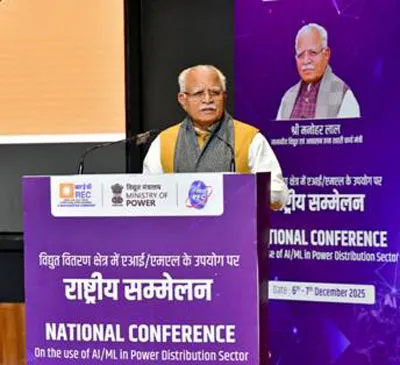
Artificial Intelligence and Machine Learning applications will be central to building intelligent, self-optimising, and consumer-focused electricity distribution networks in India, said Manohar Lal, Minister of Power. Addressing participants at a two-day National Conference on AI/ML adoption in power distribution held at Bharat Mandapam, New Delhi, he underlined how emerging technologies are set to reshape both service delivery and operational outcomes.

The Minister highlighted a wide range of AI/ML-driven capabilities—smart meter analytics, digital twins, predictive maintenance, theft-detection systems, appliance-level insights, automated outage forecasting, and GenAI-enabled decision support—that can significantly enhance reliability and consumer engagement. He commended the participation of states, industry, innovators, academia, and technology partners, and appreciated the solutions presented by Distribution Companies (DISCOMs), Advanced Metering Infrastructure Service Providers (AMISPs), Technology Solution Providers (TSPs), and Home Automation Solution Providers (HASPs).

He urged DISCOMs to collaborate more closely with ecosystem stakeholders to transition toward smart and resilient distribution systems, while emphasising the importance of consumer awareness to overcome misconceptions around new technologies. According to him, the suite of AI/ML tools not only boosts transparency but also helps households manage consumption, prevents outages proactively, safeguards honest consumers from theft-related burdens, and supports DISCOMs in reducing losses and optimising power purchase costs.

Pankaj Agarwal, Secretary, Ministry of Power, reaffirmed the government’s commitment to strengthening digital adoption across DISCOMs. He stressed the need for robust data-sharing frameworks, interoperability, and capacity building to scale the innovations demonstrated at the conference.

The conference received 195 solution entries, out of which 51 were shortlisted for detailed evaluation. Winners included TNPDCL (Tamil Nadu) and MP East in the DISCOM category; Tata Power and Apraava in the AMISP category; Pravah and Flock Energy among solution providers; and Tata Power in the home-automation category. These teams showcased innovations ranging from advanced revenue protection analytics to real-time grid intelligence and AI-based automation.

The Minister also launched STELLAR, a long-term load adequacy and resilience planning tool developed by the Central Electricity Authority. In addition, the India Smart Grid Forum unveiled a handbook outlining AI, ML, AR/VR, and robotics use cases and a roadmap for electric utilities.

Artificial Intelligence and Machine Learning applications will be central to building intelligent, self-optimising, and consumer-focused electricity distribution networks in India, said Manohar Lal, Minister of Power. Addressing participants at a two-day National Conference on AI/ML adoption in power distribution held at Bharat Mandapam, New Delhi, he underlined how emerging technologies are set to reshape both service delivery and operational outcomes.The Minister highlighted a wide range of AI/ML-driven capabilities—smart meter analytics, digital twins, predictive maintenance, theft-detection systems, appliance-level insights, automated outage forecasting, and GenAI-enabled decision support—that can significantly enhance reliability and consumer engagement. He commended the participation of states, industry, innovators, academia, and technology partners, and appreciated the solutions presented by Distribution Companies (DISCOMs), Advanced Metering Infrastructure Service Providers (AMISPs), Technology Solution Providers (TSPs), and Home Automation Solution Providers (HASPs).He urged DISCOMs to collaborate more closely with ecosystem stakeholders to transition toward smart and resilient distribution systems, while emphasising the importance of consumer awareness to overcome misconceptions around new technologies. According to him, the suite of AI/ML tools not only boosts transparency but also helps households manage consumption, prevents outages proactively, safeguards honest consumers from theft-related burdens, and supports DISCOMs in reducing losses and optimising power purchase costs.Pankaj Agarwal, Secretary, Ministry of Power, reaffirmed the government’s commitment to strengthening digital adoption across DISCOMs. He stressed the need for robust data-sharing frameworks, interoperability, and capacity building to scale the innovations demonstrated at the conference.The conference received 195 solution entries, out of which 51 were shortlisted for detailed evaluation. Winners included TNPDCL (Tamil Nadu) and MP East in the DISCOM category; Tata Power and Apraava in the AMISP category; Pravah and Flock Energy among solution providers; and Tata Power in the home-automation category. These teams showcased innovations ranging from advanced revenue protection analytics to real-time grid intelligence and AI-based automation.The Minister also launched STELLAR, a long-term load adequacy and resilience planning tool developed by the Central Electricity Authority. In addition, the India Smart Grid Forum unveiled a handbook outlining AI, ML, AR/VR, and robotics use cases and a roadmap for electric utilities.

Next Story
Resources

Jyoti Structures Launches Heat Safety Drive Across Sites

Jyoti Structures (JSL) has strengthened heat safety measures across its project sites and manufacturing facilities as temperatures rise across India. The company has implemented a Summer Safety Plan covering all transmission line projects to address risks related to heat stress, dehydration and worker fatigue.The initiative includes rescheduling work away from peak afternoon temperatures, provision of drinking water, ORS and lemon-salt solutions, and installation of rest shelters near work areas. Daily toolbox talks, worker health monitoring, first-aid preparedness, emergency transport arrange..

Next Story
Real Estate

MHADA Declares 82 Buildings Most Dangerous in Central and South Mumbai

The Maharashtra Housing and Area Development Authority (MHADA) has declared 82 buildings as most dangerous across Central and South Mumbai and has appealed to residents to vacate immediately. The list, prepared after structural assessments by the authority, identifies buildings judged to pose imminent risk to occupants and to passersby. Local civic bodies have been asked to coordinate evacuations and to make arrangements for temporary shelter and rehabilitation for displaced households. Officials said the authority prioritised buildings with visible structural distress, severe cracking, tiltin..

Next Story
Infrastructure Transport

Damage Reported At Halwara Airport Terminal After First Rains

Severe damage was reported at the terminal of Halwara Airport during the first major rain spell of the season, prompting immediate concern among aviation and local authorities. Images from the site showed water ingress and visible deterioration of the terminal interior, affecting passenger areas and ancillary services. The airport authority suspended certain operations temporarily to assess structural safety and ensure passenger wellbeing. Preliminary inspections have prioritised electrical systems and roof seals to prevent further water ingress. State aviation officials ordered a formal inqui..

Advertisement

Subscribe to Our Newsletter

Get daily newsletters around different themes from Construction world.

STAY CONNECTED

Advertisement

Advertisement

Advertisement