AVATAR Talent to Shape Next Tech Wave, say Experts at MIT-WPU
POWER & RENEWABLE ENERGY

AVATAR Talent to Shape Next Tech Wave, say Experts at MIT-WPU

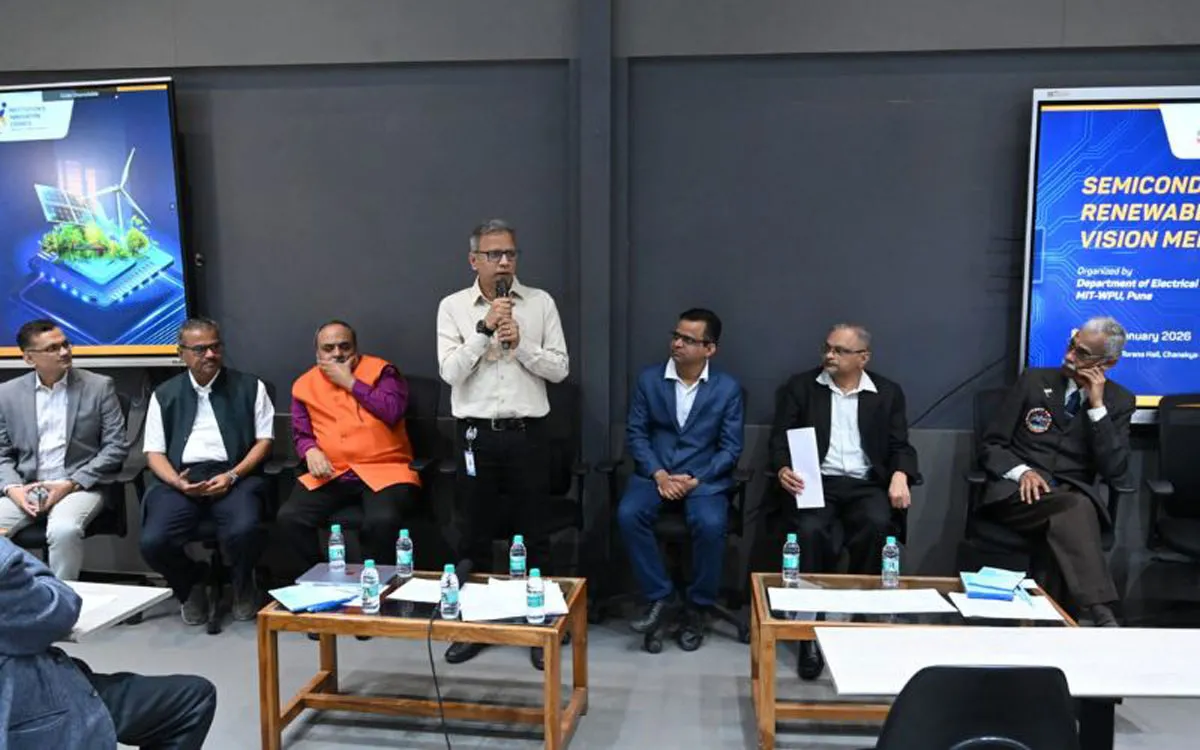
The next phase of technological leadership will be driven not by narrow specialists but by professionals capable of thinking and operating across disciplines, experts said at the Semiconductor & Renewable Energy Vision Meet held recently at MIT World Peace University (MIT-WPU). The event highlighted the urgent need for a new talent paradigm to address complex, fast-evolving global challenges.

Delivering the keynote address, Dr Satyam Priyadarshi, CEO, Reignite Future, USA, introduced the concept of “AVATAR talent”—individuals who are Always, Versatile, Adaptable, Transformative, Agile, and Resilient. He said future-ready professionals must be able to integrate structured and unstructured knowledge, collaborate across domains, and apply exponential technologies responsibly. “Institutions must move beyond textbook-driven learning and prepare students for real-world complexity and sustainable technological ecosystems,” Satyam Priyadarshi, CEO, Reignite Future, USA, said.

Hosted by the Department of Electrical and Electronics Engineering, the Vision Meet featured keynote addresses by industry and academic leaders including Apoorwa Kapse, Senior Industry Leader, Marvell Technology, Pune; Dr Arvind Shaligram, Professor Emeritus, Electronic Science and CEO, SPPU Research Park Foundation; Dr Sunil Kulkarni, Director, ANSK; and Dr Satishchandra Ogale, Director, Research Institute for Sustainable Energy (RISE), TCG-CREST, Kolkata and Emeritus Professor, IISER Pune.

Opening the event, Dr Prasad Khandekar, Chief Academic Officer, MITWPU, said India is witnessing a critical shift where talent and ecosystem development are finally converging. He reaffirmed the university’s commitment to investing in infrastructure, curriculum and partnerships to position the campus as a hub for semiconductor education and research.

Speaking on industry expectations, Apoorwa Kapse, Senior Industry Leader, Marvell Technology, Pune, advised students to focus on strong fundamentals in digital electronics and system-level understanding, noting that applied skills follow naturally. Highlighting long-term opportunities, Dr Arvind Shaligram said India’s semiconductor ecosystem will require nearly 1.5 million skilled professionals over the coming decades.

The event concluded with Dr Parul Jadhav, Program Director, Department of Electrical and Electronics Engineering, reiterating MIT-WPU’s focus on industry-aligned curricula, research-led learning and sustained collaboration to nurture future-ready talent.

The next phase of technological leadership will be driven not by narrow specialists but by professionals capable of thinking and operating across disciplines, experts said at the Semiconductor & Renewable Energy Vision Meet held recently at MIT World Peace University (MIT-WPU). The event highlighted the urgent need for a new talent paradigm to address complex, fast-evolving global challenges.Delivering the keynote address, Dr Satyam Priyadarshi, CEO, Reignite Future, USA, introduced the concept of “AVATAR talent”—individuals who are Always, Versatile, Adaptable, Transformative, Agile, and Resilient. He said future-ready professionals must be able to integrate structured and unstructured knowledge, collaborate across domains, and apply exponential technologies responsibly. “Institutions must move beyond textbook-driven learning and prepare students for real-world complexity and sustainable technological ecosystems,” Satyam Priyadarshi, CEO, Reignite Future, USA, said.Hosted by the Department of Electrical and Electronics Engineering, the Vision Meet featured keynote addresses by industry and academic leaders including Apoorwa Kapse, Senior Industry Leader, Marvell Technology, Pune; Dr Arvind Shaligram, Professor Emeritus, Electronic Science and CEO, SPPU Research Park Foundation; Dr Sunil Kulkarni, Director, ANSK; and Dr Satishchandra Ogale, Director, Research Institute for Sustainable Energy (RISE), TCG-CREST, Kolkata and Emeritus Professor, IISER Pune.Opening the event, Dr Prasad Khandekar, Chief Academic Officer, MITWPU, said India is witnessing a critical shift where talent and ecosystem development are finally converging. He reaffirmed the university’s commitment to investing in infrastructure, curriculum and partnerships to position the campus as a hub for semiconductor education and research.Speaking on industry expectations, Apoorwa Kapse, Senior Industry Leader, Marvell Technology, Pune, advised students to focus on strong fundamentals in digital electronics and system-level understanding, noting that applied skills follow naturally. Highlighting long-term opportunities, Dr Arvind Shaligram said India’s semiconductor ecosystem will require nearly 1.5 million skilled professionals over the coming decades.The event concluded with Dr Parul Jadhav, Program Director, Department of Electrical and Electronics Engineering, reiterating MIT-WPU’s focus on industry-aligned curricula, research-led learning and sustained collaboration to nurture future-ready talent.

Next Story
Infrastructure Urban

PM highlights new momentum in India-EU ties after landmark FTA

Prime Minister Shri Narendra Modi recently addressed the India–European Union Business Forum at Bharat Mandapam, New Delhi, describing the current phase as a new era of alignment in India-EU relations. He noted that the presence of EU leaders as Chief Guests at India’s Republic Day and the conclusion of the largest Free Trade Agreement in India’s history reflect unprecedented strategic convergence between the two democratic partners.Highlighting economic ties, the Prime Minister said bilateral trade has doubled over the past decade to 180 billion euros, with EU investments in India excee..

Next Story
Infrastructure Energy

PM outlines India’s energy ambitions and investment outlook

Prime Minister Narendra Modi recently addressed the inaugural ceremony of India Energy Week 2026 via video conferencing, describing India as a land of immense opportunity for the global energy sector. He noted that representatives from nearly 125 countries had gathered to deliberate on building an energy-secure and sustainable future, underlining the event’s growing stature as a global platform for dialogue and action.The Prime Minister highlighted that India’s position as the world’s fastest-growing major economy is driving sustained growth in energy demand, while also creating opportun..

Next Story
Infrastructure Urban

Landmark pact reshapes India’s trade ties with the European Union

India and the European Union have recently concluded the India–EU Free Trade Agreement (FTA), marking a major milestone in bilateral economic engagement. The agreement was jointly announced at the 16th India–EU Summit by Narendra Modi and Ursula von der Leyen, positioning the two blocs as trusted partners committed to open, rules-based and inclusive growth.The FTA follows sustained negotiations since talks were relaunched in 2022 and reflects a shared strategic vision between the world’s fourth- and second-largest economies, together accounting for about 25 per cent of global GDP and nea..

Advertisement

Subscribe to Our Newsletter

Get daily newsletters around different themes from Construction world.

STAY CONNECTED

Advertisement

Advertisement

Advertisement

Advertisement

Open In App