Bengal Launches PM Surya Ghar With Extra Solar Subsidy
POWER & RENEWABLE ENERGY

Bengal Launches PM Surya Ghar With Extra Solar Subsidy

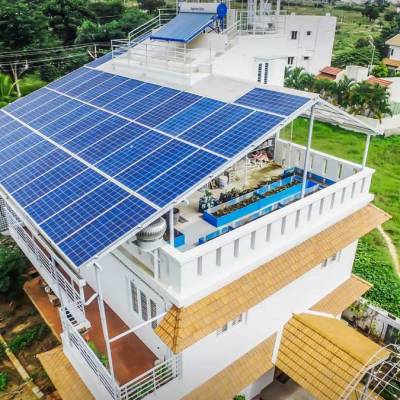
The Bengal government has launched the PM Surya Ghar: Muft Bijli Yojana in the state, announcing additional financial assistance over and above the Centre's subsidy for households installing rooftop solar systems. The scheme, launched by the Prime Minister in February 2024, aims to expand rooftop solar capacity and reduce household power bills. It seeks to cover 10 million (mn) households nationwide and is presented as the flagship central effort to promote distributed renewable generation.

Chief Minister Suvendu Adhikari reported that rooftop solar systems had already been installed in 1,810 households in the first phase. Under the state's subsidy structure, households installing systems generating up to 100 units will receive an additional Rs 5,000 over the Centre's Rs 30,000 subsidy, while 200-unit systems will attract Rs 10,000 extra against the Centre's Rs 60,000 and 300-unit systems will receive Rs 15,000 on top of the Centre's Rs 78,000. Scheduled Caste and Scheduled Tribe (SC and ST) households will receive a further Rs 15,000 from the state.

The chief minister indicated that the administration was considering separate assistance for economically disadvantaged families from other communities, and that the Chief Secretary and the Finance Secretary were examining a proposal ahead of a decision. North 24-Parganas led the first phase with 238 households, followed by Hooghly with 232, and beneficiaries were engaged through virtual interactions in which they reported falls in electricity bills and were encouraged to promote enrolment locally.

The Centre has set a target of covering 0.1 mn households in Bengal by March 31, 2027, but the state has signalled an ambition to reach 0.5 mn households. The scheme is intended to be extended to government offices to promote renewable energy use and curtail power consumption in the public sector. Adhikari also noted that Maharashtra currently has about 2.6 mn beneficiaries, a figure cited to illustrate differing levels of uptake across states.

The Bengal government has launched the PM Surya Ghar: Muft Bijli Yojana in the state, announcing additional financial assistance over and above the Centre's subsidy for households installing rooftop solar systems. The scheme, launched by the Prime Minister in February 2024, aims to expand rooftop solar capacity and reduce household power bills. It seeks to cover 10 million (mn) households nationwide and is presented as the flagship central effort to promote distributed renewable generation. Chief Minister Suvendu Adhikari reported that rooftop solar systems had already been installed in 1,810 households in the first phase. Under the state's subsidy structure, households installing systems generating up to 100 units will receive an additional Rs 5,000 over the Centre's Rs 30,000 subsidy, while 200-unit systems will attract Rs 10,000 extra against the Centre's Rs 60,000 and 300-unit systems will receive Rs 15,000 on top of the Centre's Rs 78,000. Scheduled Caste and Scheduled Tribe (SC and ST) households will receive a further Rs 15,000 from the state. The chief minister indicated that the administration was considering separate assistance for economically disadvantaged families from other communities, and that the Chief Secretary and the Finance Secretary were examining a proposal ahead of a decision. North 24-Parganas led the first phase with 238 households, followed by Hooghly with 232, and beneficiaries were engaged through virtual interactions in which they reported falls in electricity bills and were encouraged to promote enrolment locally. The Centre has set a target of covering 0.1 mn households in Bengal by March 31, 2027, but the state has signalled an ambition to reach 0.5 mn households. The scheme is intended to be extended to government offices to promote renewable energy use and curtail power consumption in the public sector. Adhikari also noted that Maharashtra currently has about 2.6 mn beneficiaries, a figure cited to illustrate differing levels of uptake across states.

Related Stories

Gold Stories

Next Story
Infrastructure Energy

Asian Energy Services Q1 FY27 PAT Rises 129 Per Cent

Asian Energy Services Limited reported a 129 per cent year-on-year rise in net profit to Rs 128 million for Q1 FY27, compared with the corresponding quarter last year.Revenue increased 135 per cent year-on-year to Rs 2.71 billion, supported by continued momentum across its services business, disciplined execution and contributions from domestic and international operations. EBITDA grew 81 per cent year-on-year during the quarter.As of June 30, 2026, the company’s standalone order book stood at Rs 17.54 billion, with around 60 per cent coming from oil and gas services and 40 per cent from min..

Next Story
Infrastructure Urban

BioBTX to Build First Commercial-Scale Circular Chemicals Plant

Dutch circular chemistry technology developer BioBTX is building what it says will be the world’s first commercial-scale plant to convert mixed plastic waste into high-quality aromatic chemicals using its proprietary Integrated Catalytic Cracking Process (ICCP) technology.The facility will be built at Chemical Park Delfzijl on the northern coast of the Netherlands and is expected to create 35 jobs. Covestro, which has been a shareholder and strategic partner of BioBTX since 2024, holds a mid-single-digit million-euro investment in the company.BioBTX’s ICCP technology uses catalytic pyrolys..

Next Story
Real Estate

Awfis Q1 FY27 PAT Jumps 140% as Revenue Rises 27%

Awfis Space Solutions reported a 140 per cent year-on-year rise in consolidated profit after tax (PAT) to Rs 240 million for Q1 FY27, compared with Rs 100 million in the corresponding quarter last year.Revenue from operations increased 27 per cent to Rs 4.25 billion from Rs 3.35 billion, while EBITDA rose 28 per cent to Rs 1.62 billion. EBITDA margin improved to 38.2 per cent from 37.8 per cent. Profit before tax increased 135 per cent to Rs 240 million.The company's co-working business recorded 27 per cent year-on-year growth, supported by demand from enterprises, Global Capability Centres (G..

Advertisement

Subscribe to Our Newsletter

Get daily newsletters around different themes from Construction world.

STAY CONNECTED

Advertisement