

+
India Meets Peak Power Demand Of 271 GW
POWER & RENEWABLE ENERGY

India Meets Peak Power Demand Of 271 GW

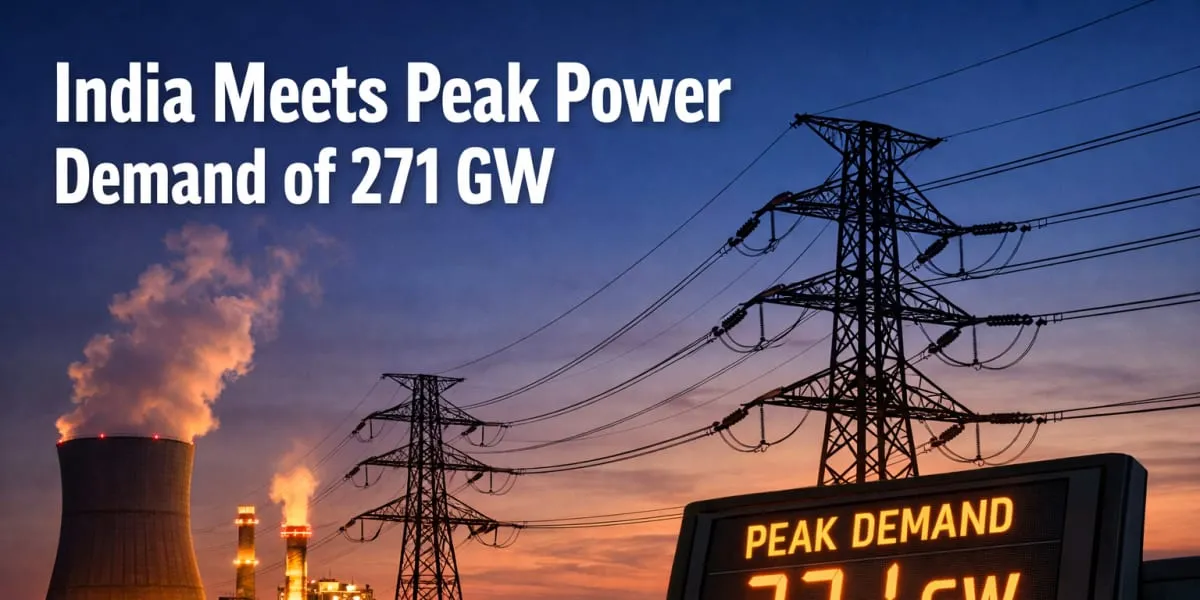
India met an all-time peak power demand of 271 GW in May 2026 and had prepared generation capacity of 284 GW to avoid shortages.

The Union government is preparing for a 300 GW capacity for the coming year as demand is expected to rise by 30 GW because of expansion of data centres and other sectors, Khattar noted at the inauguration of the Vibrant Gujarat Regional Conference in Vadodara.

He attributed the outcome to reforms and investment over the past 12 years under Prime Minister Narendra Modi.

Khattar maintained that reliable power is a cornerstone of a strong economy and that India preserved energy security despite recent events in West Asia even as many nations experienced volatility.

He highlighted progress on the principle of One Nation, One Grid, One Frequency and said the stable system gives confidence to industry and investors.

The minister added that installed generation capacity has reached roughly 542 GW.

The Centre's Saubhagya scheme has provided electricity connections to 30 million (mn) households over the past few years and additional connections have been supplied to needy families through free electricity schemes, Khattar noted.

He said distribution reforms have improved the financial health of distribution companies, which previously operated under constant losses, while enabling better consumer services and future investment.

Gujarat was described as a power surplus state with renewable capacity exceeding 50 GW and as playing a pivotal role in developing the infrastructure for the Green Hydrogen Mission.

Chief Minister Bhupendra Patel reported that investments amounting to Rs 13.30 trillion (tn) have flowed into the state through regional summits, and he inaugurated eight new smart industrial estates while outlining the Industrial Policy 2026 with a Choose Your Incentive feature for MSMEs, women entrepreneurs and start ups.

Khattar underlined that providing workers with housing, transport and comprehensive urban services boosts industrial productivity and that improving urban cleanliness, accessibility and organisation remains a government priority.

Deputy Chief Minister Harsh Sanghavi and other dignitaries attended the programme.

India met an all-time peak power demand of 271 GW in May 2026 and had prepared generation capacity of 284 GW to avoid shortages. The Union government is preparing for a 300 GW capacity for the coming year as demand is expected to rise by 30 GW because of expansion of data centres and other sectors, Khattar noted at the inauguration of the Vibrant Gujarat Regional Conference in Vadodara. He attributed the outcome to reforms and investment over the past 12 years under Prime Minister Narendra Modi. Khattar maintained that reliable power is a cornerstone of a strong economy and that India preserved energy security despite recent events in West Asia even as many nations experienced volatility. He highlighted progress on the principle of One Nation, One Grid, One Frequency and said the stable system gives confidence to industry and investors. The minister added that installed generation capacity has reached roughly 542 GW. The Centre's Saubhagya scheme has provided electricity connections to 30 million (mn) households over the past few years and additional connections have been supplied to needy families through free electricity schemes, Khattar noted. He said distribution reforms have improved the financial health of distribution companies, which previously operated under constant losses, while enabling better consumer services and future investment. Gujarat was described as a power surplus state with renewable capacity exceeding 50 GW and as playing a pivotal role in developing the infrastructure for the Green Hydrogen Mission. Chief Minister Bhupendra Patel reported that investments amounting to Rs 13.30 trillion (tn) have flowed into the state through regional summits, and he inaugurated eight new smart industrial estates while outlining the Industrial Policy 2026 with a Choose Your Incentive feature for MSMEs, women entrepreneurs and start ups. Khattar underlined that providing workers with housing, transport and comprehensive urban services boosts industrial productivity and that improving urban cleanliness, accessibility and organisation remains a government priority. Deputy Chief Minister Harsh Sanghavi and other dignitaries attended the programme.

Related Stories

Gold Stories

Next Story
Infrastructure Urban

India’s Global CE Connect

India’s construction equipment industry is entering a phase where scale is increasingly being matched by productivity, technology, localisation and lifecycle economics. Against this backdrop, bauma ConExpo India 2026, scheduled for September 15-18 at the India Expo Centre, Greater Noida, will bring the global and Indian construction machinery ecosystem together.The eighth edition is expected to be the largest yet, with the exhibition sold out across around 1.45 million sq ft. More than 1,100 exhibitors from over 100 countries are expected to participate, with visitor numbers projected to exc..

Next Story
Real Estate

Orris, Godrej Properties Settle Dispute Over Gurugram Project

Orris Infrastructure and Godrej Properties Limited have reached an amicable settlement over matters related to the jointly developed Godrej Air project in Gurugram, bringing an end to the dispute between the two companies.The Bombay High Court, while hearing a petition filed by Orris Infrastructure, ordered the immediate and unconditional release of Orris Managing Director Amit Gupta on August 25, 2026, after being informed about the settlement agreement between the parties.A single-judge bench led by Justice Milind N. Jadhav noted that in view of the settlement agreement signed by both compan..

Next Story
Infrastructure Urban

Panasonic Launches Second Cycle of Startup Co-Creation Programme

Panasonic Life Solutions India (PLSIND), through its IGNITION Open Innovation platform, has announced the second cycle of Co.lab Studio, a startup collaboration initiative focused on developing scalable digital services and solutions.The new cycle will focus on Safety & Security and Daily Living solutions for communities by leveraging Panasonic’s AI and IoT-enabled connected living platform, MirAIe. The programme aims to help startups move from innovation concepts to pilot deployments, platform integrations and commercialisation-ready solutions.The first cycle of Co.lab Studio received 1..

Advertisement

Subscribe to Our Newsletter

Get daily newsletters around different themes from Construction world.

STAY CONNECTED

Advertisement

SPECIAL OFFER
QR Code