India To Make Five Small Nuclear Power Reactors Operational By 2033
POWER & RENEWABLE ENERGY

India To Make Five Small Nuclear Power Reactors Operational By 2033

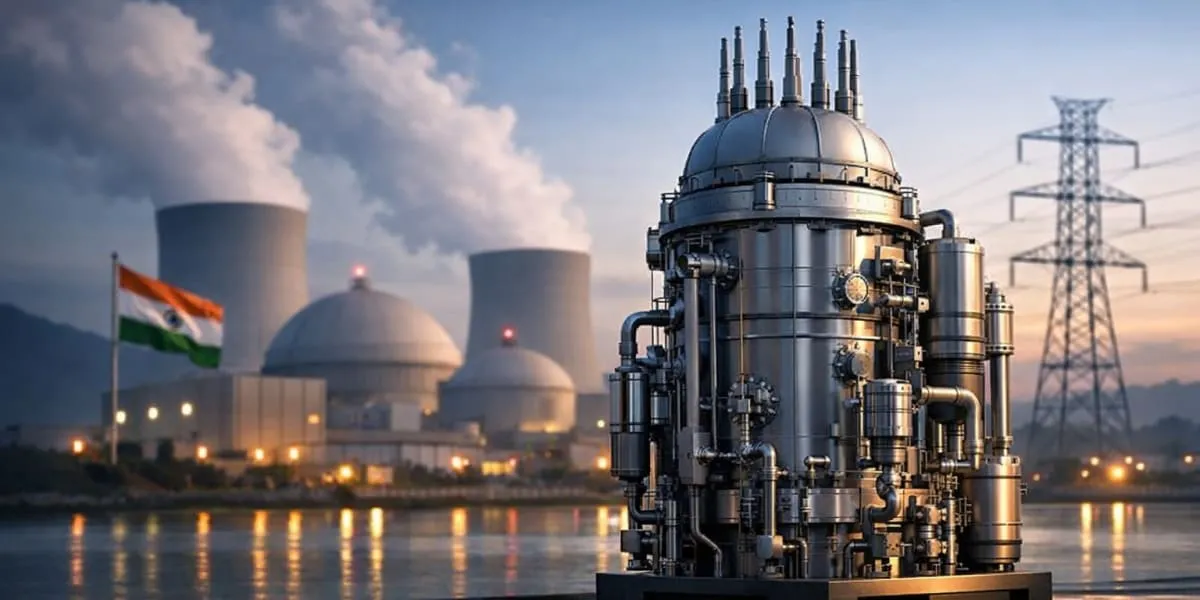
The government aims to bring at least five indigenous small modular nuclear reactors into operation by 2033, the Minister of State in the Department of Atomic Energy said in a written reply to the Lok Sabha. Parliament has enacted the SHANTI Act, 2025, which the minister said opens the nuclear energy sector to private participation. The move is part of a wider Nuclear Energy Mission that seeks to expand capacity over coming decades.

Bhabha Atomic Research Centre is developing a 220 megawatt (MW) Bharat Small Modular Reactor, a 55 MW reactor and a high-temperature gas-cooled reactor intended to produce hydrogen, the minister said. The small modular reactor designs are intended to provide flexible capacity and to support industrial and regional grid needs as they become commercially available. Researchers and agencies are working on licensing and demonstration pathways for the indigenous designs.

The government has drawn up a roadmap to reach 100 gigawatts of nuclear power capacity by 2047 under the mission. According to the roadmap, the present nuclear power capacity of eight point seven eight gigawatts is expected to reach about 22 gigawatts by 2031-32 as projects now at various stages progress to completion. The minister outlined timelines that link progressive plant commissioning to project implementation schedules.

Officials said the plan combines large scale reactors and modular units to meet baseload and distributed needs while enabling private participation and technology development. The SHANTI Act framework is designed to allow new investors to enter the sector under regulatory oversight and to coordinate with research institutions. The government said the initiative aims to accelerate deployment while maintaining safety, regulatory and non-proliferation norms. Regulators will set safety and performance criteria for modular designs before commercial rollout.

The government aims to bring at least five indigenous small modular nuclear reactors into operation by 2033, the Minister of State in the Department of Atomic Energy said in a written reply to the Lok Sabha. Parliament has enacted the SHANTI Act, 2025, which the minister said opens the nuclear energy sector to private participation. The move is part of a wider Nuclear Energy Mission that seeks to expand capacity over coming decades. Bhabha Atomic Research Centre is developing a 220 megawatt (MW) Bharat Small Modular Reactor, a 55 MW reactor and a high-temperature gas-cooled reactor intended to produce hydrogen, the minister said. The small modular reactor designs are intended to provide flexible capacity and to support industrial and regional grid needs as they become commercially available. Researchers and agencies are working on licensing and demonstration pathways for the indigenous designs. The government has drawn up a roadmap to reach 100 gigawatts of nuclear power capacity by 2047 under the mission. According to the roadmap, the present nuclear power capacity of eight point seven eight gigawatts is expected to reach about 22 gigawatts by 2031-32 as projects now at various stages progress to completion. The minister outlined timelines that link progressive plant commissioning to project implementation schedules. Officials said the plan combines large scale reactors and modular units to meet baseload and distributed needs while enabling private participation and technology development. The SHANTI Act framework is designed to allow new investors to enter the sector under regulatory oversight and to coordinate with research institutions. The government said the initiative aims to accelerate deployment while maintaining safety, regulatory and non-proliferation norms. Regulators will set safety and performance criteria for modular designs before commercial rollout.

Next Story
Infrastructure Urban

AI Powered Security Robot To Debut At Puri Station

The East Coast Railway (ECoR) has unveiled an artificial intelligence powered robotic surveillance platform that will be deployed at Puri railway station ahead of Lord Jagannath's Bahuda Yatra on 24 July to enhance passenger safety and security. The platform, named DSC ARJUN, was revealed in the presence of ECoR General Manager Parmeshwar Funkwal and senior railway and Railway Protection Force (RPF) officers. ECoR officials said the system has been introduced as a temporary deployment for the festival and may later be shifted to Bhubaneswar railway station. Developed to support Railway Protect..

Next Story
Infrastructure Urban

India Eases RCMC Rule For Low Value Exports

The Directorate General of Foreign Trade (DGFT) has proposed exempting low value export consignments from the requirement to hold a registration-cum-membership certificate (RCMC), in a move intended to simplify compliance for small exporters. The proposal targets shipments with a free-on-board value of up to Rs 10,000 and seeks to reduce paperwork for first time exporters and micro, small and medium enterprises. The announcement forms part of a wider government effort to encourage exports through online platforms and emerging delivery channels. Under the proposed amendment to Paragraph 2.57 of..

Next Story
Infrastructure Urban

Assam Launches Centre Of Excellence For Additive Manufacturing

The Assam government has inaugurated a Digital Design and additive manufacturing centre of excellence in Guwahati, signalling a push towards technology driven manufacturing across the state. Chief Minister Himanta Biswa Sarma opened the facility and outlined its intended role in fostering innovation, product development and entrepreneurship. The centre will provide industries, startups and researchers with access to advanced digital manufacturing tools and additive manufacturing capabilities. Officials said the facility aims to strengthen the state innovation ecosystem and reduce dependence on..

Advertisement

Subscribe to Our Newsletter

Get daily newsletters around different themes from Construction world.

STAY CONNECTED

Advertisement

Advertisement

Advertisement