+
INOX India LNG Systems Power Indian Railways DEMU Trial
POWER & RENEWABLE ENERGY

INOX India LNG Systems Power Indian Railways DEMU Trial

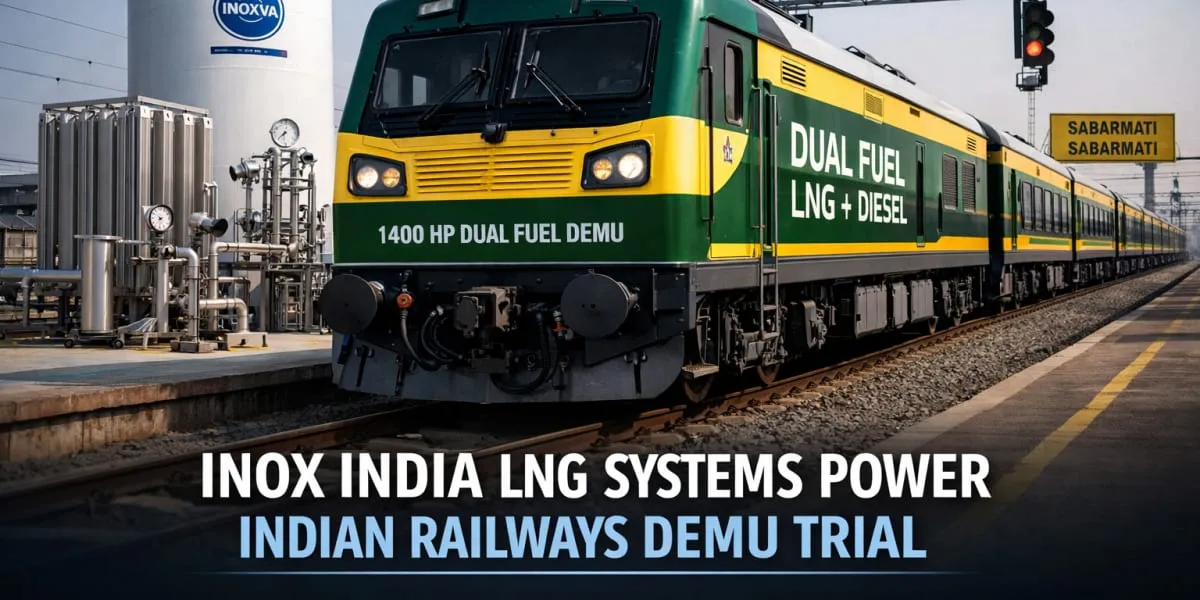
Indian Railways has operationalised the nation’s first Dual-Fuel Diesel Electric Multiple Unit (DEMU) train running on liquefied natural gas (LNG) and diesel at Sabarmati, Ahmedabad, supported by systems supplied by INOX India Limited (INOXCVA). INOXCVA provided advanced 2,200-litre liquefied natural gas receiving, storage and regasification systems integrated with 1,400 HP Driving Power Cars (DPUs) of DEMU trains. The deployment represents a significant milestone in rail decarbonisation in India.

The systems are engineered to enable seamless dual-fuel operation using liquefied natural gas and diesel, supporting substitution of up to 40 per cent of diesel consumption and reducing greenhouse gas emissions. This capability is expected to enhance fuel efficiency and cleaner operations on short- and medium-distance routes where DEMUs are extensively used. The technology thereby advances energy-efficient rail mobility while aligning with national sustainability objectives.

The dual-fuel initiative was developed by the Indian Railways Alternative Fuels Division to convert an initial batch of 10 DPUs from conventional diesel to a hybrid model using liquefied natural gas alongside diesel. INOXCVA had previously delivered two units that underwent trials and certification at the Sabarmati Division, after which Indian Railways prepared to induct additional units under the contract. CLH Gaseous Fuel Applications Pvt. Ltd. conducted the engine conversions from standalone diesel to dual-fuel operation.

INOXCVA is the sole technology provider in India to have delivered, tested and validated cryogenic LNG systems for rail applications and has indicated readiness to supply further units and to support plans to double on-board LNG capacity to enable longer routes. The company, one of the largest manufacturers of cryogenic storage, re-gas and distribution systems, operates in India, Brazil and Europe and serves customers in more than 100 countries with after-sales associates in 25 countries. The supplier views liquefied natural gas as a transition fuel while pursuing research into liquid hydrogen as a future zero-emission option, reinforcing efforts towards energy security and sustainable mobility.

Indian Railways has operationalised the nation’s first Dual-Fuel Diesel Electric Multiple Unit (DEMU) train running on liquefied natural gas (LNG) and diesel at Sabarmati, Ahmedabad, supported by systems supplied by INOX India Limited (INOXCVA). INOXCVA provided advanced 2,200-litre liquefied natural gas receiving, storage and regasification systems integrated with 1,400 HP Driving Power Cars (DPUs) of DEMU trains. The deployment represents a significant milestone in rail decarbonisation in India. The systems are engineered to enable seamless dual-fuel operation using liquefied natural gas and diesel, supporting substitution of up to 40 per cent of diesel consumption and reducing greenhouse gas emissions. This capability is expected to enhance fuel efficiency and cleaner operations on short- and medium-distance routes where DEMUs are extensively used. The technology thereby advances energy-efficient rail mobility while aligning with national sustainability objectives. The dual-fuel initiative was developed by the Indian Railways Alternative Fuels Division to convert an initial batch of 10 DPUs from conventional diesel to a hybrid model using liquefied natural gas alongside diesel. INOXCVA had previously delivered two units that underwent trials and certification at the Sabarmati Division, after which Indian Railways prepared to induct additional units under the contract. CLH Gaseous Fuel Applications Pvt. Ltd. conducted the engine conversions from standalone diesel to dual-fuel operation. INOXCVA is the sole technology provider in India to have delivered, tested and validated cryogenic LNG systems for rail applications and has indicated readiness to supply further units and to support plans to double on-board LNG capacity to enable longer routes. The company, one of the largest manufacturers of cryogenic storage, re-gas and distribution systems, operates in India, Brazil and Europe and serves customers in more than 100 countries with after-sales associates in 25 countries. The supplier views liquefied natural gas as a transition fuel while pursuing research into liquid hydrogen as a future zero-emission option, reinforcing efforts towards energy security and sustainable mobility.

Next Story
Infrastructure Urban

Implementation Status of Jal Jeevan Mission

Since August 2019 the Government has implemented Jal Jeevan Mission to provide assured potable water through household tap connections in rural India. At the start of the mission only 32.3 million (mn) rural households, representing 16.7 per cent, were reported to have tap water connections. States and union territories have reported that 125.8 mn additional rural households have since been provided with tap connections. As a result, of about 193.6 mn rural households roughly 158.2 mn, or 81.71 per cent, are reported to have tap water supply at home.\n\nThe State, district and village level st..

Next Story
Infrastructure Urban

Jal Jeevan Mission Reaches Eighty One Per Cent Rural Coverage

The Government reported substantial progress under the Jal Jeevan Mission, launched in August 2019 to provide tap water to every rural household. At launch only 32.3 million (mn) rural households had tap connections and states and Union territories reported provision of 125.8 mn additional households by March 2026. Consequently, out of about 193.6 mn rural households around 158.2 mn, or 81.71 per cent, are reported to have tap water at home. The Finance Minister announced extension of the mission until 2028 in the 2025-26 budget speech. The Swachh Bharat Mission Grameen, launched in October 20..

Next Story
Infrastructure Urban

Empowering Local Governance for Sustainable Rural Water Supply

The Ministry of Jal Shakti has aligned the Jal Jeevan Mission (JJM) with the 73rd Amendment to strengthen village level planning and community ownership of water supply. Gram Panchayats, village water and sanitation committees and Pani Samitis are to plan, implement, manage and maintain piped water systems, with gram sabha processes formalising handover and oversight. Implementation support agencies including non government organisations, community based organisations and self help groups have been empanelled to train local committees and promote women participation. Under JJM, the department ..

Advertisement

Subscribe to Our Newsletter

Get daily newsletters around different themes from Construction world.

STAY CONNECTED

Advertisement

Advertisement

Advertisement