Kolkata Metro Launches Battery Energy Storage System On Blue Line
POWER & RENEWABLE ENERGY

Kolkata Metro Launches Battery Energy Storage System On Blue Line

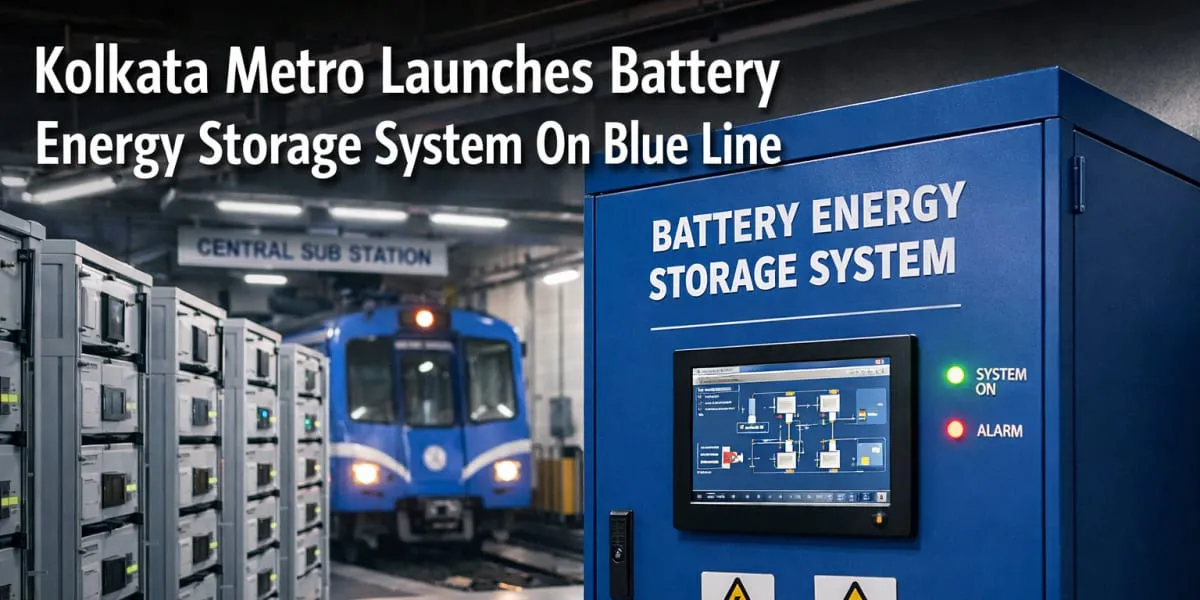
Kolkata Metro has commissioned a Battery Energy Storage System (BESS) on the Blue Line as part of efforts to enhance energy resilience and operational flexibility. The system was installed at the Central sub-station and represents a first implementation of a microgrid at an Indian metro station. Authorities indicated that the deployment follows a successful trial and marks the start of a phased roll-out.

The BESS has a six point four MWh capacity and comprises 88 racks, each fitted with an integrated fire suppression system to improve safety. Engineers noted that the configuration allows the facility to supply auxiliary power and to support regenerative energy flows when coupled with appropriate converters. The installation is intended to reduce reliance on external supply during peak operations and to bolster system reliability. The design includes monitoring systems for real-time performance assessment and remote management.

Officials said the present deployment is an initial phase and that additional power converter components are planned to enable the system to absorb excess regenerative energy when no metro rake is in acceleration mode. The additional converter would improve energy capture from braking and allow stored energy to be redeployed across the network. Project leads emphasised that upgrades would be introduced gradually following performance evaluations.

Delta Electronics India developed the power converter for the project and its managing director highlighted that the BESS can transmit auxiliary power and operate trains along the tunnel section between Dumdum and Mahanayak Uttam Kumar. The company described the deployment as part of its commitment to deliver critical public infrastructure across India. Kolkata Metro officials expect the technology to proliferate across other corridors as part of broader efforts to improve energy efficiency. Officials added that collaboration with industry partners will support scaling and local maintenance capabilities.

Kolkata Metro has commissioned a Battery Energy Storage System (BESS) on the Blue Line as part of efforts to enhance energy resilience and operational flexibility. The system was installed at the Central sub-station and represents a first implementation of a microgrid at an Indian metro station. Authorities indicated that the deployment follows a successful trial and marks the start of a phased roll-out. The BESS has a six point four MWh capacity and comprises 88 racks, each fitted with an integrated fire suppression system to improve safety. Engineers noted that the configuration allows the facility to supply auxiliary power and to support regenerative energy flows when coupled with appropriate converters. The installation is intended to reduce reliance on external supply during peak operations and to bolster system reliability. The design includes monitoring systems for real-time performance assessment and remote management. Officials said the present deployment is an initial phase and that additional power converter components are planned to enable the system to absorb excess regenerative energy when no metro rake is in acceleration mode. The additional converter would improve energy capture from braking and allow stored energy to be redeployed across the network. Project leads emphasised that upgrades would be introduced gradually following performance evaluations. Delta Electronics India developed the power converter for the project and its managing director highlighted that the BESS can transmit auxiliary power and operate trains along the tunnel section between Dumdum and Mahanayak Uttam Kumar. The company described the deployment as part of its commitment to deliver critical public infrastructure across India. Kolkata Metro officials expect the technology to proliferate across other corridors as part of broader efforts to improve energy efficiency. Officials added that collaboration with industry partners will support scaling and local maintenance capabilities.

Next Story
Infrastructure Urban

Jyoti Structures FY26 profit rises 56.5%

Jyoti Structures (JSL) recently reported strong financial results for the quarter and year ended 31 March 2026, driven by disciplined execution, cost management and steady progress across its order book.For Q4 FY2025-26, total income rose 44.2 per cent to Rs 2.41 billion from Rs 1.67 billion in Q4 FY2024-25. EBITDA increased 58.6 per cent to Rs 237 million, while EBITDA margin improved by 89 basis points to 9.84 per cent. Profit before tax grew 53.3 per cent to Rs 188.5 million, and net profit rose 51.9 per cent to Rs 181.4 million.For FY2025-26, total income grew 53.1 per cent to Rs 7.72 bill..

Next Story
Infrastructure Energy

Cat BEPU to Power Doppstadt Separator at IFAT 2026

Caterpillar’s Cat Battery Electric Power Unit (BEPU) has been selected by Doppstadt to power its SWS 6 Spiral Shaft Separator, which will be showcased for the first time at IFAT 2026 in Munich, Germany, from 4–7 May.The compact plug-and-play BEPU is designed to replace a diesel engine within the same space, using the same mounting locations and relative machine position. It integrates the battery, motor, inverter, onboard charging, cooling and controls, enabling OEMs to electrify existing chassis platforms without extensive redesign.Caterpillar and Cat dealer Zeppelin Power Systems have be..

Next Story
Infrastructure Urban

VECV sales rise 6.9% in April 2026

VE Commercial Vehicles, a joint venture between Volvo Group and Eicher Motors, recorded sales of 7,318 units in April 2026, compared to 6,846 units in April 2025, registering 6.9 per cent growth. The total included 7,159 units under the Eicher brand and 159 units under the Volvo brand.Eicher branded trucks and buses reported sales of 7,159 units during the month, up 6.6 per cent from 6,717 units in April 2025. In the domestic commercial vehicle market, Eicher sales rose 8.6 per cent to 6,797 units from 6,257 units a year earlier.Exports declined 21.3 per cent, with VECV recording 362 units in ..

Advertisement

Subscribe to Our Newsletter

Get daily newsletters around different themes from Construction world.

STAY CONNECTED

Advertisement

Advertisement

Advertisement