SHANTI Act To Transform India’s Nuclear Sector
POWER & RENEWABLE ENERGY

SHANTI Act To Transform India’s Nuclear Sector

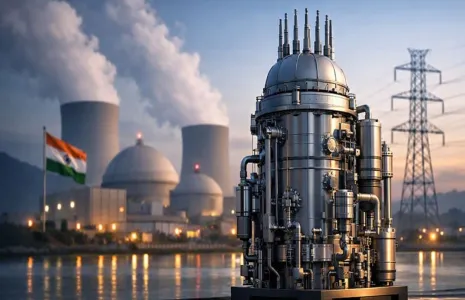
The SHANTI Act, which received Presidential assent in 2025, is designed to accelerate the expansion of nuclear capacity and open the sector to private participation once implementing rules are issued. The present nuclear energy capacity of India stands at eight point seven eight gigawatts (GW) and the new law sets a long term target of 100 gigawatts (GW) by 2047. Applications for licences from private companies, joint ventures and research institutions will be considered only after the rules are formally notified and the parliamentary processes are completed.

The Act repeals the Atomic Energy Act of 1962 and the Civil Liability for Nuclear Damage Act of 2010 and seeks to consolidate regulatory frameworks in support of a clean energy transition. It grants statutory recognition to the Atomic Energy Regulatory Board and is intended to establish clearer oversight and procedures for permitting and safety. The reform is presented as enabling limited private involvement while retaining government control over sensitive fuel cycle activities.

Key provisions aim to allow private parties to build and operate reactors and to engage in activities such as atomic mineral exploration, fuel fabrication and equipment manufacturing under regulatory oversight. Liability norms are being reworked to introduce insurance-backed liability caps with government backstop support beyond a defined threshold and proposals for a Nuclear Liability Fund funded by a levy on electricity tariffs. Sections 84 and 85 set out extensive matters to be addressed in rules, which has contributed to a detailed and time consuming drafting exercise.

Consultations led by NITI Aayog and other agencies have focused on operationalisation, strengthening domestic manufacturing, supply chain resilience and capacity building for a skilled workforce. Multiple 700 megawatts (MW) and 1,000 megawatts (MW) indigenous reactors are under development, with capacity projected to exceed 22 gigawatts (GW) by 2031-32. The government has indicated that private firms will be able to pursue bilateral trade, investment and technology discussions once the Act and its rules are formally in force, and officials have signalled that the notification process will guide the timeline for licence applications.

The SHANTI Act, which received Presidential assent in 2025, is designed to accelerate the expansion of nuclear capacity and open the sector to private participation once implementing rules are issued. The present nuclear energy capacity of India stands at eight point seven eight gigawatts (GW) and the new law sets a long term target of 100 gigawatts (GW) by 2047. Applications for licences from private companies, joint ventures and research institutions will be considered only after the rules are formally notified and the parliamentary processes are completed. The Act repeals the Atomic Energy Act of 1962 and the Civil Liability for Nuclear Damage Act of 2010 and seeks to consolidate regulatory frameworks in support of a clean energy transition. It grants statutory recognition to the Atomic Energy Regulatory Board and is intended to establish clearer oversight and procedures for permitting and safety. The reform is presented as enabling limited private involvement while retaining government control over sensitive fuel cycle activities. Key provisions aim to allow private parties to build and operate reactors and to engage in activities such as atomic mineral exploration, fuel fabrication and equipment manufacturing under regulatory oversight. Liability norms are being reworked to introduce insurance-backed liability caps with government backstop support beyond a defined threshold and proposals for a Nuclear Liability Fund funded by a levy on electricity tariffs. Sections 84 and 85 set out extensive matters to be addressed in rules, which has contributed to a detailed and time consuming drafting exercise. Consultations led by NITI Aayog and other agencies have focused on operationalisation, strengthening domestic manufacturing, supply chain resilience and capacity building for a skilled workforce. Multiple 700 megawatts (MW) and 1,000 megawatts (MW) indigenous reactors are under development, with capacity projected to exceed 22 gigawatts (GW) by 2031-32. The government has indicated that private firms will be able to pursue bilateral trade, investment and technology discussions once the Act and its rules are formally in force, and officials have signalled that the notification process will guide the timeline for licence applications.

Next Story
Infrastructure Transport

Government Plans Rs 450 bn Rail Investment Along Borders

The government plans to invest Rs 450 bn to upgrade railways along borders with China, Pakistan and Bangladesh, the press release said. The programme will run over 18 to 24 months and will finance new tracks, platforms and network strengthening across Punjab, West Bengal, Himachal Pradesh, Rajasthan, Assam and several northeastern states. That is about $4.7 bn. Officials indicated the initiative represents nearly 22 per cent of all railway infrastructure outlay planned over the next two years and is among the most significant strategic infrastructure pushes in recent years. The plan extends be..

Next Story
Infrastructure Transport

Indian Railways Approves Daily Express Between Mumbai CSMT And Sawantwadi Road

Indian Railways has approved a new daily express service between Chhatrapati Shivaji Maharaj Terminus (CSMT), Mumbai, and Sawantwadi Road to boost rail connectivity across Maharashtra and the Konkan region. The service will operate over a 510-km route and will run daily as Train No. 15087 CSMT–Sawantwadi Road Express and Train No. 15088 Sawantwadi Road–CSMT Express. It is intended to provide direct and reliable rail connectivity for passengers travelling for tourism, education, employment and business. The Ministry of Railways said the move forms part of ongoing efforts to expand passenger..

Next Story
Infrastructure Urban

SECR Invites Rs 4550.2 mn EPC Tender For Chhattisgarh Line

South East Central Railway (SECR) has invited bids for an engineering, procurement and construction (EPC) contract worth Rs 4550.2 mn for a section of the Dallirajhara-Rowghat-Jagdalpur New Railway Line in Chhattisgarh. The contract covers a nearly 30 km stretch between Kurkanar and Bhanpuri and forms part of the larger corridor linking the mineral-rich Bastar region with the state rail network. The authority has positioned the package as a key link to improve passenger and freight movement within the region. Tender documents carry tender number CAO-C-BSP-26-27-14 and an earnest money deposit ..

Advertisement

Subscribe to Our Newsletter

Get daily newsletters around different themes from Construction world.

STAY CONNECTED

Advertisement

Advertisement

Advertisement