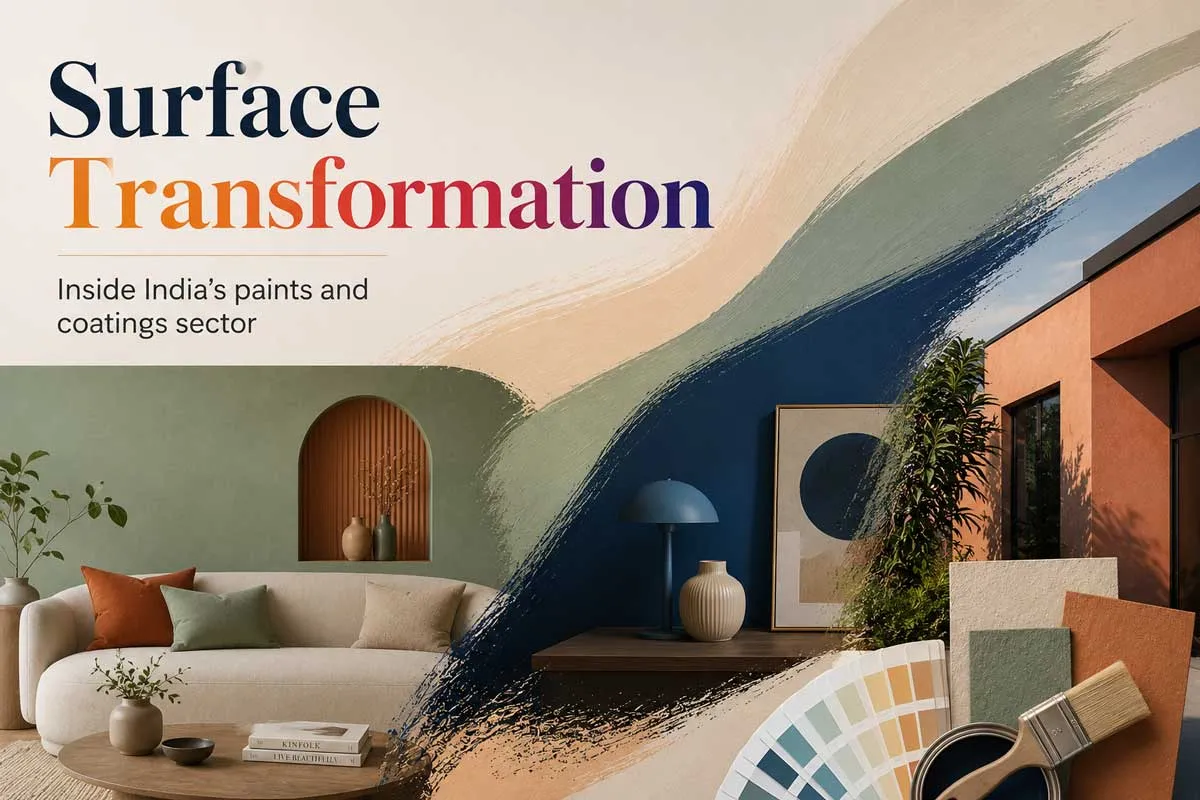
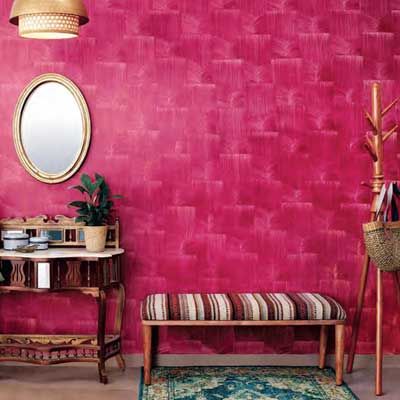
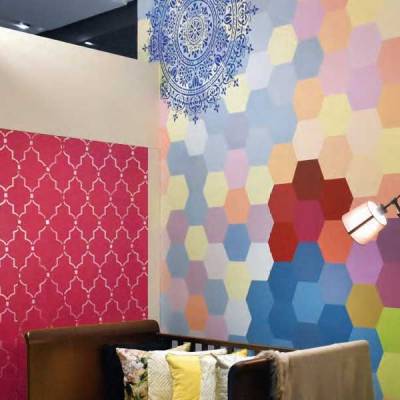
From being a way to add colour and décor to interior spaces, paints have transformed into a means to introduce a variety of finishes to enhance the spatial experience. Alongside paints, coatings, best known for protecting built spaces from water leakages, have undergone a fundamental shift to play an additional role in extending the life of high-end wall and furniture finishes. Describing this transition, Swathy S, CEO / Principal Architect, Storeyboard Design, says, “Paint is no longer a superficial layer but functions as a critical interface between material, environment and user interaction, influencing durability, maintenance cycles and spatial perception.”Trending productsIn the decorative paints category, Anupam Singh, Founder, AapkaPainter, says three clear shifts are visible on the ground. “Washability and antimicrobial performance are now baseline expectations across the residential, healthcare and education segments. Texture finishes such as Royale Play, Berger Silk Glamor and Nippon Momento are steadily replacing wallpaper, especially on accent walls, driven by better repairability and longer lifecycle. Low-VOC and indoor air quality compliance is increasingly shaping corporate fit-out specifications, particularly for IT and BFSI clients with ESG commitments.”In the surface protective coatings category, Singh says clients are evaluating solutions for their five to 10-year durability rather than just their initial cost; essentially, they are prioritising lifecycle cost over upfront cost. Further, with growing awareness that water ingress impacts structural integrity, crack treatment, joint sealing and waterproofing are increasingly treated as an integrated scope. And compared to traditional cementitious coatings, elastomeric systems are gaining preference owing to superior flexibility, crack-bridging ability and UV resistance, especially for exposed terraces.“The future of paints,” according to Swathy, “lies in system thinking rather than product selection, where coatings are specified not just for aesthetics, but for performance, longevity and environmental responsibility.”In this new paradigm, the role of designers is to bridge material science and spatial intent, ensuring that every surface is not only seen, but engineered.Premium Applications From Metallic to Stencil TextureAt Anayasa, a residence, a premium metallic paint system from Colour Coats – chosen for its fine pigment quality and smooth, non-gaudy finish – on select feature walls brings depth and a subtle visual richness, a surface that reflects ambient lighting, adding movement without relying on heavy materials, shares Amit Porwal, Founder, Icon Projects In-Space.“Metallic paints work well within neutral and minimal palettes, and have a seamless finish compared to cladding materials,” he continues. “Just that they are slightly more expensive than regular paint systems; application-sensitive; and can show roller or brush marks. Therefore, they need careful application for a consistent finish across large wall expanses and require perfect base surface preparation.”In premium applications, Swathy has specified ICA texture finishes to achieve high-fidelity material emulation with performance integrity. For a lift lobby wall where the requirement was “a visually rich yet resilient surface that does not easily show stains or wear”, she chose a Moonstone effect for its high-touch, high-traffic zone resistance.For a bedroom wall panel, a steel effect enabled a metallic expression through a coating system, delivering warmth and subtlety that actual metal surfaces often lack in residential contexts.“ICA systems are highly execution-sensitive, requiring trained applicators, controlled site conditions and multi-layer application protocols,” opines Swathy. “Touch-ups are inherently difficult, often necessitating full-panel rework. Additionally, certain finishes are substrate-restrictive, performing best on prepared wood or MDF surfaces rather than directly on masonry walls.”She has used Luxture stencil texture paint for feature applications, to translate graphic intent into a tactile surface system. It allows for controlled patterning with depth, creating a hybrid between art and finish. However, she cautions that substrate preparation becomes critical with a build thickness of approximately 4-5 mm. Any inconsistency can lead to delamination or peeling, often requiring complete surface redo. The system is also labour-intensive and precision-driven.Paints that Mimic Concrete TextureA dining room from the Komal Sachdev Designer + Planner (KSDP) project House of Arches features a panel blending concrete texture from Stonelite and Creativa Metallica by ICA. “The idea was to create something where different textures and finishes are married together,” explains Komal Sachdev, Founder and Principal Designer, KSDP.“We chose Creativa Metallica by ICA because it easily replicates metal, and is amendable to various possibilities,” she says. Real concrete textures are vulnerable to cracking owing to repeated expansion and contraction caused by temperature fluctuation. Moreover, concrete texture has limitations when such cracks occur as the entire wall or panel needs to be redone. Sachdev says this issue can be worked round by using a wall paint like Stonelite, as any unsightliness can be easily rectified by touch-ups.Swathy chose Asian Paints concrete textures for larger, continuous surfaces like a meeting room for its seamless, monolithic character and enhanced abrasion resistance. Its multi-layer build-up provides durability while masking minor substrate imperfections. However, she cautions, “Execution variability can result in patchiness and tonal inconsistencies, particularly across expansive surfaces, making applicator skill and process control critical.”Multiple Paint Finishes for Cost-Effective AestheticsIn a store of MyTruso, a jewellery brand, conceptualised around ‘The Haveli Courtyard’, Juhi Santani, Director & Creative Head, Retale Design, used texture paint as a key differentiating element within the design.Paint finishes play a key role in this project because the colour palette is almost monochromatic, calm and subtle, she explains. “Various finishes – matte, textured and pearl satin – bring subtle variations to the experience.”To stay aligned with the inspiration drawn from Jaipur’s historic havelis, the Nilaya pearl finish texture was chosen for its soft, refined surface quality. Rather than becoming a dominant visual feature, the finish introduces subtle depth and gentle luminosity to the walls, creating a backdrop that feels both elegant and understated.“Adding richness without making the space visually heavy makes the neutral colours feel warmer,” says Santani.Compared to many premium wall finishes, this choice delivers a good balance between cost and aesthetic value, making it suitable for budget-conscious projects. Especially in boutique retail environments, the finish can create a richer environment while allowing the product to remain the primary focus. Further, the availability of multiple colour options makes it easier to align the finish with different design concepts.A key challenge in such projects is achieving the exact same shade from one store to another. Even with the same specification of Asian Paints, Santani says slight variations can occur between batches. Colours can appear different onsite owing to natural light, artificial lighting and humidity. Skilled appliers are essential. Also, after prolonged use, the finish shows scratches and abrasion, mostly in customer interaction zones, making it inappropriate for food and beverage projects with open kitchens.CW Lens:Both decorative paints and protective coatings have stepped up. Decorative paints now mimic metal, concrete and high-end embossed wallpaper. Coatings which used to be about waterproofing are now protecting furniture and wall paint. Essentially, paints and coatings are no longer a superficial layer but function as a critical interface between material, environment and user interaction, influencing durability, maintenance cycles and spatial perception. Their cost-effectiveness while delivering high performance goes in their favour.- Charu Bahri