+
Signature Global Signs Rs 380 Cr Pact for Seismic Safety Tech
Real Estate

Signature Global Signs Rs 380 Cr Pact for Seismic Safety Tech

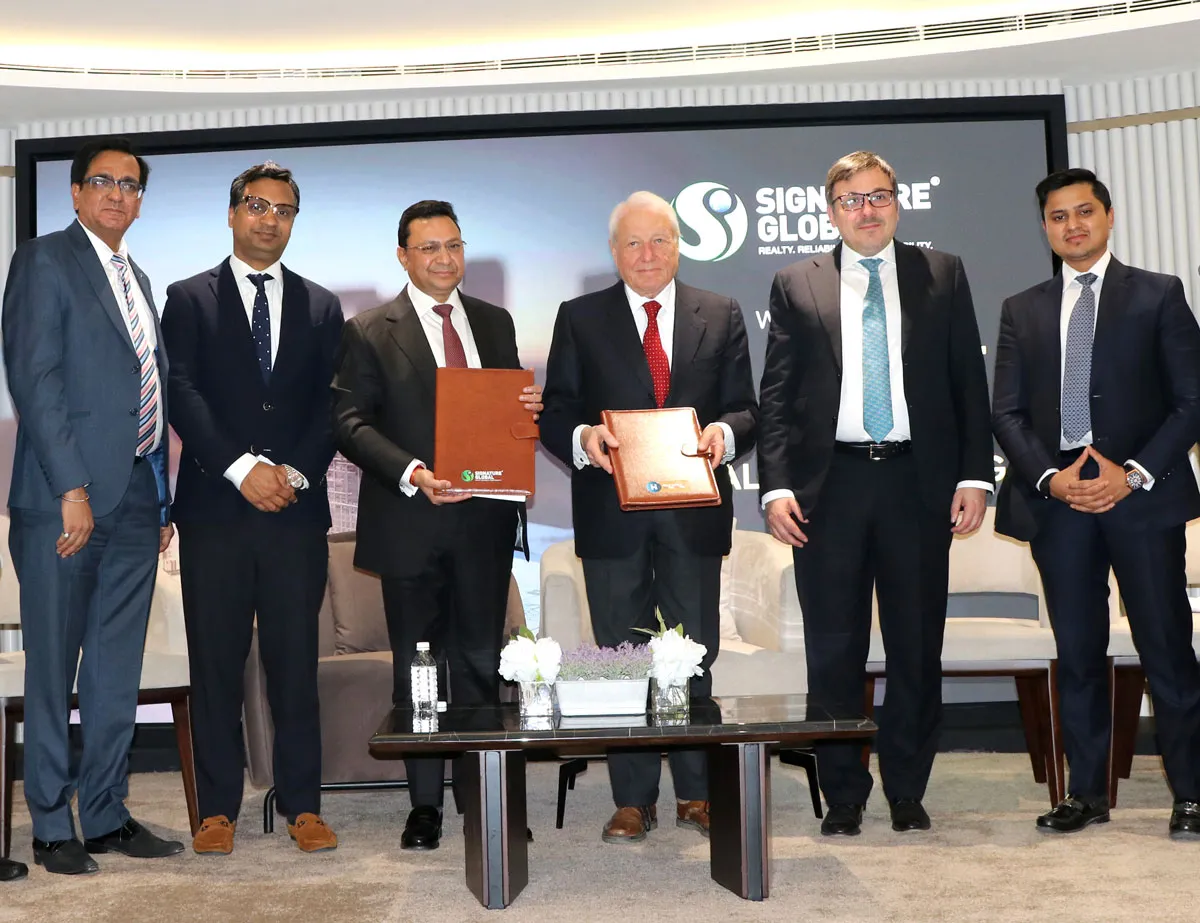
Signature Global has signed a Rs 3.8 billion memorandum of understanding with Indo-Italian joint venture CECO Hirun to implement advanced earthquake-resistance technology across its projects over the next 15 years. The initiative is aimed at strengthening structural safety and occupant comfort in high-rise developments, particularly in seismic-prone regions such as Delhi-NCR, which falls under Seismic Zone IV.
As Indian cities continue to grow vertically, buildings are increasingly exposed to dynamic forces including seismic activity, strong winds and temperature variations. To address these challenges, Signature Global will integrate Hysteretic Tuned Mass Dampers (HTMDs), a specialised vibration-control system designed to reduce building movement caused by wind and earthquakes. Unlike conventional damping solutions, HTMDs remain effective under varying seismic and wind conditions, making them suitable for tall structures.
Under the MoU, CECO Hirun will design customised HTMD systems for Signature Global’s high-rise projects. The programme will be executed in India through an end-to-end process covering design evaluation, industrial manufacturing and on-site deployment.
Commenting on the collaboration, Lalit Aggarwal, Co-Founder and Vice Chairman, Signature Global (India) Ltd, said, “Today marks an important milestone for Signature Global as we introduce advanced earthquake-resistance and vibration-control technology across our high-rise projects. As India’s cities grow taller, the responsibility to ensure safety, comfort, and long-term value for residents becomes even more critical. Our collaboration with CECO Hirun combines global expertise with deep understanding of local construction practices, enabling technically robust systems that integrate seamlessly into our building designs.”
He added, “At Signature Global, we believe high-rise living should never compromise safety, comfort, or resilience. This initiative reflects our vision of creating future-ready homes that residents can trust, setting new benchmarks in innovation and quality for India’s urban landscape.”
Dr Agostino Marioni, Chairman, CECO Hirun India, said, “We are delighted to partner with Signature Global to deploy advanced vibration-control technology across their high-rise developments. This initiative reflects our shared commitment to engineering excellence and innovation, setting new benchmarks for resilient, future-ready infrastructure in India.”
The integration of HTMD technology is expected to enhance earthquake resilience by reducing wind sway and seismic impact, while protecting critical interior systems such as elevators, partitions and walls from vibration-related damage, reinforcing Signature Global’s focus on safe and future-ready high-rise living.

Signature Global has signed a Rs 3.8 billion memorandum of understanding with Indo-Italian joint venture CECO Hirun to implement advanced earthquake-resistance technology across its projects over the next 15 years. The initiative is aimed at strengthening structural safety and occupant comfort in high-rise developments, particularly in seismic-prone regions such as Delhi-NCR, which falls under Seismic Zone IV.As Indian cities continue to grow vertically, buildings are increasingly exposed to dynamic forces including seismic activity, strong winds and temperature variations. To address these challenges, Signature Global will integrate Hysteretic Tuned Mass Dampers (HTMDs), a specialised vibration-control system designed to reduce building movement caused by wind and earthquakes. Unlike conventional damping solutions, HTMDs remain effective under varying seismic and wind conditions, making them suitable for tall structures.Under the MoU, CECO Hirun will design customised HTMD systems for Signature Global’s high-rise projects. The programme will be executed in India through an end-to-end process covering design evaluation, industrial manufacturing and on-site deployment.Commenting on the collaboration, Lalit Aggarwal, Co-Founder and Vice Chairman, Signature Global (India) Ltd, said, “Today marks an important milestone for Signature Global as we introduce advanced earthquake-resistance and vibration-control technology across our high-rise projects. As India’s cities grow taller, the responsibility to ensure safety, comfort, and long-term value for residents becomes even more critical. Our collaboration with CECO Hirun combines global expertise with deep understanding of local construction practices, enabling technically robust systems that integrate seamlessly into our building designs.”He added, “At Signature Global, we believe high-rise living should never compromise safety, comfort, or resilience. This initiative reflects our vision of creating future-ready homes that residents can trust, setting new benchmarks in innovation and quality for India’s urban landscape.”Dr Agostino Marioni, Chairman, CECO Hirun India, said, “We are delighted to partner with Signature Global to deploy advanced vibration-control technology across their high-rise developments. This initiative reflects our shared commitment to engineering excellence and innovation, setting new benchmarks for resilient, future-ready infrastructure in India.”The integration of HTMD technology is expected to enhance earthquake resilience by reducing wind sway and seismic impact, while protecting critical interior systems such as elevators, partitions and walls from vibration-related damage, reinforcing Signature Global’s focus on safe and future-ready high-rise living.

Next Story
Infrastructure Transport

Second Mountain Tunnel Breakthrough in Palghar Advances High Speed Rail

The Mumbai-Ahmedabad high speed rail (MAHSR) project reached a milestone with the breakthrough of a mountain tunnel in Palghar, Maharashtra. Mountain tunnel MT-six measures 454 metres long and 14.4 metres wide and will accommodate up and down tracks. The breakthrough follows MT-five near Saphale on second January 2026 and the MT-six excavation was completed from both ends using the New Austrian Tunnelling Method. The ministry reported that the tunnelling was completed within 12 months. The New Austrian Tunnelling Method is favoured for its flexibility in complex geology and irregular tunnel s..

Next Story
Infrastructure Transport

Modi Government Pushes Atmanirbhar Container Drive With BCSL MoU

The Union Government advanced a plan to create an integrated, domestically anchored container ecosystem with the signing of a Memorandum of Understanding to establish the Bharat Container Shipping Line (BCSL). The MoU was signed by key agencies including the Shipping Corporation of India and Container Corporation of India alongside major port authorities and Sagarmala Finance Corporation Limited under the Ministry of Ports, Shipping and Waterways, in the presence of senior ministers. The initiative aligns with the Container Manufacturing Assistance Scheme announced in the Union Budget 2026–2..

Next Story
Infrastructure Urban

Ministry Reports Gains In Mobility For Marginalised Communities

The Ministry of Social Justice and Empowerment is implementing skill development, education and rehabilitation schemes to promote socio-economic mobility and sustainable livelihoods for marginalised and disadvantaged communities across the country. Programmes target Scheduled Castes, Other Backward Classes, Economically Weaker Sections, De-notified Tribes and Safai Karamcharis through specialised implementing corporations and empanelled training institutes. Pradhan Mantri Dakshata Aur Kushalta Sampann Hitgrahi Yojana, or PM-DAKSH, provided skill training and placement support through the Nati..

Advertisement

Subscribe to Our Newsletter

Get daily newsletters around different themes from Construction world.

STAY CONNECTED

Advertisement

Advertisement

Advertisement

Open In App