
Mumbai gets Rs 200 billion projects
ECONOMY & POLICY

Mumbai gets Rs 200 billion projects

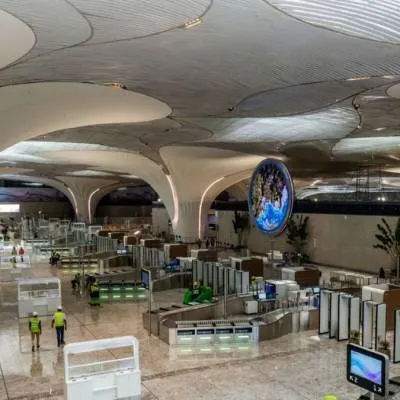
Prime Minister Narendra Modi recently initiated for India’s financial capital, projects worth Rs 200 billion. These projects have been initiated in line with the ‘Mumbai in Minutes’ vision. The projects reportedly include new metro lines, Metro Bhavan and new facilities at metro stations that are expected to give a new dimension to Mumbai and make it convenient for city residents. Reportedly, Rs 200 billion have been initiated in Mumbai while Rs 1.5 trillion has already been invested in Mumbai Metro.

The three metro lines, for which the foundation stone was laid, will together add more than 42-km to the metro network of Mumbai. The three corridors are: the 9.2-km Gaimukh-Shivaji Chowk (Mira Road) Metro-10 Corridor, the 12.7-km Wadala-CST Metro-11 Corridor; and the 20.7-km-long Kalyan-Taloja Metro-12 Corridor.
The state-of-the-art Metro Bhavan will be a 32-storey centre that will operate and control 14 metro lines measuring around 340 km.

Further, the Bandongri Metro Station at Kandivali East was also inaugurated; along with a state-of-the-art metro coach – the first metro coach under the government’s Make in India initiative.

In line with the ‘Mumbai in Minutes’ goal, a vision document has been released to provide better infrastructure for the Mumbai Metropolitan Region (MMR). As reported, the document explains how to make the best use of various modes of transport. A master plan has also been made for Mumbai Metro, which is expected to see a significant expansion in the coming years.

With Mumbai’s current metro network at 11 km, the city is expected to witness a network of 325 km by 2023-24. Further, the metro projects are expected to create job opportunities for about 10,000 engineers and 40,000 skilled and unskilled workers.

Prime Minister Narendra Modi recently initiated for India’s financial capital, projects worth Rs 200 billion. These projects have been initiated in line with the ‘Mumbai in Minutes’ vision. The projects reportedly include new metro lines, Metro Bhavan and new facilities at metro stations that are expected to give a new dimension to Mumbai and make it convenient for city residents. Reportedly, Rs 200 billion have been initiated in Mumbai while Rs 1.5 trillion has already been invested in Mumbai Metro.The three metro lines, for which the foundation stone was laid, will together add more than 42-km to the metro network of Mumbai. The three corridors are: the 9.2-km Gaimukh-Shivaji Chowk (Mira Road) Metro-10 Corridor, the 12.7-km Wadala-CST Metro-11 Corridor; and the 20.7-km-long Kalyan-Taloja Metro-12 Corridor.The state-of-the-art Metro Bhavan will be a 32-storey centre that will operate and control 14 metro lines measuring around 340 km.Further, the Bandongri Metro Station at Kandivali East was also inaugurated; along with a state-of-the-art metro coach – the first metro coach under the government’s Make in India initiative.In line with the ‘Mumbai in Minutes’ goal, a vision document has been released to provide better infrastructure for the Mumbai Metropolitan Region (MMR). As reported, the document explains how to make the best use of various modes of transport. A master plan has also been made for Mumbai Metro, which is expected to see a significant expansion in the coming years.With Mumbai’s current metro network at 11 km, the city is expected to witness a network of 325 km by 2023-24. Further, the metro projects are expected to create job opportunities for about 10,000 engineers and 40,000 skilled and unskilled workers.

Related Stories

Gold Stories
Next Story
Real Estate

A Concrete Statement in Jubilee Hills

The Jubilee Hills residence is an exploration of structure as architecture, where mathematical precision, exposed concrete, and engineering discipline come together to create a bold and enduring built form.Constructed with Blushfarbe, HAACE’s bespoke concrete finish, the project demanded exceptional control, as every visible structural element was also required to perform as the final architectural surface. Deep reinforced concrete roof frames extend into the vertical façade, while precision-cast fluted surfaces, rhythmic vertical fins, circular columns, and a cantilevered staircase create ..

Next Story
Infrastructure Energy

Hindustan Zinc raises renewable power share to 22 per cent

Hindustan Zinc has increased the share of renewable energy in its overall power consumption to 22 per cent, up from around 18 per cent in FY26, as it advances towards sourcing 70 per cent of its power requirements from renewable sources by FY28.During FY26, the company generated 892 million units of green power, up from 632 million units in FY25. It has also expanded its round-the-clock renewable power arrangement with Serentica Renewables from 450 MW to 530 MW to support the transition.Hindustan Zinc is strengthening its renewable energy portfolio through solar, wind and energy storage soluti..

Next Story
Resources

Crompton unveils new brand identity and super-premium platform

Crompton Greaves Consumer Electricals Ltd. has unveiled a new master brand identity as part of its Crompton 2.0 transformation, alongside the launch of its super-premium brand Crompton Rhion and the strengthening of its Energion platform.The refreshed identity introduces Cephyr, a new emblem inspired by sapphire and Zephyrus, the Greek wind, representing Crompton’s evolution towards a design-led, consumer-centric brand. The new brand promise, ‘Amazing, Every Day’, is supported by a new sonic identity that will be rolled out across advertising, digital platforms, products and retail envir..

Advertisement

Subscribe to Our Newsletter

Get daily newsletters around different themes from Construction world.

STAY CONNECTED

Advertisement