Guwahati Integrated Terminal Begins Commercial Operations
ECONOMY & POLICY

Guwahati Integrated Terminal Begins Commercial Operations

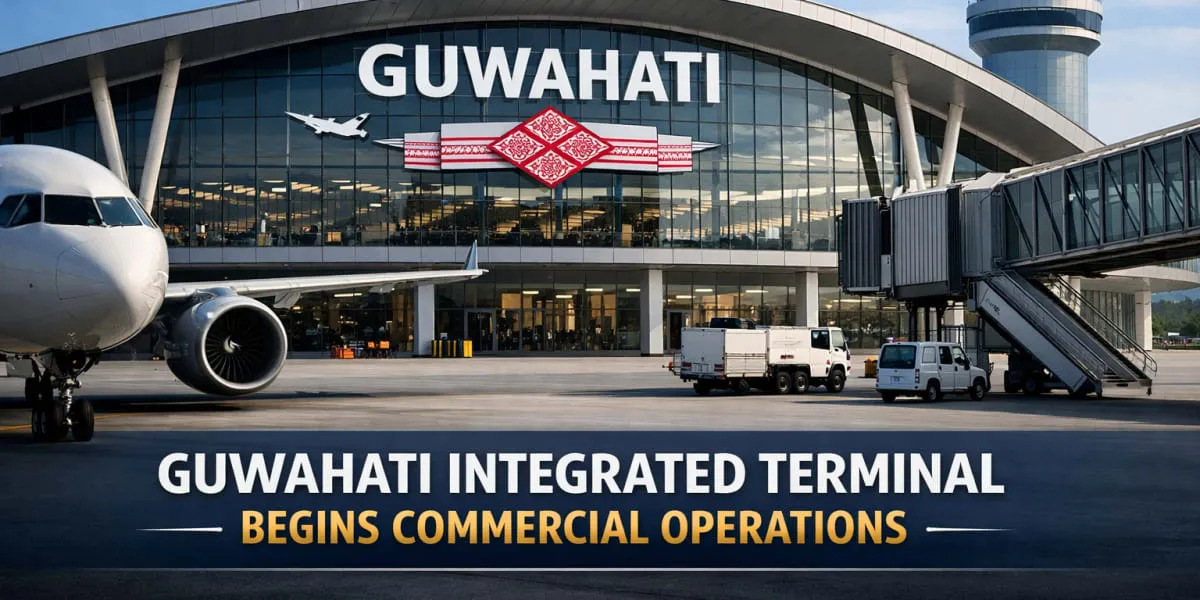
Assam Chief Minister Himanta Biswa Sarma announced that the new integrated terminal at Lokapriya Gopinath Bordoloi International Airport (LGBI Airport) in Guwahati commenced commercial operations today, marking a significant addition to the state's aviation infrastructure. He said that the terminal had been constructed with local participation and was intended to strengthen Assam's role as a gateway to the north eastern region and beyond. The announcement followed the sharing of visuals depicting the new terminal and its passenger amenities.

Officials indicated that the integrated terminal would substantially enhance passenger handling capacity and improve overall operational efficiency in response to rising air traffic in the region. They said the layout and systems had been designed to streamline flows, reduce dwell times and provide modern passenger facilities, including expanded check in and baggage handling provisions. Authorities expected a phased operational ramp up to ensure service standards and safety protocols.

Lokapriya Gopinath Bordoloi International Airport serves as the primary aviation gateway to the north eastern region, linking Guwahati with major Indian cities and selected international destinations. Policymakers suggested that the upgraded terminal would support tourism, trade and investment by offering improved connections and a better passenger experience. Stakeholders in the travel and hospitality sectors anticipated positive downstream effects on regional commerce and employment.

The state administration framed the terminal opening as part of a broader push to bolster infrastructure and connectivity across the region, with attention to multimodal links and last mile access. Officials said that coordination with airport operators and civil aviation authorities would continue to manage capacity and scheduling. Observers noted that the development could encourage additional airline services and frequency increases as demand strengthens.

Assam Chief Minister Himanta Biswa Sarma announced that the new integrated terminal at Lokapriya Gopinath Bordoloi International Airport (LGBI Airport) in Guwahati commenced commercial operations today, marking a significant addition to the state's aviation infrastructure. He said that the terminal had been constructed with local participation and was intended to strengthen Assam's role as a gateway to the north eastern region and beyond. The announcement followed the sharing of visuals depicting the new terminal and its passenger amenities. Officials indicated that the integrated terminal would substantially enhance passenger handling capacity and improve overall operational efficiency in response to rising air traffic in the region. They said the layout and systems had been designed to streamline flows, reduce dwell times and provide modern passenger facilities, including expanded check in and baggage handling provisions. Authorities expected a phased operational ramp up to ensure service standards and safety protocols. Lokapriya Gopinath Bordoloi International Airport serves as the primary aviation gateway to the north eastern region, linking Guwahati with major Indian cities and selected international destinations. Policymakers suggested that the upgraded terminal would support tourism, trade and investment by offering improved connections and a better passenger experience. Stakeholders in the travel and hospitality sectors anticipated positive downstream effects on regional commerce and employment. The state administration framed the terminal opening as part of a broader push to bolster infrastructure and connectivity across the region, with attention to multimodal links and last mile access. Officials said that coordination with airport operators and civil aviation authorities would continue to manage capacity and scheduling. Observers noted that the development could encourage additional airline services and frequency increases as demand strengthens.

Next Story
Infrastructure Transport

Sector 51-52 Metro skywalk in Noida remains shut despite being ready for over a year

Thousands of commuters travelling between Delhi Metro Rail Corporation’s (DMRC) Sector 52 station and Noida Metro Rail Corporation’s (NMRC) Sector 51 station continue to face daily inconvenience as the 300-metre air-conditioned skywalk connecting the two stations remains closed, despite being completed over a year ago, according to a report.The Noida Metro Rail Corporation built the foot overbridge to enable a seamless interchange between the Delhi Metro and Noida Metro networks. However, pending finishing work and a structural obstruction have delayed its opening.Krishna Karunesh, Chief E..

Next Story
Infrastructure Transport

Maharashtra clears Metro Line 5A, expansion of Mumbai Metro Line 5

The Maharashtra government has approved the expansion of Mumbai Metro Line 5 along with a new integrated corridor, Metro Line 5A, forming a combined 34.2-km metro network across the Thane-Bhiwandi-Kalyan-Ulhasnagar belt. The integrated project has been cleared at an estimated cost of ₹18,130.55 crore, according to a government resolution (GR).Metro Line 5 was originally approved in October 2017 as a 24.9-km fully elevated corridor with 17 stations connecting Thane, Bhiwandi and Kalyan, with an initial project cost of ₹8,416.51 crore. The corridor is being developed in two phases.The first ..

Next Story
Infrastructure Transport

Bengaluru Metro expansion seen driving office demand

Bengaluru’s expanding metro network is expected to emerge as a major catalyst for real estate growth, with the Yellow and Pink Lines likely to boost both office demand and residential prices across key micro-markets, according to a report by Colliers India.The report estimates that over the next two years, Bengaluru could witness an additional 5–7 million sq ft of Grade A office space demand across the Central Business District (CBD), Secondary Business District (SBD) and Electronic City. Improved metro connectivity and reduced commute times are expected to drive higher occupier interest a..

Advertisement

Subscribe to Our Newsletter

Get daily newsletters around different themes from Construction world.

STAY CONNECTED

Advertisement

Advertisement

Advertisement