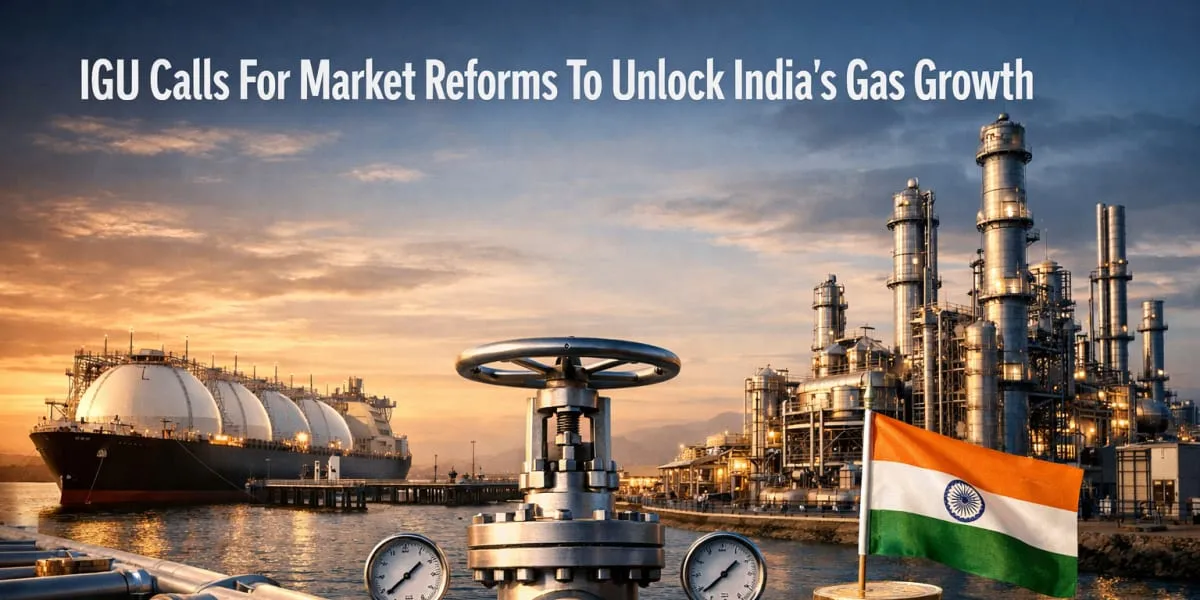
IGU Calls For Market Reforms To Unlock India’s Gas Growth
ECONOMY & POLICY

IGU Calls For Market Reforms To Unlock India’s Gas Growth

The International Gas Union report said India’s long-term natural gas growth will depend on expanding liquefied natural gas import capacity and accelerating investment in transmission and distribution infrastructure, gas-intensive industries and reforms to market design, regulation and pricing. The analysis urged policy changes to support sustained demand growth rather than relying solely on import terminals. It recommended a coordinated approach across public and private stakeholders to unlock the next phase of gas deployment.

While regasification terminal capacity has been significantly expanded, investment in midstream infrastructure has lagged and constrained the ability to raise gas consumption. The report argued that reforms to pricing mechanisms and market access are essential to support sustained growth in gas demand. It noted that the Strait of Hormuz crisis underlined import dependencies and that India is heavily reliant on Gulf-sourced liquefied petroleum gas and liquefied natural gas, with Qatari exports a primary source.

The analysis said domestic gas output meets around 50 to 52 per cent of the country’s demand, with the balance met through LNG imports from Qatar, Australia, the US and Russia. LPG dependence is higher, with imports covering around 60 to 65 per cent of requirements despite India’s large consumption. Disruption to transit through the Strait of Hormuz during the recent Iran war exposed this vulnerability and the report said prospects could improve if the Gulf crisis eases and new export capacity comes online later in the decade.

The report said India must enable buyers to respond to short-term LNG price opportunities by liberalising terminal bookings and system entry charges and improving access. It warned gas will struggle to compete with coal without significant transmission expansion and competitive transport tariffs to supply the north, east and centre. The analysis added that meaningful investment is unlikely without wholesale price reform after the shift to hub-linked pricing in 2015 and the 2022 link to oil, with domestic prices remaining above USD seven per million British thermal units.

The International Gas Union report said India’s long-term natural gas growth will depend on expanding liquefied natural gas import capacity and accelerating investment in transmission and distribution infrastructure, gas-intensive industries and reforms to market design, regulation and pricing. The analysis urged policy changes to support sustained demand growth rather than relying solely on import terminals. It recommended a coordinated approach across public and private stakeholders to unlock the next phase of gas deployment. While regasification terminal capacity has been significantly expanded, investment in midstream infrastructure has lagged and constrained the ability to raise gas consumption. The report argued that reforms to pricing mechanisms and market access are essential to support sustained growth in gas demand. It noted that the Strait of Hormuz crisis underlined import dependencies and that India is heavily reliant on Gulf-sourced liquefied petroleum gas and liquefied natural gas, with Qatari exports a primary source. The analysis said domestic gas output meets around 50 to 52 per cent of the country’s demand, with the balance met through LNG imports from Qatar, Australia, the US and Russia. LPG dependence is higher, with imports covering around 60 to 65 per cent of requirements despite India’s large consumption. Disruption to transit through the Strait of Hormuz during the recent Iran war exposed this vulnerability and the report said prospects could improve if the Gulf crisis eases and new export capacity comes online later in the decade. The report said India must enable buyers to respond to short-term LNG price opportunities by liberalising terminal bookings and system entry charges and improving access. It warned gas will struggle to compete with coal without significant transmission expansion and competitive transport tariffs to supply the north, east and centre. The analysis added that meaningful investment is unlikely without wholesale price reform after the shift to hub-linked pricing in 2015 and the 2022 link to oil, with domestic prices remaining above USD seven per million British thermal units.

Next Story
Infrastructure Urban

SCLR Extension Nears Completion Linking BKC With Signal-Free Route

The Santacruz-Chembur Link Road (SCLR) extension towards Bandra-Kurla Complex (BKC) via the Mumbai University campus has entered its final stage, bringing motorists closer to a direct, signal-free connection between the Western Express Highway and the city’s commercial district. The elevated connector is being built as an arm from the SCLR alignment and will link the western suburbs with BKC without surface signals. The link is designed to reduce journey times for commuters travelling from the western suburbs to BKC and to improve access to eastern Mumbai. By carrying through traffic above s..

Next Story
Infrastructure Transport

Raiganj MP Seeks Bengal Only Highway Link To Siliguri

Raiganj Member of Parliament Kartik Chandra Paul met Union Minister for Road Transport and Highways Nitin Gadkari in New Delhi to press for a new stretch of national highway in North Dinajpur district. He urged approval for a Bengal-to-Bengal link that would connect National Highways 12 and 27 to allow vehicles bound for Siliguri to avoid the current route through Kishanganj in neighbouring Bihar. He also submitted a proposed alignment of the new road to the ministry for consideration. At present vehicles from Raiganj travel along NH-12 and join NH-27 at Purnia More in Dalkhola, a route that p..

Next Story
Infrastructure Transport

Airport Kilambakkam Metro Line To Be Extended To Chengalpattu

Chennai Metro Rail (CMRL) has invited tenders for two detailed project reports that would extend its rail network to Chengalpattu in the south and extend Corridor-5 to Wimco Nagar in the north as part of a second wave of expansion beyond the operator's corridors under construction. The move signals an acceleration of planning for suburban links and interchange nodes. The larger of the two studies covers a roughly 27km extension from the planned Kilambakkam metro station to Chengalpattu under Corridor-1, Phase I. CMRL floated the tender at an estimated cost of Rs 21.6 mn. The proposed line woul..

Advertisement

Subscribe to Our Newsletter

Get daily newsletters around different themes from Construction world.

STAY CONNECTED

Advertisement

Advertisement

Advertisement