+
India Tracks Infrastructure Projects Worth Rs 37.11 tn As Of July
ECONOMY & POLICY

India Tracks Infrastructure Projects Worth Rs 37.11 tn As Of July

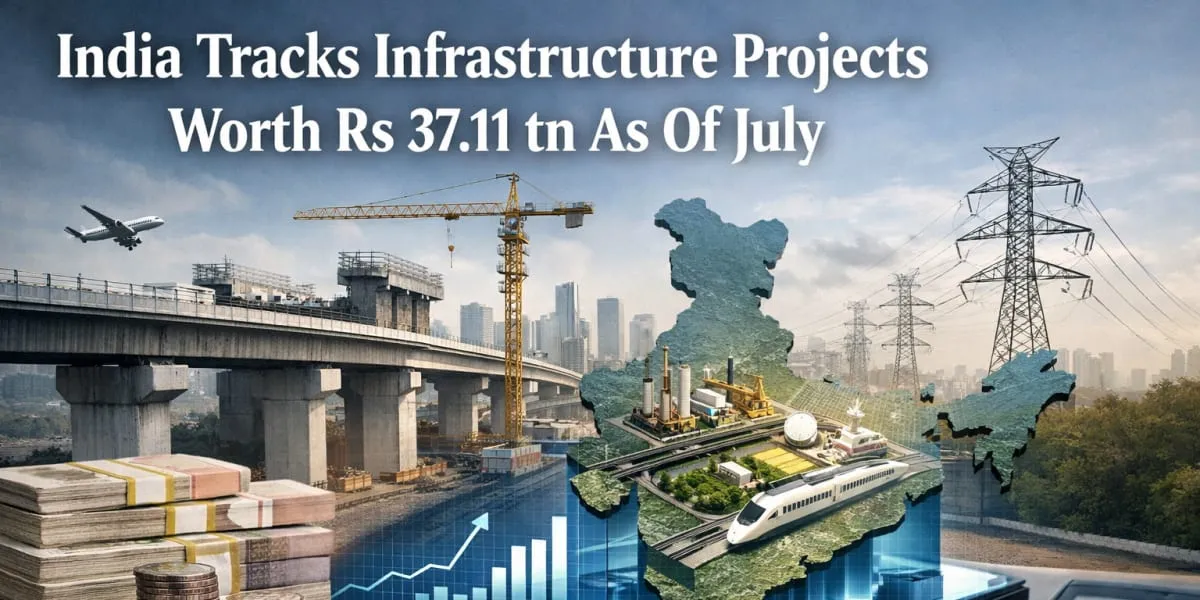
As of July 2026 the government was monitoring 1,775 ongoing central sector infrastructure projects with a combined estimated cost of Rs 37.11 trillion (tn) on the PAIMANA platform of the Ministry of Statistics and Programme Implementation. The ministry said 36 projects were added during the month and that cumulative expenditure on tracked projects reached Rs 19.26 trillion, or about 51.91 per cent of revised cost. The dataset showed that slightly more than half of the revised financial outlay had been incurred to date. Oversight was described as part of routine implementation monitoring.

The ministry reported that 675 projects, or around 38 per cent, had reached more than 80 per cent physical progress while 305 projects, or about 17 per cent, had crossed 80 per cent financial completion, reflecting a mix of early stage and near completion works. The transport and logistics sector held the largest share with 1,246 projects and a revised cost of Rs 19.81 trillion, followed by the energy sector with 205 projects valued at Rs 10.66 trillion.

At departmental level the Ministry of Road Transport and Highways had 993 projects, representing 56 per cent of tracked schemes and a revised cost of Rs 9.62 trillion. The Railways had 190 projects worth Rs 6.38 trillion and the Ministry of Coal had 121 projects costing Rs 2.22 trillion. Projects recorded as completed or commissioned during July included the Srikakulam Angul Gas Pipeline Project at Rs 28,100 million (mn) and other road and urban packages such as Aligarh-Kanpur Package one and Dwarka Expressway Package three.

The 36 newly monitored projects comprised 16 from the Department of Telecommunications, nine from the Ministry of Steel, six from Road Transport and Highways, three from the Ministry of Commerce and Industry and one each from the Ministry of Housing and Urban Affairs and the Ministry of Power. Key additions included the Rs 383,580 million Meja Thermal Power Project Stage two, the Rs 130,376.6 million Jaipur Metro Rail Project Phase two and a Rs 14,181.6 million greenfield Varanasi-Ranchi-Kolkata highway project. The ministry said the pipeline contained projects at varying stages that required continued oversight.

As of July 2026 the government was monitoring 1,775 ongoing central sector infrastructure projects with a combined estimated cost of Rs 37.11 trillion (tn) on the PAIMANA platform of the Ministry of Statistics and Programme Implementation. The ministry said 36 projects were added during the month and that cumulative expenditure on tracked projects reached Rs 19.26 trillion, or about 51.91 per cent of revised cost. The dataset showed that slightly more than half of the revised financial outlay had been incurred to date. Oversight was described as part of routine implementation monitoring. The ministry reported that 675 projects, or around 38 per cent, had reached more than 80 per cent physical progress while 305 projects, or about 17 per cent, had crossed 80 per cent financial completion, reflecting a mix of early stage and near completion works. The transport and logistics sector held the largest share with 1,246 projects and a revised cost of Rs 19.81 trillion, followed by the energy sector with 205 projects valued at Rs 10.66 trillion. At departmental level the Ministry of Road Transport and Highways had 993 projects, representing 56 per cent of tracked schemes and a revised cost of Rs 9.62 trillion. The Railways had 190 projects worth Rs 6.38 trillion and the Ministry of Coal had 121 projects costing Rs 2.22 trillion. Projects recorded as completed or commissioned during July included the Srikakulam Angul Gas Pipeline Project at Rs 28,100 million (mn) and other road and urban packages such as Aligarh-Kanpur Package one and Dwarka Expressway Package three. The 36 newly monitored projects comprised 16 from the Department of Telecommunications, nine from the Ministry of Steel, six from Road Transport and Highways, three from the Ministry of Commerce and Industry and one each from the Ministry of Housing and Urban Affairs and the Ministry of Power. Key additions included the Rs 383,580 million Meja Thermal Power Project Stage two, the Rs 130,376.6 million Jaipur Metro Rail Project Phase two and a Rs 14,181.6 million greenfield Varanasi-Ranchi-Kolkata highway project. The ministry said the pipeline contained projects at varying stages that required continued oversight.

Related Stories

Gold Stories

Next Story
Real Estate

BMC OC Amnesty Scheme Requires Key Approvals from Mumbai Societies

The Brihanmumbai Municipal Corporation (BMC) has clarified that housing societies applying under its Occupation Certificate (OC) amnesty scheme must possess key approvals linked to the original construction. The requirements include a valid Intimation of Disapproval (IOD), an approved building plan and a Commencement Certificate (CC), along with a No Objection Certificate (NOC) from the developer or original construction applicant. The Standard Operating Procedure (SOP) makes clear that the absence of an OC alone will not qualify a building for relief. Societies must establish that their build..

Next Story
Real Estate

Gurugram Emerges as Luxury Senior Living Hub

Gurugram is emerging as a potential hub for luxury senior living, supported by available land, healthcare infrastructure, connectivity and a concentration of affluent professionals, high-net-worth individuals and non-resident Indians. These factors could give the city an advantage over land-constrained metros such as Mumbai. A report by the Association of Senior Living India (ASLI) and JLL estimates that India’s organised senior living market could represent a $10.1 bn opportunity by 2030. The sector had about 25,050 organised units as of June 2026, while penetration stood at only 1.5 per ce..

Next Story
Real Estate

Corrosion Costs India’s Infrastructure Rs. 142 bn Annually

Corrosion costs India an estimated Rs. 1.42 tn annually, equivalent to 4.3 per cent of gross domestic product, according to a report by the Confederation of Indian Industry and the National Research Institute. Infrastructure accounts for Rs. 142 bn of the annual burden, making it the sector with the largest absolute cost among those examined. The report, presented at the CII Annual Infrastructure Summit 2026, said the infrastructure-sector cost equals about 2.9 per cent of the sector’s gross domestic product. It estimated that effective measures could generate maximum savings of Rs. 495.8 bn..

Advertisement

Subscribe to Our Newsletter

Get daily newsletters around different themes from Construction world.

STAY CONNECTED

Advertisement

SPECIAL OFFER
QR Code