MNRE Extends Self Certification Deadline For SPV Inverters
ECONOMY & POLICY

MNRE Extends Self Certification Deadline For SPV Inverters

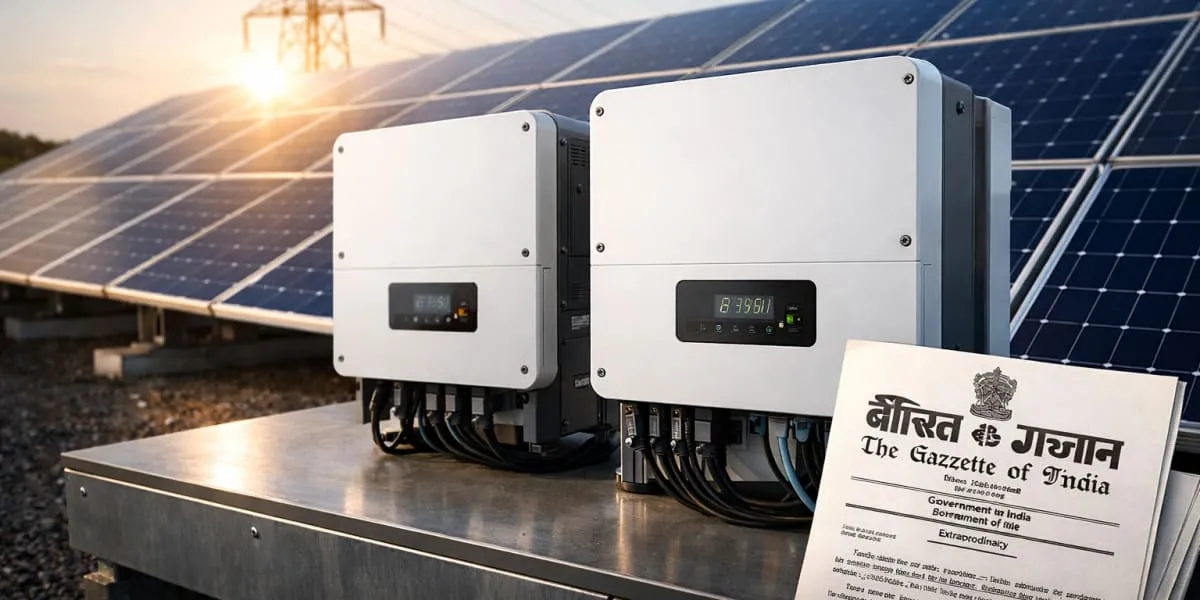
The Ministry of New and Renewable Energy (MNRE) has extended the deadline for self certification of high capacity solar photovoltaic (SPV) inverters measured in kilowatt (kW) to assist manufacturers facing delays caused by limited testing infrastructure. The decision was notified in the Gazette of India on 8 July 2026 under the authority of Joint Secretary Rajesh Kulhari. The extension is intended to provide additional time for manufacturers to meet mandatory quality and safety requirements.

The notification extends the self certification timeline for SPV inverters with a capacity above 200 kW, covered under items four and five of the relevant quality control framework, until 31 December 2026 or until further orders, whichever is earlier. The requirement for self certification was introduced under the Solar Systems, Devices and Components Goods Order, 2025, which took effect on 27 January 2025. Initially manufacturers were given 180 days to comply with new requirements for five specified product categories.

The ministry had earlier recognised testing capacity constraints and issued an amendment on 5 August 2025 that extended the deadline to 30 June 2026. The latest order imposes strict compliance conditions and requires manufacturers to hold valid Indian Standards (IS) and International Electrotechnical Commission (IEC) certificates corresponding to prescribed standards. For item four compliance is required with IS 16221 (Part 2): 2015 / IEC 62109-2: 2011 and IS/IEC 61683: 1999. For item five manufacturers must comply with IS 16221 (Part 2): 2015 / IEC 62109-2: 2011, IS 16169: 2019 / IEC 62116: 2014, and IS 17980: 2022 / IEC 62891: 2020.

The notification also requires submission of test reports issued by accredited laboratories to support self certification. The ministry said that the extension balances the need to ease compliance burdens with the requirement to maintain high standards of quality, safety and reliability for large capacity solar inverter deployments across India. Manufacturers will use the additional time to arrange testing and documentation in line with the prescribed standards.

The Ministry of New and Renewable Energy (MNRE) has extended the deadline for self certification of high capacity solar photovoltaic (SPV) inverters measured in kilowatt (kW) to assist manufacturers facing delays caused by limited testing infrastructure. The decision was notified in the Gazette of India on 8 July 2026 under the authority of Joint Secretary Rajesh Kulhari. The extension is intended to provide additional time for manufacturers to meet mandatory quality and safety requirements. The notification extends the self certification timeline for SPV inverters with a capacity above 200 kW, covered under items four and five of the relevant quality control framework, until 31 December 2026 or until further orders, whichever is earlier. The requirement for self certification was introduced under the Solar Systems, Devices and Components Goods Order, 2025, which took effect on 27 January 2025. Initially manufacturers were given 180 days to comply with new requirements for five specified product categories. The ministry had earlier recognised testing capacity constraints and issued an amendment on 5 August 2025 that extended the deadline to 30 June 2026. The latest order imposes strict compliance conditions and requires manufacturers to hold valid Indian Standards (IS) and International Electrotechnical Commission (IEC) certificates corresponding to prescribed standards. For item four compliance is required with IS 16221 (Part 2): 2015 / IEC 62109-2: 2011 and IS/IEC 61683: 1999. For item five manufacturers must comply with IS 16221 (Part 2): 2015 / IEC 62109-2: 2011, IS 16169: 2019 / IEC 62116: 2014, and IS 17980: 2022 / IEC 62891: 2020. The notification also requires submission of test reports issued by accredited laboratories to support self certification. The ministry said that the extension balances the need to ease compliance burdens with the requirement to maintain high standards of quality, safety and reliability for large capacity solar inverter deployments across India. Manufacturers will use the additional time to arrange testing and documentation in line with the prescribed standards.

Next Story
Infrastructure Transport

Surya Roshni delivers customised lighting for NCRTC RRTS stations

Surya Roshni has supplied customised indoor lighting solutions for 18 elevated stations on the National Capital Region Transport Corporation's (NCRTC) Rapid Rail Transit System (RRTS), strengthening its presence in India's infrastructure lighting segment.The project involved the design and deployment of lighting systems for platforms, concourses, foot overbridges (FOBs) and back-of-house (BOH) areas. According to the company, the luminaires were developed specifically to meet NCRTC's design, operational and performance requirements rather than using standard products.Surya introduced two custo..

Next Story
Real Estate

Hilton debuts Tapestry Collection brand in Vietnam

Hilton has opened NHAAN Resort & Spa Hoi An, Tapestry Collection by Hilton, marking the debut of the Tapestry Collection brand in Vietnam and expanding its lifestyle hospitality portfolio in Southeast Asia.Located along the Co Co River in Cam Thanh village, the 174-key resort provides access to Hoi An Ancient Town, Cua Dai Beach and the Cam Thanh Nipa Forest. The property has been designed by Vietnamese architect Vo Trong Nghia, incorporating biophilic architecture, locally sourced materials and riverfront landscapes.The resort offers a mix of guest rooms and suites, including family-frien..

Next Story
Building Material

Electrent expands lithium energy storage system portfolio

Electrent Energy has expanded its lithium-based energy storage portfolio with the launch of the ESS 850 and ESS 1050, targeting compact and maintenance-free power backup solutions for Indian homes.The new systems integrate a Home UPS and a LiFePO4 lithium battery into a single unit, extending the company's product range following the launch of its ESS 1350 and ESS 2500 models.Designed for apartments and smaller homes, the ESS 850 provides up to 1 hour 15 minutes of backup, while the ESS 1050 offers up to 1 hour 45 minutes on a typical 400 W household load. The systems can power essential appli..

Advertisement

Subscribe to Our Newsletter

Get daily newsletters around different themes from Construction world.

STAY CONNECTED

Advertisement

Advertisement

Advertisement