




NCB And DTU Sign MoU To Boost Construction Skills
ECONOMY & POLICY

NCB And DTU Sign MoU To Boost Construction Skills

The National Council for Cement and Building Materials (NCB) has signed a Memorandum of Understanding with Delhi Technological University (DTU) to strengthen research–academia collaboration in India’s cement and construction sector. The partnership will promote joint research and innovation in cement and concrete technologies and enable training for students, professionals and stakeholders. It will facilitate knowledge exchange between academia and industry and aim to disseminate best practices and technical expertise.

The collaboration is intended to enhance skill development and capacity building across the sector and to support development of sustainable and resilient infrastructure in the country. It is expected to strengthen technical capabilities and institutional collaboration within India’s construction ecosystem. The MoU identifies training programmes, research projects and workshops as priority areas to translate scientific advances into practical applications.

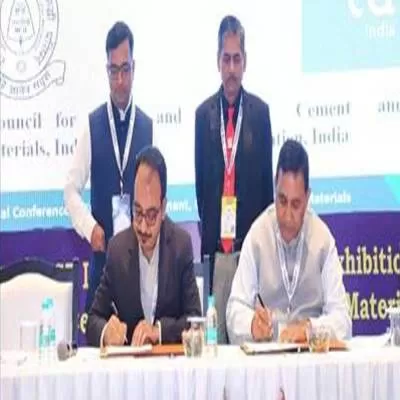
The memorandum was signed by Dr. L. P. Singh, Director General of the National Council for Cement and Building Materials, and Shri Binod Doley, Registrar of Delhi Technological University, in the presence of the vice chancellor and senior representatives from the council on March 30, 2026 at Delhi Technological University in New Delhi. Present officials included the vice chancellor, joint director and secretarial and managerial heads from technical and commercial divisions, who will support implementation of collaborative activities. The institutions will establish mechanisms for monitoring progress and for periodic review of outcomes.

The partnership will seek to integrate academic curricula with industry requirements, expand practical training and create pathways for professional development and capacity building across urban and rural projects. It will also encourage innovation in materials and construction methods that address climate resilience and resource efficiency while responding to regulatory and market needs. Stakeholders will be able to access shared facilities and expertise as projects move from research to field application.

The National Council for Cement and Building Materials (NCB) has signed a Memorandum of Understanding with Delhi Technological University (DTU) to strengthen research–academia collaboration in India’s cement and construction sector. The partnership will promote joint research and innovation in cement and concrete technologies and enable training for students, professionals and stakeholders. It will facilitate knowledge exchange between academia and industry and aim to disseminate best practices and technical expertise. The collaboration is intended to enhance skill development and capacity building across the sector and to support development of sustainable and resilient infrastructure in the country. It is expected to strengthen technical capabilities and institutional collaboration within India’s construction ecosystem. The MoU identifies training programmes, research projects and workshops as priority areas to translate scientific advances into practical applications. The memorandum was signed by Dr. L. P. Singh, Director General of the National Council for Cement and Building Materials, and Shri Binod Doley, Registrar of Delhi Technological University, in the presence of the vice chancellor and senior representatives from the council on March 30, 2026 at Delhi Technological University in New Delhi. Present officials included the vice chancellor, joint director and secretarial and managerial heads from technical and commercial divisions, who will support implementation of collaborative activities. The institutions will establish mechanisms for monitoring progress and for periodic review of outcomes. The partnership will seek to integrate academic curricula with industry requirements, expand practical training and create pathways for professional development and capacity building across urban and rural projects. It will also encourage innovation in materials and construction methods that address climate resilience and resource efficiency while responding to regulatory and market needs. Stakeholders will be able to access shared facilities and expertise as projects move from research to field application.

Related Stories

Gold Stories

Next Story
Infrastructure Urban

KONE Opens India's First Digital Experience Centre in Pune

KONE, a global elevator and escalator manufacturer, has inaugurated its first Digital Experience Centre (DEC) in India, located in Pune. The facility aims to showcase how artificial intelligence (AI), connectivity and data-driven technologies can enhance customer experiences and improve building operations.The centre was inaugurated by Jussi Herlin, Executive Vice Chair, KONE Corporation; Philippe Delorme, President and CEO, KONE; and Nandan Nilekani, Co-founder and Chairman of the Board, Infosys.Designed as an interactive customer environment, the facility demonstrates digital solutions cover..

Next Story
Infrastructure Urban

CII GreenCo Launches Circularity Guidelines for Indian Industry

The Confederation of Indian Industry (CII) GreenCo Council has launched the CII GreenCo Circularity Guidelines – Pilot Version at the 17th CII GreenCo Waste & Resource Management Summit 2026 in Chennai. The initiative aims to strengthen resource efficiency, waste reduction and circular economy practices across Indian manufacturing and process industries.The guidelines introduce a structured framework with circularity indices covering raw materials, consumables, packaging and other resource inputs. These indicators will help industries assess existing practices, identify opportunities to ..

Next Story
Infrastructure Energy

Global Electronics Association Launches IPC-1783-CO2E Standard

The Global Electronics Association has introduced IPC-1783-CO2E, a new international standard aimed at improving consistency, transparency and comparability in product carbon footprint reporting across the electronics manufacturing industry.The standard, titled International Standard for Data Collection and Reporting of CO2 Equivalent (CO2e) Emissions for the Electronics Manufacturing Supply Chain, provides industry-specific guidance for collecting, estimating and reporting carbon emissions data.With increasing regulatory requirements and customer expectations, electronics manufacturers face c..

Advertisement

Subscribe to Our Newsletter

Get daily newsletters around different themes from Construction world.

STAY CONNECTED

Advertisement

SPECIAL OFFER
QR Code











