Nexon Geochem And Giredmet To Build Integrated Rare Earth Platform
ECONOMY & POLICY

Nexon Geochem And Giredmet To Build Integrated Rare Earth Platform

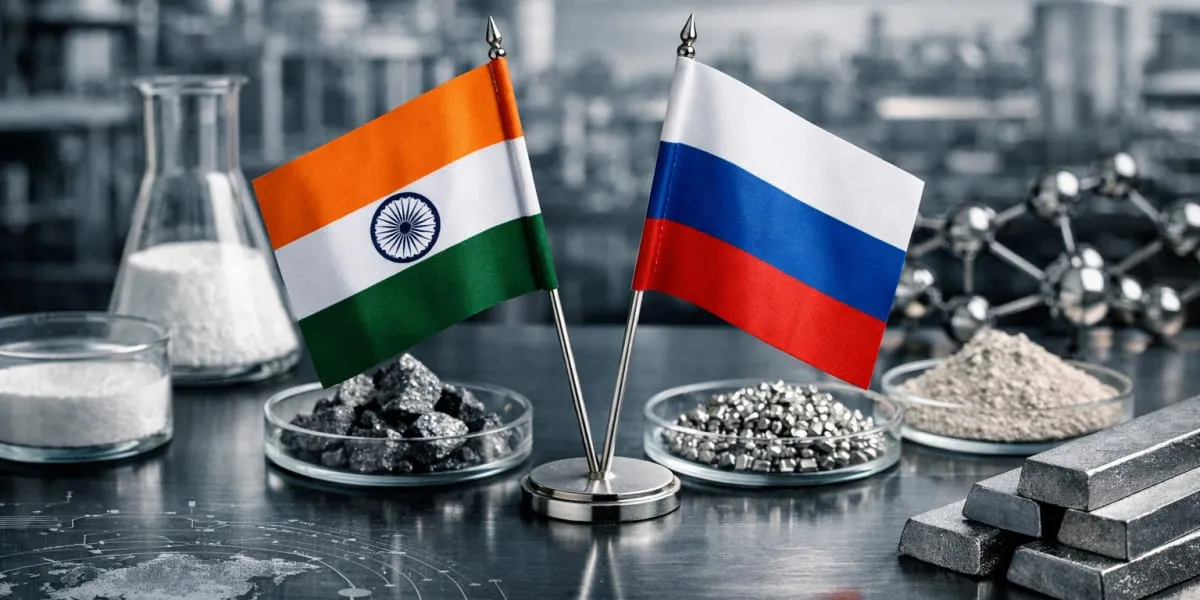
Nexon Geochem of Hyderabad has signed a memorandum of understanding with Giredmet, the State Research and Design Institute of Rare Metal Industry under Russia's Rosatom State Corporation, to build integrated rare-earth processing and downstream facilities. The partnership was announced in a company statement and will draw on Giredmet's nearly century of rare metal expertise alongside Nexon Geochem's advanced materials capabilities. The collaboration is presented as a strategic move to develop domestic rare-earth processing capacity and to build end-to-end manufacturing for critical magnet technologies.

An immediate objective is to establish a scalable sintered Neodymium Iron Boron (NdFeB) permanent magnet manufacturing facility in Hyderabad, intended to link rare earth oxide inputs through to finished magnet production. The company indicated it was poised to reach a benchmark production capability of 1,200 t per annum by FY 2033, reflecting a staged scaling approach from laboratory to pilot and then to commercial lines. The project is described as positioning the firm among the first integrated rare earth oxide-to-magnet platforms in India and as a foundation for wider industrial adoption.

The pact covers joint research and development of deep-processing technologies, technology transfer, analytical control methodology development and academic programmes to support skills and innovation. NdFeB permanent magnets are set out as essential components for electric vehicles, wind turbines, defence systems, robotics and advanced electronics, underpinning the energy and technology transition and industrial competitiveness. Export curbs by China during 2025-26 exposed vulnerabilities in supply chains for these critical inputs and reinforced policy focus on localised value chains.

The announcement is framed as addressing India's reliance on imports for inputs across electric vehicle, wind and defence manufacturing while creating a domestic platform for testing, validation and scale-up of separation, refining and magnet manufacturing processes. India possesses the world's third-largest rare earth reserves, estimated at nearly seven million tonnes (mn t), yet commercial-scale separation and industrial magnet production remain limited, according to the statement. The partners plan joint validation, scaling and educational initiatives intended to develop deep-processing capabilities, build technical talent and reduce import dependence over the coming decade.

Nexon Geochem of Hyderabad has signed a memorandum of understanding with Giredmet, the State Research and Design Institute of Rare Metal Industry under Russia's Rosatom State Corporation, to build integrated rare-earth processing and downstream facilities. The partnership was announced in a company statement and will draw on Giredmet's nearly century of rare metal expertise alongside Nexon Geochem's advanced materials capabilities. The collaboration is presented as a strategic move to develop domestic rare-earth processing capacity and to build end-to-end manufacturing for critical magnet technologies. An immediate objective is to establish a scalable sintered Neodymium Iron Boron (NdFeB) permanent magnet manufacturing facility in Hyderabad, intended to link rare earth oxide inputs through to finished magnet production. The company indicated it was poised to reach a benchmark production capability of 1,200 t per annum by FY 2033, reflecting a staged scaling approach from laboratory to pilot and then to commercial lines. The project is described as positioning the firm among the first integrated rare earth oxide-to-magnet platforms in India and as a foundation for wider industrial adoption. The pact covers joint research and development of deep-processing technologies, technology transfer, analytical control methodology development and academic programmes to support skills and innovation. NdFeB permanent magnets are set out as essential components for electric vehicles, wind turbines, defence systems, robotics and advanced electronics, underpinning the energy and technology transition and industrial competitiveness. Export curbs by China during 2025-26 exposed vulnerabilities in supply chains for these critical inputs and reinforced policy focus on localised value chains. The announcement is framed as addressing India's reliance on imports for inputs across electric vehicle, wind and defence manufacturing while creating a domestic platform for testing, validation and scale-up of separation, refining and magnet manufacturing processes. India possesses the world's third-largest rare earth reserves, estimated at nearly seven million tonnes (mn t), yet commercial-scale separation and industrial magnet production remain limited, according to the statement. The partners plan joint validation, scaling and educational initiatives intended to develop deep-processing capabilities, build technical talent and reduce import dependence over the coming decade.

Related Stories

Gold Stories

Next Story
Infrastructure Urban

KONE Opens India's First Digital Experience Centre in Pune

KONE, a global elevator and escalator manufacturer, has inaugurated its first Digital Experience Centre (DEC) in India, located in Pune. The facility aims to showcase how artificial intelligence (AI), connectivity and data-driven technologies can enhance customer experiences and improve building operations.The centre was inaugurated by Jussi Herlin, Executive Vice Chair, KONE Corporation; Philippe Delorme, President and CEO, KONE; and Nandan Nilekani, Co-founder and Chairman of the Board, Infosys.Designed as an interactive customer environment, the facility demonstrates digital solutions cover..

Next Story
Infrastructure Urban

CII GreenCo Launches Circularity Guidelines for Indian Industry

The Confederation of Indian Industry (CII) GreenCo Council has launched the CII GreenCo Circularity Guidelines – Pilot Version at the 17th CII GreenCo Waste & Resource Management Summit 2026 in Chennai. The initiative aims to strengthen resource efficiency, waste reduction and circular economy practices across Indian manufacturing and process industries.The guidelines introduce a structured framework with circularity indices covering raw materials, consumables, packaging and other resource inputs. These indicators will help industries assess existing practices, identify opportunities to ..

Next Story
Infrastructure Energy

Global Electronics Association Launches IPC-1783-CO2E Standard

The Global Electronics Association has introduced IPC-1783-CO2E, a new international standard aimed at improving consistency, transparency and comparability in product carbon footprint reporting across the electronics manufacturing industry.The standard, titled International Standard for Data Collection and Reporting of CO2 Equivalent (CO2e) Emissions for the Electronics Manufacturing Supply Chain, provides industry-specific guidance for collecting, estimating and reporting carbon emissions data.With increasing regulatory requirements and customer expectations, electronics manufacturers face c..

Advertisement

Subscribe to Our Newsletter

Get daily newsletters around different themes from Construction world.

STAY CONNECTED

Advertisement

SPECIAL OFFER
QR Code