PM Modi Inaugurates Skyroot’s Infinity Campus in Hyderabad
ECONOMY & POLICY

PM Modi Inaugurates Skyroot’s Infinity Campus in Hyderabad

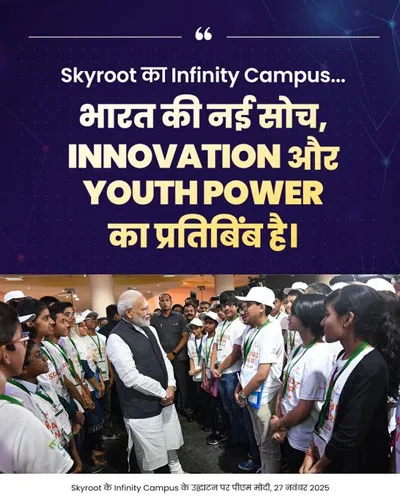
Prime Minister Narendra Modi inaugurated Skyroot’s Infinity Campus in Hyderabad, Telangana, via video conferencing, highlighting the unprecedented opportunities emerging in India’s space sector. He said the new campus reflects the nation’s innovative energy, entrepreneurial talent and growing private-sector participation, noting that India is poised to become a global leader in satellite-launch services.
Congratulating Skyroot co-founders Pawan Kumar Chandana and Naga Bharath Daka, the Prime Minister said their success demonstrates the power of risk-taking, determination and youth-led innovation. He recalled India’s early space journey—where rocket parts were once transported by bicycle—emphasising that ambition, not resources, defines success. ISRO, he said, has long strengthened India’s credibility and capability in space.
PM Modi noted the expanding role of space technologies in communication, agriculture, urban planning, weather monitoring and national security. He said historic reforms, including the opening of the space sector to private players and the establishment of IN-SPACe, have transformed India into an open and innovation-driven ecosystem. More than 300 space startups now operate in the country, many founded with small teams but strong determination—fueling what he called India’s “private space revolution”.
He underlined that demand for small satellites is rising globally, presenting a major opportunity for India’s cost-effective and reliable launch capabilities. Global firms increasingly seek to manufacture satellites in India, use Indian launch services and collaborate on space technologies.
The Prime Minister said this growth mirrors India’s wider startup transformation across sectors such as fintech, agritech, healthtech, climatetech and defence technology. With over 0.15 million registered startups and a strong push into deep-tech, India has become the world’s third-largest startup ecosystem. He pointed to semiconductor manufacturing as an example of rapid progress, with new fabrication units, design hubs and broader electronics value-chain development supporting self-reliance and global supply-chain integration.
PM Modi said reforms are also extending to the nuclear sector, with new opportunities being created for private participation in small modular reactors, advanced reactors and nuclear innovation—key to enhancing energy security and technological leadership.
Focusing on research, the Prime Minister highlighted initiatives such as the National Research Foundation, the “One Nation, One Subscription” model for journal access, the Rs 1 trillion Research, Development and Innovation Fund, and more than 10,000 Atal Tinkering Labs. Plans are underway to establish 50,000 additional labs to nurture innovation nationwide.
Reaffirming India’s long-term space ambitions, he said that within five years the country aims to expand launch capacity and create five new space-sector unicorns. Skyroot’s progress, he added, underscores India’s ability to meet its goals.
The Prime Minister reiterated the government’s support for young innovators, startups, scientists and engineers, urging them to help make the 21st century the century of India—on Earth and in space. Union Minister G. Kishan Reddy was present at the event.

Prime Minister Narendra Modi inaugurated Skyroot’s Infinity Campus in Hyderabad, Telangana, via video conferencing, highlighting the unprecedented opportunities emerging in India’s space sector. He said the new campus reflects the nation’s innovative energy, entrepreneurial talent and growing private-sector participation, noting that India is poised to become a global leader in satellite-launch services.Congratulating Skyroot co-founders Pawan Kumar Chandana and Naga Bharath Daka, the Prime Minister said their success demonstrates the power of risk-taking, determination and youth-led innovation. He recalled India’s early space journey—where rocket parts were once transported by bicycle—emphasising that ambition, not resources, defines success. ISRO, he said, has long strengthened India’s credibility and capability in space.PM Modi noted the expanding role of space technologies in communication, agriculture, urban planning, weather monitoring and national security. He said historic reforms, including the opening of the space sector to private players and the establishment of IN-SPACe, have transformed India into an open and innovation-driven ecosystem. More than 300 space startups now operate in the country, many founded with small teams but strong determination—fueling what he called India’s “private space revolution”.He underlined that demand for small satellites is rising globally, presenting a major opportunity for India’s cost-effective and reliable launch capabilities. Global firms increasingly seek to manufacture satellites in India, use Indian launch services and collaborate on space technologies.The Prime Minister said this growth mirrors India’s wider startup transformation across sectors such as fintech, agritech, healthtech, climatetech and defence technology. With over 0.15 million registered startups and a strong push into deep-tech, India has become the world’s third-largest startup ecosystem. He pointed to semiconductor manufacturing as an example of rapid progress, with new fabrication units, design hubs and broader electronics value-chain development supporting self-reliance and global supply-chain integration.PM Modi said reforms are also extending to the nuclear sector, with new opportunities being created for private participation in small modular reactors, advanced reactors and nuclear innovation—key to enhancing energy security and technological leadership.Focusing on research, the Prime Minister highlighted initiatives such as the National Research Foundation, the “One Nation, One Subscription” model for journal access, the Rs 1 trillion Research, Development and Innovation Fund, and more than 10,000 Atal Tinkering Labs. Plans are underway to establish 50,000 additional labs to nurture innovation nationwide.Reaffirming India’s long-term space ambitions, he said that within five years the country aims to expand launch capacity and create five new space-sector unicorns. Skyroot’s progress, he added, underscores India’s ability to meet its goals.The Prime Minister reiterated the government’s support for young innovators, startups, scientists and engineers, urging them to help make the 21st century the century of India—on Earth and in space. Union Minister G. Kishan Reddy was present at the event.

Next Story
Infrastructure Energy

Delhi HC Stays PGCIL Order against KEC International

KEC International has informed stock exchanges of a significant legal development concerning its eligibility to participate in tenders floated by Power Grid Corporation of India (PGCIL), in a disclosure made under Regulation 30 of the SEBI (Listing Obligations and Disclosure Requirements) Regulations.The update follows the company’s earlier intimation dated November 18, 2025, regarding an order issued by PGCIL that excluded KEC International from participating in its tenders for a period of nine months. Challenging the said order, the company filed a writ petition before the Hon’ble High C..

Next Story
Building Material

LANXESS Advances Pigment Solutions for New-Age Concrete Technologies

LANXESS is deepening its engagement with next-generation concrete technologies by advancing research into the performance of iron oxide pigments across emerging construction applications, including self-compacting concrete (SCC), geopolymers and 3D-printed concrete. Through extensive investigations and long-term weathering tests, iron oxide pigments have proven their suitability for a wide range of concrete construction materials, though their use in new formulations requires a thorough understanding of construction chemistry and material interactions.According to Oliver Fleschentraeger, Techn..

Next Story
Infrastructure Urban

JHS Svendgaard to Invest Rs 250 Million in Kala Amb Expansion

JHS Svendgaard Laboratories (JHS), a leading Indian manufacturer of oral care products, has announced an investment of Rs 250 million to expand its manufacturing footprint in Kala Amb, Himachal Pradesh. The investment is aimed at strengthening production capacity, introducing advanced technologies and supporting the company’s next phase of growth in response to rising domestic and global demand.As part of the expansion plan, JHS will construct a new 100,000 sq ft manufacturing facility on its existing five-acre land parcel at Kala Amb. The project is expected to be executed over a two-year p..

Advertisement

Subscribe to Our Newsletter

Get daily newsletters around different themes from Construction world.

STAY CONNECTED

Advertisement

Advertisement

Advertisement

Advertisement

Open In App