Rs 6,717.2 Million Cleared for Kolkata Metro Blue Line
ECONOMY & POLICY

Rs 6,717.2 Million Cleared for Kolkata Metro Blue Line

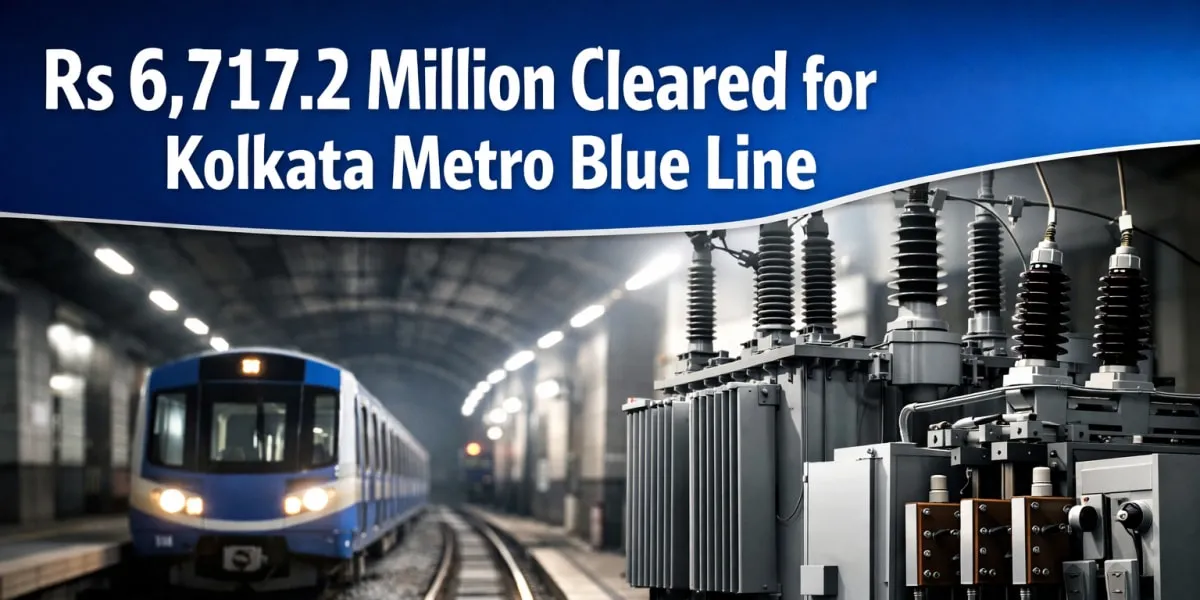
The Centre has sanctioned Rs 6,717.2 million (mn) for an upgrade of electrical infrastructure on the north-south corridor of Kolkata Metro Railway. The allocation aims to increase train frequency on the Blue Line, which currently operates with a peak-hour headway of five minutes and is planned to be reduced to two-and-a-half minutes by 2030. A Press Information Bureau release dated May 2 set out the sanctioned works and funding split.

Of the total, Rs 2,910.6 mn will be used to install seven additional traction substations and Rs 3,806.6 mn will replace transformers, rectifiers, high-speed circuit breakers and the network of cables. Engineers said that each station requires a traction substation for shorter intervals and that modern traction substations can now handle 33KV alternating current directly. The Blue Line was built in the 1980s and retains five receiving substations that step down high-voltage power before it reaches older traction equipment.

The corridor has 26 stations and 13 traction substations, and the sanctioned work will add eight more so that most stations have dedicated traction supply, with an extra substation planned between Dum Dum and Belgachia because of the longer distance. Two new traction substations at Chandni Chowk and Gitanjali are nearing completion and are expected to be operational by the end of July. The seven additional substations will be located at Kalighat, Netaji Bhawan, Maidan, Esplanade, MG Road, Sovabazar and between Belgachia and Dum Dum.

Upgrades are intended to reduce energy losses and enable faster train acceleration by replacing the steel third rail with an aluminium one, which offers improved electrical conductivity and lower voltage drop. The works are being implemented in phases; most of the underground section has been upgraded while the elevated stretch between Tollygunge and Kavi Subhas remains to be completed. Officials said the investment will save energy and operating costs and support the planned increase in service frequency.

The Centre has sanctioned Rs 6,717.2 million (mn) for an upgrade of electrical infrastructure on the north-south corridor of Kolkata Metro Railway. The allocation aims to increase train frequency on the Blue Line, which currently operates with a peak-hour headway of five minutes and is planned to be reduced to two-and-a-half minutes by 2030. A Press Information Bureau release dated May 2 set out the sanctioned works and funding split. Of the total, Rs 2,910.6 mn will be used to install seven additional traction substations and Rs 3,806.6 mn will replace transformers, rectifiers, high-speed circuit breakers and the network of cables. Engineers said that each station requires a traction substation for shorter intervals and that modern traction substations can now handle 33KV alternating current directly. The Blue Line was built in the 1980s and retains five receiving substations that step down high-voltage power before it reaches older traction equipment. The corridor has 26 stations and 13 traction substations, and the sanctioned work will add eight more so that most stations have dedicated traction supply, with an extra substation planned between Dum Dum and Belgachia because of the longer distance. Two new traction substations at Chandni Chowk and Gitanjali are nearing completion and are expected to be operational by the end of July. The seven additional substations will be located at Kalighat, Netaji Bhawan, Maidan, Esplanade, MG Road, Sovabazar and between Belgachia and Dum Dum. Upgrades are intended to reduce energy losses and enable faster train acceleration by replacing the steel third rail with an aluminium one, which offers improved electrical conductivity and lower voltage drop. The works are being implemented in phases; most of the underground section has been upgraded while the elevated stretch between Tollygunge and Kavi Subhas remains to be completed. Officials said the investment will save energy and operating costs and support the planned increase in service frequency.

Related Stories

Gold Stories

Next Story
Infrastructure Urban

KONE Opens India's First Digital Experience Centre in Pune

KONE, a global elevator and escalator manufacturer, has inaugurated its first Digital Experience Centre (DEC) in India, located in Pune. The facility aims to showcase how artificial intelligence (AI), connectivity and data-driven technologies can enhance customer experiences and improve building operations.The centre was inaugurated by Jussi Herlin, Executive Vice Chair, KONE Corporation; Philippe Delorme, President and CEO, KONE; and Nandan Nilekani, Co-founder and Chairman of the Board, Infosys.Designed as an interactive customer environment, the facility demonstrates digital solutions cover..

Next Story
Infrastructure Urban

CII GreenCo Launches Circularity Guidelines for Indian Industry

The Confederation of Indian Industry (CII) GreenCo Council has launched the CII GreenCo Circularity Guidelines – Pilot Version at the 17th CII GreenCo Waste & Resource Management Summit 2026 in Chennai. The initiative aims to strengthen resource efficiency, waste reduction and circular economy practices across Indian manufacturing and process industries.The guidelines introduce a structured framework with circularity indices covering raw materials, consumables, packaging and other resource inputs. These indicators will help industries assess existing practices, identify opportunities to ..

Next Story
Infrastructure Energy

Global Electronics Association Launches IPC-1783-CO2E Standard

The Global Electronics Association has introduced IPC-1783-CO2E, a new international standard aimed at improving consistency, transparency and comparability in product carbon footprint reporting across the electronics manufacturing industry.The standard, titled International Standard for Data Collection and Reporting of CO2 Equivalent (CO2e) Emissions for the Electronics Manufacturing Supply Chain, provides industry-specific guidance for collecting, estimating and reporting carbon emissions data.With increasing regulatory requirements and customer expectations, electronics manufacturers face c..

Advertisement

Subscribe to Our Newsletter

Get daily newsletters around different themes from Construction world.

STAY CONNECTED

Advertisement

SPECIAL OFFER
QR Code