TEXMiN and GIREDMET Sign Pact on Rare Earth Technologies
ECONOMY & POLICY

TEXMiN and GIREDMET Sign Pact on Rare Earth Technologies

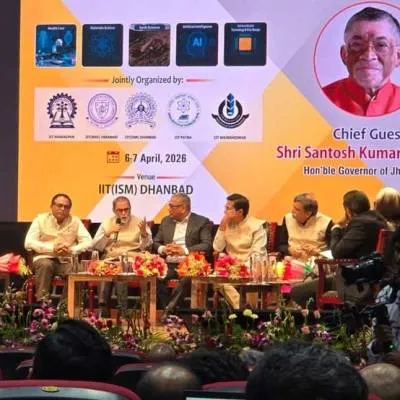
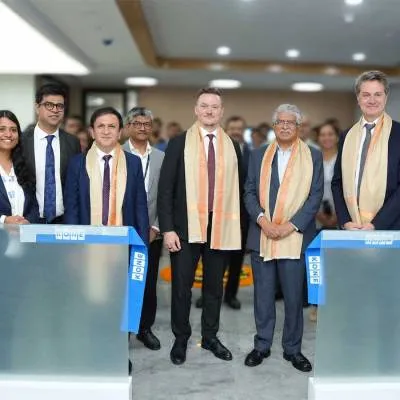
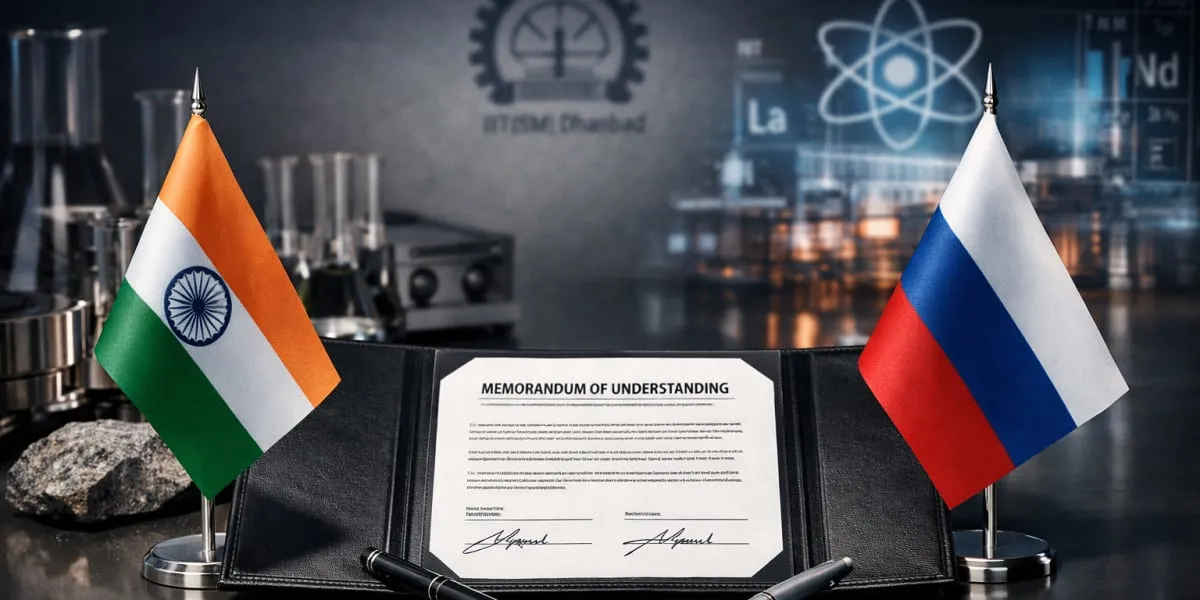
India's TEXMiN Foundation and Russia's GIREDMET signed a memorandum of understanding to collaborate on rare earth and critical mineral technologies, with the agreement concluded at an industry institute conclave at IIT (ISM) Dhanbad. The partnership brings together the Technology Translation Research Park under the Department of Science and Technology and a state research and design institute of the Russian rare metal industry under Rosatom. The signing took place in the presence of senior representatives from Indian research bodies and GIREDMET leadership.

Under the MoU the institutions will pursue joint research and development across the mining value chain, covering exploration, beneficiation, extraction, separation and refining, as well as advanced materials development. A principal focus is the development of high coercivity permanent magnet blocks based on neodymium iron boron supported by a complete rare earth metallurgical cycle. The collaboration will also target high purity metals and alloys, refractory metal powders and materials for electronics and optics.

A key element is pilot-scale validation and technology translation under the Technology Translation Research Park framework, enabling industry-facing demonstrations and higher technology readiness levels. The partners will explore hydrometallurgical recycling for lithium ion batteries to recover lithium, nickel and cobalt and will develop recovery solutions for legacy mine dumps, tailings and low-grade or complex ores. Digital twin-enabled smart processing plants integrating artificial intelligence, machine learning and sensor systems are planned to support optimisation and process control.

The MoU provides for expert exchanges, joint doctoral supervision, specialised training programmes and advisory support to governments, public sector undertakings and industry stakeholders to accelerate deployment of sustainable, industry-ready solutions aligned with the Atmanirbhar Bharat initiative. Representatives from TEXMiN and IIT (ISM) Dhanbad plan to attend an international congress on rare metals and related technologies in Moscow in May where global scientific and technological challenges will be discussed. The collaboration is intended to strengthen domestic capabilities in rare metals and advanced materials and to foster translational outcomes for high tech industries.

India's TEXMiN Foundation and Russia's GIREDMET signed a memorandum of understanding to collaborate on rare earth and critical mineral technologies, with the agreement concluded at an industry institute conclave at IIT (ISM) Dhanbad. The partnership brings together the Technology Translation Research Park under the Department of Science and Technology and a state research and design institute of the Russian rare metal industry under Rosatom. The signing took place in the presence of senior representatives from Indian research bodies and GIREDMET leadership. Under the MoU the institutions will pursue joint research and development across the mining value chain, covering exploration, beneficiation, extraction, separation and refining, as well as advanced materials development. A principal focus is the development of high coercivity permanent magnet blocks based on neodymium iron boron supported by a complete rare earth metallurgical cycle. The collaboration will also target high purity metals and alloys, refractory metal powders and materials for electronics and optics. A key element is pilot-scale validation and technology translation under the Technology Translation Research Park framework, enabling industry-facing demonstrations and higher technology readiness levels. The partners will explore hydrometallurgical recycling for lithium ion batteries to recover lithium, nickel and cobalt and will develop recovery solutions for legacy mine dumps, tailings and low-grade or complex ores. Digital twin-enabled smart processing plants integrating artificial intelligence, machine learning and sensor systems are planned to support optimisation and process control. The MoU provides for expert exchanges, joint doctoral supervision, specialised training programmes and advisory support to governments, public sector undertakings and industry stakeholders to accelerate deployment of sustainable, industry-ready solutions aligned with the Atmanirbhar Bharat initiative. Representatives from TEXMiN and IIT (ISM) Dhanbad plan to attend an international congress on rare metals and related technologies in Moscow in May where global scientific and technological challenges will be discussed. The collaboration is intended to strengthen domestic capabilities in rare metals and advanced materials and to foster translational outcomes for high tech industries.

Next Story
Infrastructure Transport

Sector 51-52 Metro skywalk in Noida remains shut despite being ready for over a year

Thousands of commuters travelling between Delhi Metro Rail Corporation’s (DMRC) Sector 52 station and Noida Metro Rail Corporation’s (NMRC) Sector 51 station continue to face daily inconvenience as the 300-metre air-conditioned skywalk connecting the two stations remains closed, despite being completed over a year ago, according to a report.The Noida Metro Rail Corporation built the foot overbridge to enable a seamless interchange between the Delhi Metro and Noida Metro networks. However, pending finishing work and a structural obstruction have delayed its opening.Krishna Karunesh, Chief E..

Next Story
Infrastructure Transport

Maharashtra clears Metro Line 5A, expansion of Mumbai Metro Line 5

The Maharashtra government has approved the expansion of Mumbai Metro Line 5 along with a new integrated corridor, Metro Line 5A, forming a combined 34.2-km metro network across the Thane-Bhiwandi-Kalyan-Ulhasnagar belt. The integrated project has been cleared at an estimated cost of ₹18,130.55 crore, according to a government resolution (GR).Metro Line 5 was originally approved in October 2017 as a 24.9-km fully elevated corridor with 17 stations connecting Thane, Bhiwandi and Kalyan, with an initial project cost of ₹8,416.51 crore. The corridor is being developed in two phases.The first ..

Next Story
Infrastructure Transport

Bengaluru Metro expansion seen driving office demand

Bengaluru’s expanding metro network is expected to emerge as a major catalyst for real estate growth, with the Yellow and Pink Lines likely to boost both office demand and residential prices across key micro-markets, according to a report by Colliers India.The report estimates that over the next two years, Bengaluru could witness an additional 5–7 million sq ft of Grade A office space demand across the Central Business District (CBD), Secondary Business District (SBD) and Electronic City. Improved metro connectivity and reduced commute times are expected to drive higher occupier interest a..

Advertisement

Subscribe to Our Newsletter

Get daily newsletters around different themes from Construction world.

STAY CONNECTED

Advertisement

Advertisement

Advertisement