+
World Cement Association Conference To Convene Industry Leaders
ECONOMY & POLICY

World Cement Association Conference To Convene Industry Leaders

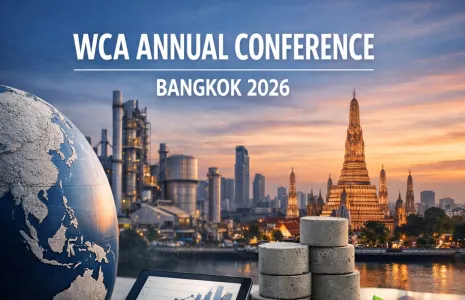
The World Cement Association (WCA) will host its 2026 Annual Conference from 19 to 21 April 2026 at The Athenee Hotel in Bangkok, Thailand. The two-day conference will bring together global cement industry leaders, policymakers, technology providers and stakeholders to examine strategic, operational and sustainability challenges shaping the sector's next phase of transformation. The programme will open with an assessment of the global economic environment and regional outlooks across Asia and Europe.\n\nDelegates will review regulatory developments including carbon border adjustment mechanisms in Europe and progress in China's carbon trading system while examining market dynamics in Thailand and South East Asia. Industry experts will outline practical decarbonisation pathways designed to safeguard competitiveness, covering alternative fuels, next generation supplementary cementitious materials and calcined clay developments. Sessions will also consider artificial intelligence enabled kiln optimisation and digital maturity in plant operations.\n\nThe second conference day will address overcapacity and industry restructuring with case studies and regional perspectives intended to provide practical insights into unlocking performance while accelerating decarbonisation. Discussions will include manufacturing optimisation, sustainable building solutions and circular concrete models alongside evolving customer requirements across the construction value chain. The event will also feature an awards ceremony recognising excellence in sustainability, innovation, safety and leadership at an awards gala dinner on 20 April.\n\nPhilippe Richart, chief executive officer of the World Cement Association, said the sector faced complex challenges and opportunities and that the conference would promote exchange of practical solutions and strengthened collaboration to shape a sustainable and resilient future for cement. Registration is open and tickets include admission to all sessions, refreshments and lunch, exhibition access and the awards gala dinner. Further information and enquiries on sponsorship and exhibition were directed to the WCA event team.

The World Cement Association (WCA) will host its 2026 Annual Conference from 19 to 21 April 2026 at The Athenee Hotel in Bangkok, Thailand. The two-day conference will bring together global cement industry leaders, policymakers, technology providers and stakeholders to examine strategic, operational and sustainability challenges shaping the sector's next phase of transformation. The programme will open with an assessment of the global economic environment and regional outlooks across Asia and Europe.\n\nDelegates will review regulatory developments including carbon border adjustment mechanisms in Europe and progress in China's carbon trading system while examining market dynamics in Thailand and South East Asia. Industry experts will outline practical decarbonisation pathways designed to safeguard competitiveness, covering alternative fuels, next generation supplementary cementitious materials and calcined clay developments. Sessions will also consider artificial intelligence enabled kiln optimisation and digital maturity in plant operations.\n\nThe second conference day will address overcapacity and industry restructuring with case studies and regional perspectives intended to provide practical insights into unlocking performance while accelerating decarbonisation. Discussions will include manufacturing optimisation, sustainable building solutions and circular concrete models alongside evolving customer requirements across the construction value chain. The event will also feature an awards ceremony recognising excellence in sustainability, innovation, safety and leadership at an awards gala dinner on 20 April.\n\nPhilippe Richart, chief executive officer of the World Cement Association, said the sector faced complex challenges and opportunities and that the conference would promote exchange of practical solutions and strengthened collaboration to shape a sustainable and resilient future for cement. Registration is open and tickets include admission to all sessions, refreshments and lunch, exhibition access and the awards gala dinner. Further information and enquiries on sponsorship and exhibition were directed to the WCA event team.

Next Story
Infrastructure Urban

Implementation Status of Jal Jeevan Mission

Since August 2019 the Government has implemented Jal Jeevan Mission to provide assured potable water through household tap connections in rural India. At the start of the mission only 32.3 million (mn) rural households, representing 16.7 per cent, were reported to have tap water connections. States and union territories have reported that 125.8 mn additional rural households have since been provided with tap connections. As a result, of about 193.6 mn rural households roughly 158.2 mn, or 81.71 per cent, are reported to have tap water supply at home.\n\nThe State, district and village level st..

Next Story
Infrastructure Urban

Jal Jeevan Mission Reaches Eighty One Per Cent Rural Coverage

The Government reported substantial progress under the Jal Jeevan Mission, launched in August 2019 to provide tap water to every rural household. At launch only 32.3 million (mn) rural households had tap connections and states and Union territories reported provision of 125.8 mn additional households by March 2026. Consequently, out of about 193.6 mn rural households around 158.2 mn, or 81.71 per cent, are reported to have tap water at home. The Finance Minister announced extension of the mission until 2028 in the 2025-26 budget speech. The Swachh Bharat Mission Grameen, launched in October 20..

Next Story
Infrastructure Urban

Empowering Local Governance for Sustainable Rural Water Supply

The Ministry of Jal Shakti has aligned the Jal Jeevan Mission (JJM) with the 73rd Amendment to strengthen village level planning and community ownership of water supply. Gram Panchayats, village water and sanitation committees and Pani Samitis are to plan, implement, manage and maintain piped water systems, with gram sabha processes formalising handover and oversight. Implementation support agencies including non government organisations, community based organisations and self help groups have been empanelled to train local committees and promote women participation. Under JJM, the department ..

Advertisement

Subscribe to Our Newsletter

Get daily newsletters around different themes from Construction world.

STAY CONNECTED

Advertisement

Advertisement

Advertisement