Air India Expands International Network With Upgraded Aircraft
AVIATION & AIRPORTS

Air India Expands International Network With Upgraded Aircraft

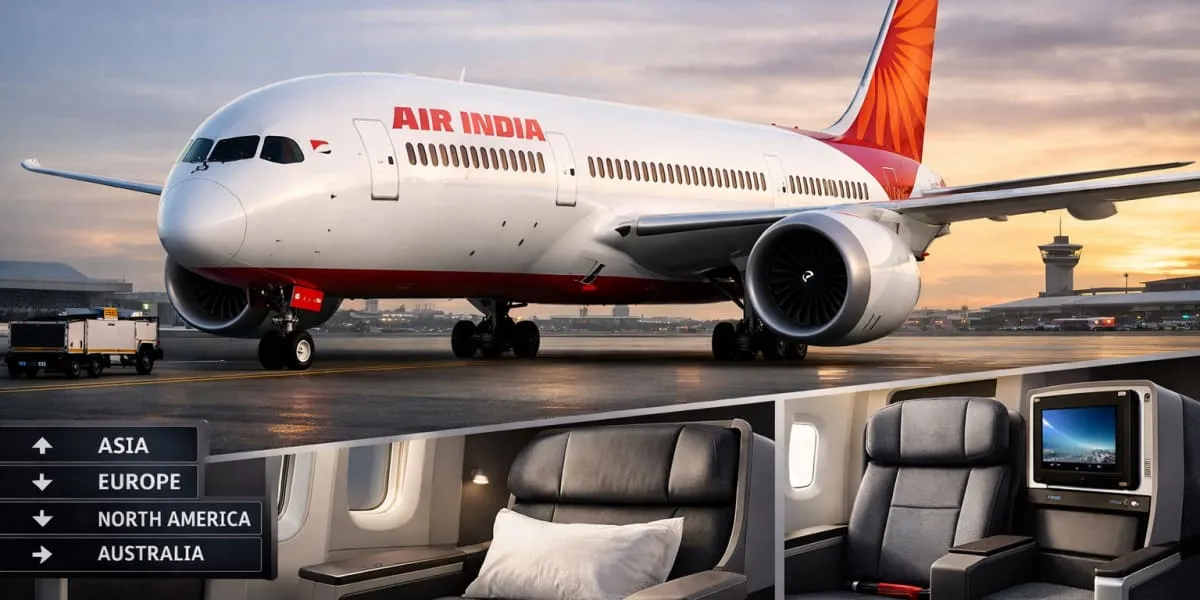
Air India is expanding its international network under the Northern Summer Schedule 2026 and will deploy aircraft with new, retrofitted or upgraded cabin interiors on long-haul routes to boost capacity and passenger comfort across Asia, Europe, North America and Australia. From 14 February 2026, the Delhi–Tokyo Haneda service will be operated by the Boeing 787-9 in a three-class configuration, introducing Premium Economy and adding 2,408 seats per month.

Starting one March 2026, flights between Delhi and Toronto will rise from seven weekly to 10 weekly to improve connectivity to Canada. From 29 March 2026, the Delhi–Seoul Incheon service will increase from five weekly to six weekly, and the Delhi–Shanghai service will expand from four weekly to five weekly, with each increase adding about 2,048 seats per month.

From July, Mumbai–London Heathrow will be operated by a mix of new Boeing 787-9 and retrofitted Boeing 787-8 aircraft with new cabin interiors, replacing the Boeing 777-300ER. Several other long-haul sectors will receive similar new or upgraded cabin products.

Daily Delhi–Melbourne services will use upgraded Boeing 777-300ER aircraft and will introduce First Class with eight First Class suites, 40 fully flat beds in Business Class and 280 seats in Economy Class, adding nearly 4,000 seats per month. From August, Bengaluru–London Heathrow flights will be operated with retrofitted Boeing 787-8 aircraft featuring Premium Economy so all services to London Heathrow will have upgraded cabin products.

The airline is retrofitting 26 Boeing 787-8 aircraft with new cabins and a repaint in Air India’s new livery, and expects the first two retrofitted aircraft to return to service in the coming weeks with further upgrades through 2026. Air India also expects delivery of three new Boeing 787-9 aircraft and two Airbus A350-1000 aircraft in line fit configuration as part of the Tata Group transformation plan to modernise the carrier and enhance the long-haul travel experience.

Air India is expanding its international network under the Northern Summer Schedule 2026 and will deploy aircraft with new, retrofitted or upgraded cabin interiors on long-haul routes to boost capacity and passenger comfort across Asia, Europe, North America and Australia. From 14 February 2026, the Delhi–Tokyo Haneda service will be operated by the Boeing 787-9 in a three-class configuration, introducing Premium Economy and adding 2,408 seats per month. Starting one March 2026, flights between Delhi and Toronto will rise from seven weekly to 10 weekly to improve connectivity to Canada. From 29 March 2026, the Delhi–Seoul Incheon service will increase from five weekly to six weekly, and the Delhi–Shanghai service will expand from four weekly to five weekly, with each increase adding about 2,048 seats per month. From July, Mumbai–London Heathrow will be operated by a mix of new Boeing 787-9 and retrofitted Boeing 787-8 aircraft with new cabin interiors, replacing the Boeing 777-300ER. Several other long-haul sectors will receive similar new or upgraded cabin products. Daily Delhi–Melbourne services will use upgraded Boeing 777-300ER aircraft and will introduce First Class with eight First Class suites, 40 fully flat beds in Business Class and 280 seats in Economy Class, adding nearly 4,000 seats per month. From August, Bengaluru–London Heathrow flights will be operated with retrofitted Boeing 787-8 aircraft featuring Premium Economy so all services to London Heathrow will have upgraded cabin products. The airline is retrofitting 26 Boeing 787-8 aircraft with new cabins and a repaint in Air India’s new livery, and expects the first two retrofitted aircraft to return to service in the coming weeks with further upgrades through 2026. Air India also expects delivery of three new Boeing 787-9 aircraft and two Airbus A350-1000 aircraft in line fit configuration as part of the Tata Group transformation plan to modernise the carrier and enhance the long-haul travel experience.

Next Story
Infrastructure Energy

Indian Urea Producers Shut Plants As Iran War Cuts Qatari LNG Supplies

Indian urea producers have shut several plants after the war involving Iran led to cuts in Qatari supplies of liquefied natural gas (LNG), industry participants said. The reduction in LNG shipments has constrained feedstock availability and raised operational pressures at ammonia and urea units across the country, complicating production scheduling and maintenance plans. Producers have scaled back output in response to fuel shortages and logistical challenges affecting domestic fertiliser production and have implemented staggered shutdowns to manage inventories. The disruptions have heightened..

Next Story
Infrastructure Urban

Adani Plans Rs 600 bn Investment In Schools And Hospitals

Adani Group plans a Rs 600 billion (Rs 600 bn) social investment to construct 300 schools and 30 hospitals across India, aimed at expanding educational and healthcare infrastructure nationwide. The initiative is presented as a long term commitment to strengthen community services and address gaps in access to quality education and primary healthcare. The group highlighted investment in both physical infrastructure and associated services to ensure schools and hospitals are functional from opening. The programme will focus on building resilient facilities that meet prevailing regulatory standar..

Next Story
Infrastructure Transport

PM Launches Development Projects Worth Rs 235.5 Billion (bn) From Silchar

The Prime Minister launched development projects worth Rs 235.5 billion (bn) from Silchar in Assam and performed the bhumi pujan for three projects in the Barak Valley. The schemes comprise the Silchar High-Speed Corridor at an estimated cost of Rs 228.6 bn, the Silchar Town Flyover at about Rs 5.65 bn and the Patharkandi College of Agriculture at about Rs 1.22 bn. The announcement was made at a public ceremony in Cachar district. He said that southern Assam's Barak Valley is emerging as a strategic link to Southeast Asia and that the North East is taking a lead in the government's Act East po..

Advertisement

Subscribe to Our Newsletter

Get daily newsletters around different themes from Construction world.

STAY CONNECTED

Advertisement

Advertisement

Advertisement