Odisha Launches Rs Six Billion Bridge-Cum-Weir Scheme
ROADS & HIGHWAYS

Odisha Launches Rs Six Billion Bridge-Cum-Weir Scheme

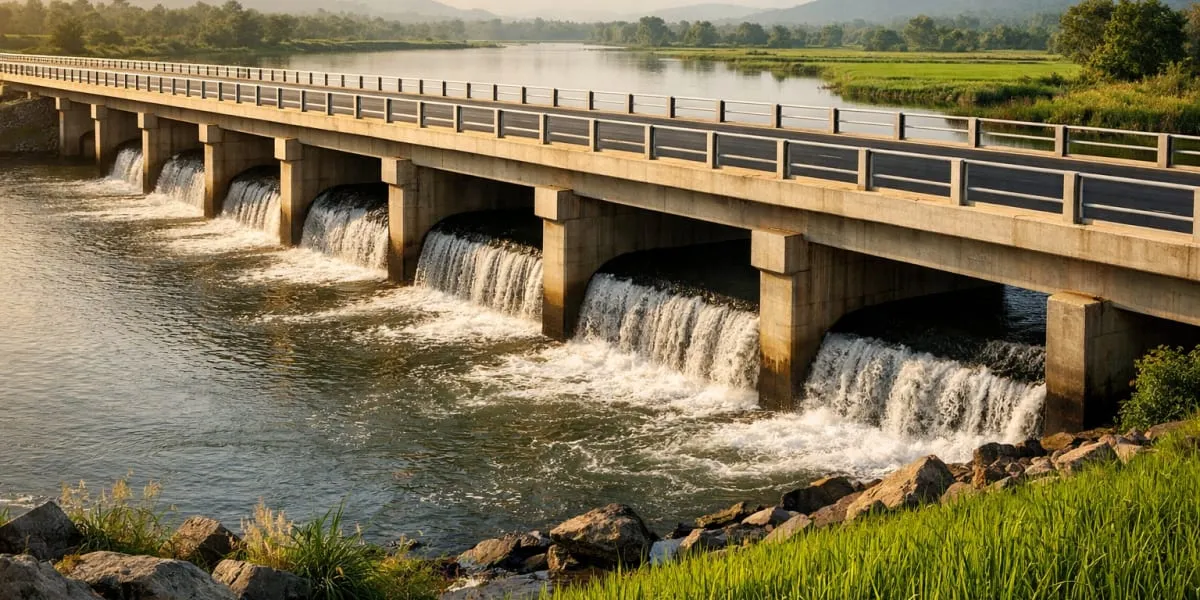
The Odisha government has launched a five-year bridge-cum-weir scheme with an outlay of Rs six billion (Rs 6 bn) to enhance rural connectivity and water conservation across districts. The scheme, to be implemented from 2026-27 to 2030-31, will convert existing bridges into structures that provide uninterrupted road connectivity and impound water for irrigation, groundwater recharge, livestock and domestic use.

The Rural Development department said 670 bridge-cum-weir projects will be taken up during the period. The programme will include 106 new projects and completion of 162 spill-over projects in 2026-27 at an estimated cost of Rs 550 million (Rs 550 mn), and will continue with 100 projects each year from 2027-28 to 2030-31 supported by an allocation of Rs 5.45 billion (Rs 5.45 bn). The total investment over the five-year period will be Rs six billion (Rs 6 bn).

To ensure safety and long-term sustainability the government has prescribed technical criteria for project selection and will consider only structurally sound bridges with open or raft foundations. Preference will be given to bridges where rigid floor protection is already in good condition and to sites with mild to moderate stream-bed slopes to minimise scouring and structural damage.

Selected bridges should be located across streams with moderate to low water currents where velocity generally does not exceed three metres per second and where stable well-defined embankments can safely store impounded water without flooding adjoining areas. The scheme requires that bridge-cum-weirs directly benefit nearby habitations, agricultural fields and livestock by providing dependable water storage and the government has said a third-party evaluation will be carried out at the end of the period to assess socio-economic and environmental impact and inform decisions on continuation.

The Odisha government has launched a five-year bridge-cum-weir scheme with an outlay of Rs six billion (Rs 6 bn) to enhance rural connectivity and water conservation across districts. The scheme, to be implemented from 2026-27 to 2030-31, will convert existing bridges into structures that provide uninterrupted road connectivity and impound water for irrigation, groundwater recharge, livestock and domestic use. The Rural Development department said 670 bridge-cum-weir projects will be taken up during the period. The programme will include 106 new projects and completion of 162 spill-over projects in 2026-27 at an estimated cost of Rs 550 million (Rs 550 mn), and will continue with 100 projects each year from 2027-28 to 2030-31 supported by an allocation of Rs 5.45 billion (Rs 5.45 bn). The total investment over the five-year period will be Rs six billion (Rs 6 bn). To ensure safety and long-term sustainability the government has prescribed technical criteria for project selection and will consider only structurally sound bridges with open or raft foundations. Preference will be given to bridges where rigid floor protection is already in good condition and to sites with mild to moderate stream-bed slopes to minimise scouring and structural damage. Selected bridges should be located across streams with moderate to low water currents where velocity generally does not exceed three metres per second and where stable well-defined embankments can safely store impounded water without flooding adjoining areas. The scheme requires that bridge-cum-weirs directly benefit nearby habitations, agricultural fields and livestock by providing dependable water storage and the government has said a third-party evaluation will be carried out at the end of the period to assess socio-economic and environmental impact and inform decisions on continuation.

Related Stories

Gold Stories

Next Story
Infrastructure Urban

KONE Opens India's First Digital Experience Centre in Pune

KONE, a global elevator and escalator manufacturer, has inaugurated its first Digital Experience Centre (DEC) in India, located in Pune. The facility aims to showcase how artificial intelligence (AI), connectivity and data-driven technologies can enhance customer experiences and improve building operations.The centre was inaugurated by Jussi Herlin, Executive Vice Chair, KONE Corporation; Philippe Delorme, President and CEO, KONE; and Nandan Nilekani, Co-founder and Chairman of the Board, Infosys.Designed as an interactive customer environment, the facility demonstrates digital solutions cover..

Next Story
Infrastructure Urban

CII GreenCo Launches Circularity Guidelines for Indian Industry

The Confederation of Indian Industry (CII) GreenCo Council has launched the CII GreenCo Circularity Guidelines – Pilot Version at the 17th CII GreenCo Waste & Resource Management Summit 2026 in Chennai. The initiative aims to strengthen resource efficiency, waste reduction and circular economy practices across Indian manufacturing and process industries.The guidelines introduce a structured framework with circularity indices covering raw materials, consumables, packaging and other resource inputs. These indicators will help industries assess existing practices, identify opportunities to ..

Next Story
Infrastructure Energy

Global Electronics Association Launches IPC-1783-CO2E Standard

The Global Electronics Association has introduced IPC-1783-CO2E, a new international standard aimed at improving consistency, transparency and comparability in product carbon footprint reporting across the electronics manufacturing industry.The standard, titled International Standard for Data Collection and Reporting of CO2 Equivalent (CO2e) Emissions for the Electronics Manufacturing Supply Chain, provides industry-specific guidance for collecting, estimating and reporting carbon emissions data.With increasing regulatory requirements and customer expectations, electronics manufacturers face c..

Advertisement

Subscribe to Our Newsletter

Get daily newsletters around different themes from Construction world.

STAY CONNECTED

Advertisement

SPECIAL OFFER
QR Code