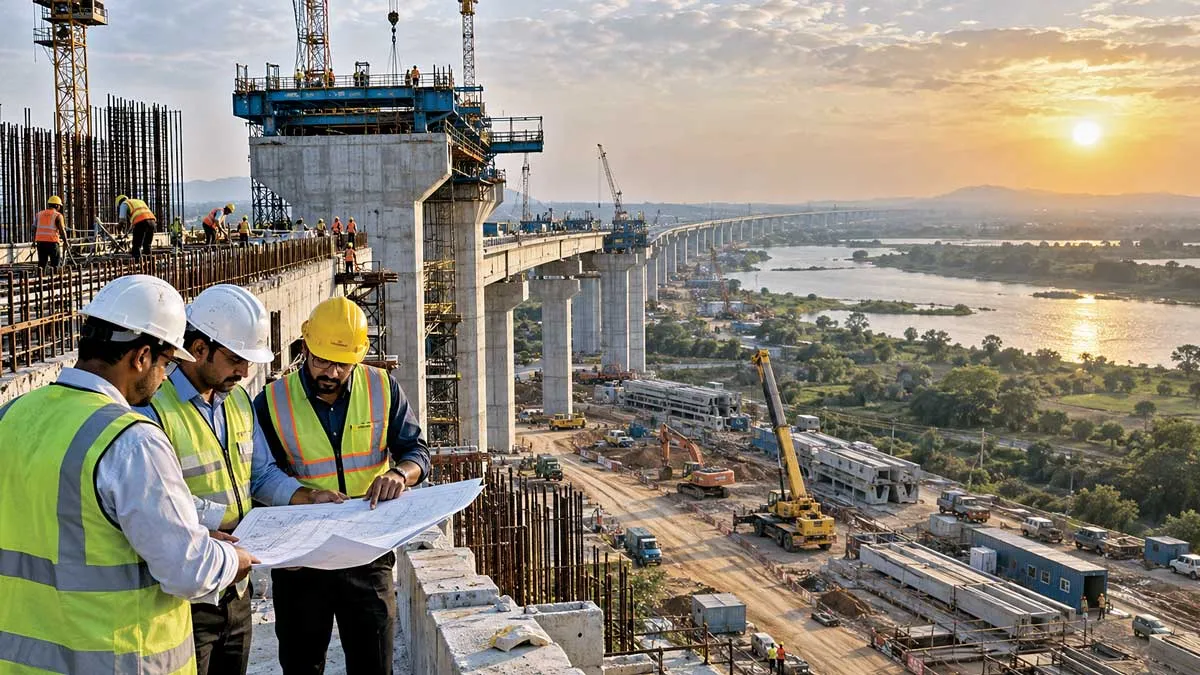
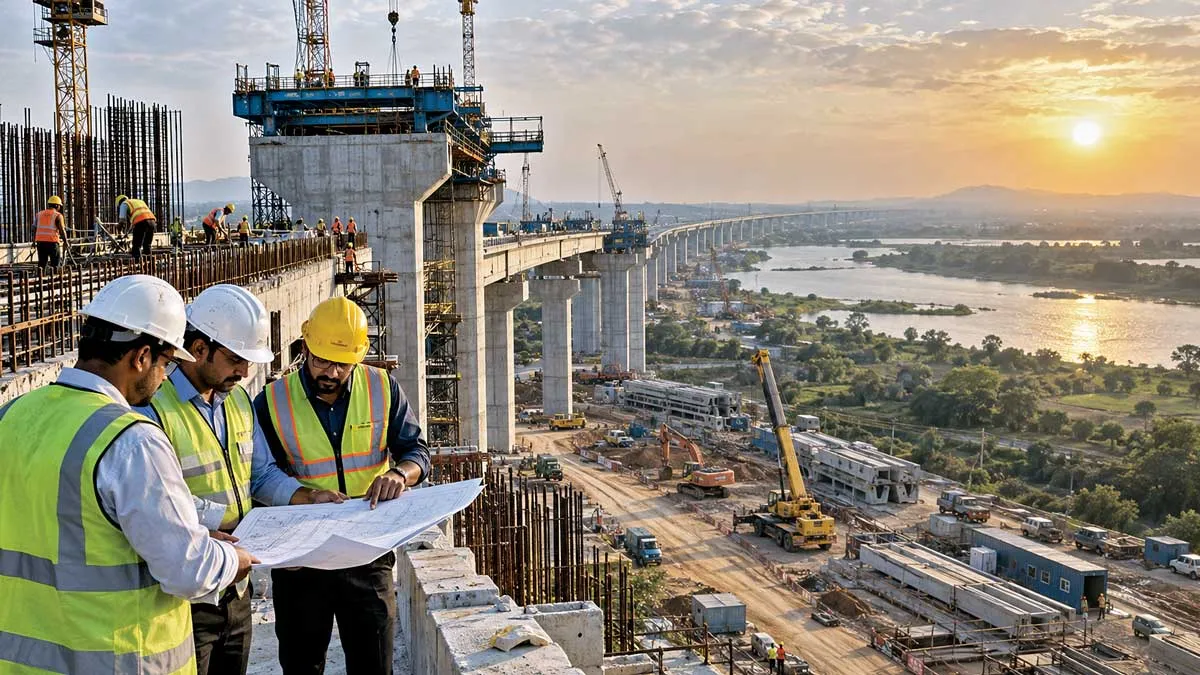
India's infrastructure sector is building at a scale few markets can match. New highways, expressways, metros, bridges and complex engineering projects are transforming the country's landscape. Yet, behind this rapid expansion is a growing concern within the contracting community: Can infrastructure be delivered sustainably when competition pushes prices below commercially viable levels?For Praveen Sethia, Founder & Director, Infra Advisors, who moderated the discussion, the question goes beyond the contractor's commercial interests. Contractors may be one of the two parties to a contract, but they operate in what is often a far more challenging execution environment while carrying the responsibility of converting plans, approvals and investments into physical infrastructure. And when bidding becomes excessively aggressive, the risk does not remain confined to the contractor – it ultimately extends to the infrastructure asset itself.That distinction shaped much of the discussion. Ultra-low bids may put a contractor's equipment, manpower and financial resources at risk, but delayed or compromised execution can also affect national assets – particularly network projects, where a delay in one package can hold up the benefits of an entire corridor.The issue, therefore, is not competition itself. Competition is central to efficient procurement. The concern is what happens when the race for the lowest bid becomes disconnected from the actual cost of delivering a project to the required quality and performance standards.Ultra-low bidding was one of the strongest concerns to emerge from the discussion.Ajay Hans, Managing Director, GHV Infra Projects, pointed out that contractors today are often bidding not merely to secure margins but to sustain their organisations. Construction companies carry significant investments in plant, equipment, manpower and operational infrastructure. Keeping these assets productive, maintaining order books and preserving banking limits can sometimes become critical considerations in the decision to pursue a project.But there is a point beyond which competition becomes unhealthy.When bids fall dramatically below estimated costs, the industry has to ask a fundamental question: How can the project be delivered without compromising either time, quality or commercial viability?Hans argued that the bidding system needs to move beyond price alone. Contractor quality ratings, performance credentials and other parameters should play a greater role in project awards. An unusually large difference between the L1 bid and other bids, he suggested, should also invite greater scrutiny.T R Rao, Whole Time Director, PNC Infratech, echoed this concern, describing ultra-low bidding as a challenge that has intensified in the post-COVID period. The expansion of the contractor base and the relaxation of qualification criteria increased participation in the market, while contractors also faced pressure to keep their people and equipment engaged. The result has been intense competition, particularly in projects where entry barriers are relatively low.Rao's argument was straightforward: Civil construction has a practical cost structure. While contractors can improve efficiencies, reduce overheads and adopt better engineering practices, there is a limit to how much cost can realistically be compressed. Beyond that point, something has to give.For highly specialised infrastructure works, the challenge is even more pronounced.Puneet Singh, Managing Director, Maccaferri India, highlighted the importance of strong pre-qualification criteria, particularly in sectors such as slope stabilisation and rockfall protection. These are not conventional construction activities that can be executed simply because a contractor has experience in roads. They require specialised geotechnical knowledge, engineering design and execution capabilities. The industry, therefore, needs to distinguish between broad contracting capacity and specialised competence.Recent measures requiring additional financial security for exceptionally low bids were seen as steps in the right direction. However, Sethia raised a larger question during the discussion: Are such measures addressing the problem at its source or are they mechanisms being introduced after the procurement system has already allowed an unrealistic bid to emerge? The challenge, he suggested, is to recognise the problem upfront and create a procurement framework that prevents commercially and technically unsustainable outcomes rather than merely managing their consequences.Quality has to be built into the processThe discussion repeatedly returned to one issue: Quality cannot be treated as something that is inspected into a project at the end.For Hans, quality is not simply about meeting requirements until the defect liability period expires. Infrastructure must be engineered and executed to perform well beyond handover.That requires discipline at every stage – from design and engineering to construction, supervision and monitoring.Companies are also responding to the competitive environment by becoming more selective about the projects they pursue. Rather than bidding indiscriminately, contractors are increasingly assessing where their capabilities offer an advantage and where competition is likely to be commercially unsustainable.Suhas Eklahare, Associate Director, NCC, noted that companies must analyse competition and focus on projects where their technical strengths can make a difference. NCC is also looking at technology, monitoring systems, training and operational efficiencies as ways of strengthening execution without compromising quality.Technology, however, comes with its own commercial challenge.Greater mechanisation, digital monitoring, BIM and other advanced systems can improve quality and control, but they require investment. Rao made the point that if one contractor factors in the cost of advanced equipment and technology while another assumes a lower-cost execution model, the bidding process may not create a level playing field. The answer may lie in making quality expectations and technological requirements part of the bidding and contractual framework itself.Contracts, skills and climate risksThe sustainability of the contracting sector also depends on how risks are allocated and managed.India's contracting frameworks have evolved significantly across EPC, HAM and BOT models. However, the effectiveness of a contract depends as much on implementation as on the document itself. Delays in land acquisition, for instance, can prevent work from progressing even after a contractor has mobilised manpower and equipment.The consequences are not limited to contractors. Delayed infrastructure also means delayed economic benefits. Project completion, therefore, needs to become a shared responsibility rather than being viewed solely as a contractor's obligation.The industry is also grappling with manpower shortages.Eklahare spoke about the need to improve workforce retention through better worker facilities, timely payments, incentives and training. A more stable and skilled workforce, he pointed out, has a direct impact on project quality and productivity.Meanwhile, changing climatic conditions are adding another dimension to infrastructure risk.Increasingly intense rainfall, landslides and slope failures are forcing engineers and contractors to reassess conventional approaches to design and execution.Singh emphasised that such failures are rarely caused by a single factor. Geological conditions, inadequate investigations, drainage issues, design assumptions and execution practices can combine to create vulnerability.The response, therefore, has to be proactive. Advanced geotechnical solutions, monitoring systems and slope protection technologies must increasingly become part of infrastructure planning rather than being deployed only after an incident.Quality is not a separate functionPerhaps the most fitting conclusion to the discussion came from Sethia himself.“Quality,” he observed, “should be part of the process – it should not stand outside and merely watch whether the work is being carried out properly.”That observation captures the central message of the discussion.Quality cannot be separated from the way a project is bid. It cannot be separated from contractor capability, workforce skills, technology, risk allocation or engineering design. Nor can it be guaranteed through inspection alone. If India is to build infrastructure that performs over decades rather than merely reaching completion milestones, quality has to begin much earlier – in the way projects are conceived, procured, designed and priced.The real measure of infrastructure, therefore, cannot simply be how cheaply a project was awarded or how quickly it was completed. It will be how reliably it performs, how resilient it remains and how long it continues to serve.(The above views were expressed during a panel discussion held at RAHSTA in August in Mumbai. The session was moderated by Praveen Sethia, Founder & Director, Infra Advisors, and featured Ajay Hans, Managing Director, GHV Infra Projects; T R Rao, Whole Time Director, PNC Infratech; Puneet Singh, Managing Director, Maccaferri India; and Suhas Eklahare, Associate Director, NCC.)