Bengaluru Suburban Rail And Metro To Share 500-Metre Corridor
RAILWAYS & METRO RAIL

Bengaluru Suburban Rail And Metro To Share 500-Metre Corridor

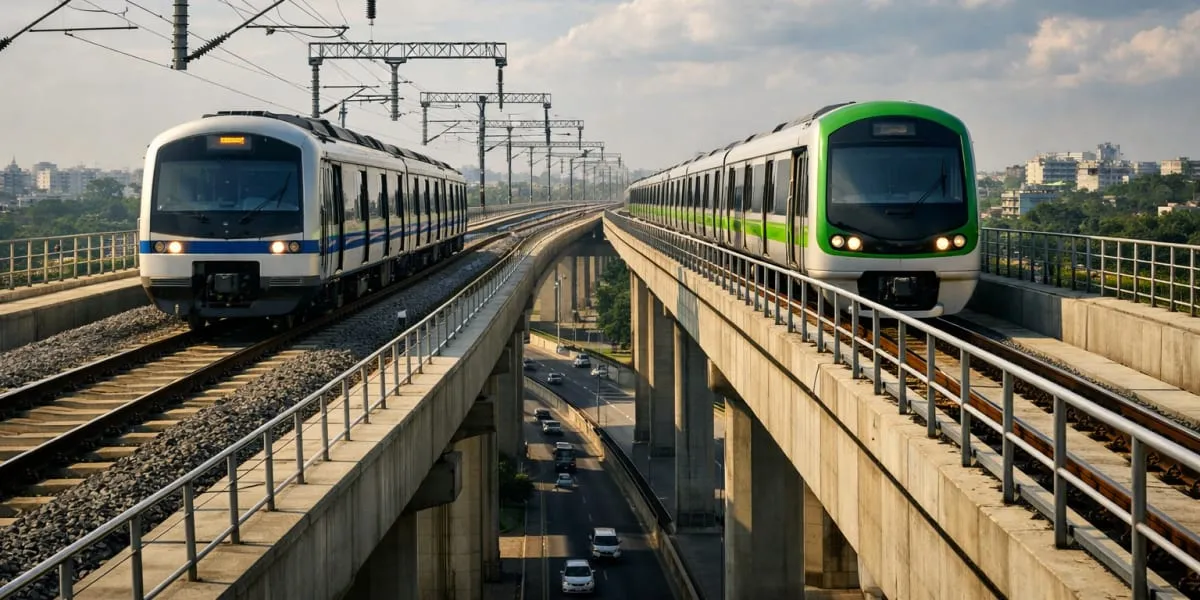
Bengaluru suburban rail and the Metro will share a 500-metre corridor at Benniganahalli, a decision that planners say will reduce capital expenditure and urban disruption. The consolidation of alignments across the short stretch is intended to avoid duplication of elevated structures and station facilities while cutting land acquisition needs. Authorities put the maximum savings at Rs 1.69 bn (1,690 mn). The arrangement also aims to streamline construction interfaces between the two systems.

The shared corridor will require coordinated design of track beds, piers and passenger access so that signalling and safety systems can be integrated where feasible. Project teams will align construction schedules to minimise the pile-up of work and to limit traffic diversions in the surrounding neighbourhood. Engineering assessments have focused on harmonising clearances and loadings to accommodate both rail systems within the constrained corridor. This technical integration is intended to reduce contingency costs.

Financially, combining the routes removes the need for separate viaducts and ancillary structures over the 500-metre stretch, lowering material and labour outlays. Savings stem from reduced land purchases, fewer utility relocations and simplified traffic management during works. The Rs 1.69 bn (1,690 mn) figure reflects an estimate of avoided capital items and is cited by project planners as the upper bound of savings. Officials indicate that cost efficiencies will be reallocated to improve station access and passenger amenities on adjacent segments.

Stakeholders will proceed to finalise engineering drawings and obtain statutory clearances before construction planning proceeds. Coordination between agencies is being positioned as a model for integrating urban transport projects in dense corridors. The integrated corridor is expected to shorten delivery timelines for the linked segments and limit long-term maintenance overlaps. Project managers emphasise that careful staging will be required to maintain service continuity on existing routes during works.

Bengaluru suburban rail and the Metro will share a 500-metre corridor at Benniganahalli, a decision that planners say will reduce capital expenditure and urban disruption. The consolidation of alignments across the short stretch is intended to avoid duplication of elevated structures and station facilities while cutting land acquisition needs. Authorities put the maximum savings at Rs 1.69 bn (1,690 mn). The arrangement also aims to streamline construction interfaces between the two systems. The shared corridor will require coordinated design of track beds, piers and passenger access so that signalling and safety systems can be integrated where feasible. Project teams will align construction schedules to minimise the pile-up of work and to limit traffic diversions in the surrounding neighbourhood. Engineering assessments have focused on harmonising clearances and loadings to accommodate both rail systems within the constrained corridor. This technical integration is intended to reduce contingency costs. Financially, combining the routes removes the need for separate viaducts and ancillary structures over the 500-metre stretch, lowering material and labour outlays. Savings stem from reduced land purchases, fewer utility relocations and simplified traffic management during works. The Rs 1.69 bn (1,690 mn) figure reflects an estimate of avoided capital items and is cited by project planners as the upper bound of savings. Officials indicate that cost efficiencies will be reallocated to improve station access and passenger amenities on adjacent segments. Stakeholders will proceed to finalise engineering drawings and obtain statutory clearances before construction planning proceeds. Coordination between agencies is being positioned as a model for integrating urban transport projects in dense corridors. The integrated corridor is expected to shorten delivery timelines for the linked segments and limit long-term maintenance overlaps. Project managers emphasise that careful staging will be required to maintain service continuity on existing routes during works.

Next Story
Infrastructure Urban

Cabinet Approves Two Year Scheme To Replace Old Trucks And Buses

The Union Cabinet, chaired by the Prime Minister, approved a two-year scheme to reduce air pollution in the Delhi–NCR region and promote cleaner mobility. The programme will be funded through the National Capital Region Planning Board under the Ministry of Housing and Urban Affairs and implemented by the Ministry of Road Transport and Highways and the Ministry of Petroleum and Natural Gas, with participating States and Union Territories of Delhi, Haryana, Rajasthan and Uttar Pradesh. The total financial outlay has been set at Rs 95.85 billion (bn), with the Central Government contributing Rs..

Advertisement

Subscribe to Our Newsletter

Get daily newsletters around different themes from Construction world.

STAY CONNECTED

Advertisement

Advertisement

Advertisement