+
Cabinet Clears 16 km Delhi Metro Phase V(A) Expansion
RAILWAYS & METRO RAIL

Cabinet Clears 16 km Delhi Metro Phase V(A) Expansion

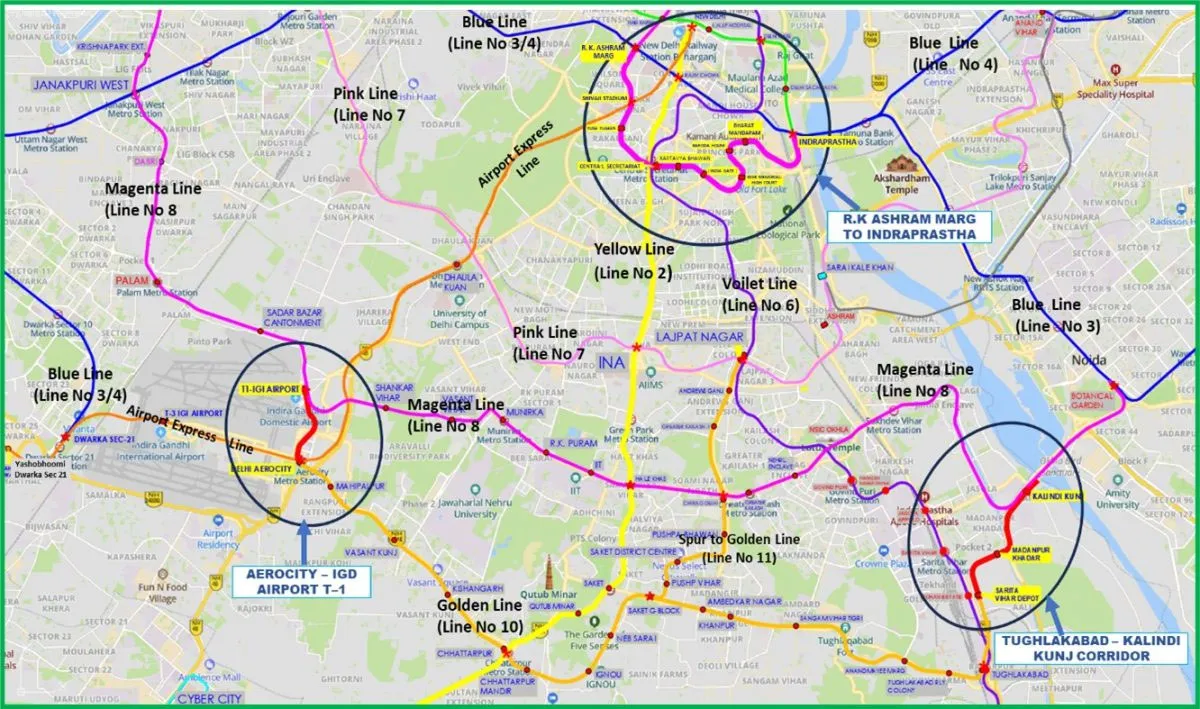
The Union Cabinet, chaired by Prime Minister Narendra Modi, has approved the construction of three new corridors under Delhi Metro Phase V(A), aimed at strengthening connectivity across key parts of the national capital. The approved stretches include R.K. Ashram Marg to Indraprastha (9.913 km), Aerocity to Indira Gandhi Domestic Airport Terminal-1 (2.263 km) and Tughlakabad to Kalindi Kunj (3.9 km). Together, the project will add 16.076 km to the Metro network at an estimated cost of Rs 120.15 billion, to be funded by the Centre, the Government of Delhi and international funding agencies.

According to the Cabinet decision, the R.K. Ashram Marg–Indraprastha corridor will provide direct Metro access to the Central Vista area, including the Kartavya Bhawans. Officials said the line is expected to benefit around 60,000 office-goers and nearly 200,000 visitors daily, while helping ease road congestion and reduce fossil fuel consumption. This corridor will extend the existing Botanical Garden–R.K. Ashram Marg line.

The Aerocity–IGD Terminal-1 and Tughlakabad–Kalindi Kunj corridors will extend the Aerocity–Tughlakabad line, improving airport connectivity from south Delhi localities such as Saket, Chhattarpur and Kalindi Kunj. In total, the three extensions will comprise 13 stations, of which 10 will be underground and three elevated.

Once operational, the R.K. Ashram Marg–Indraprastha stretch is expected to enhance links between west, north and old Delhi with central Delhi. The airport and south Delhi extensions will provide direct Metro access to Domestic Airport Terminal-1 through major residential and commercial areas. These additions, forming part of the Magenta Line and the Golden Line, are also expected to reduce vehicular pollution.

Stations on the R.K. Ashram Marg–Indraprastha section will include R.K. Ashram Marg, Shivaji Stadium, Central Secretariat, Kartavya Bhawan, India Gate, War Memorial–High Court, Baroda House, Bharat Mandapam and Indraprastha. The Tughlakabad–Kalindi Kunj stretch will have stations at Sarita Vihar Depot, Madanpur Khadar and Kalindi Kunj, while the Aerocity corridor will be extended to IGD Terminal-1.

Meanwhile, construction under Phase IV of the Delhi Metro, covering 111 km with 83 stations, is progressing. Officials said about 80.43 per cent of civil work on the three priority corridors has been completed, with phased commissioning targeted by December 2026. The Metro currently records an average daily ridership of around 6.5 million passenger journeys, with a peak of 8.19 million trips logged on 8 August 2025.

At present, the network spans about 395 km across 12 operational lines with 289 stations in Delhi and the National Capital Region, operated by the Delhi Metro Rail Corporation.

The Union Cabinet, chaired by Prime Minister Narendra Modi, has approved the construction of three new corridors under Delhi Metro Phase V(A), aimed at strengthening connectivity across key parts of the national capital. The approved stretches include R.K. Ashram Marg to Indraprastha (9.913 km), Aerocity to Indira Gandhi Domestic Airport Terminal-1 (2.263 km) and Tughlakabad to Kalindi Kunj (3.9 km). Together, the project will add 16.076 km to the Metro network at an estimated cost of Rs 120.15 billion, to be funded by the Centre, the Government of Delhi and international funding agencies. According to the Cabinet decision, the R.K. Ashram Marg–Indraprastha corridor will provide direct Metro access to the Central Vista area, including the Kartavya Bhawans. Officials said the line is expected to benefit around 60,000 office-goers and nearly 200,000 visitors daily, while helping ease road congestion and reduce fossil fuel consumption. This corridor will extend the existing Botanical Garden–R.K. Ashram Marg line. The Aerocity–IGD Terminal-1 and Tughlakabad–Kalindi Kunj corridors will extend the Aerocity–Tughlakabad line, improving airport connectivity from south Delhi localities such as Saket, Chhattarpur and Kalindi Kunj. In total, the three extensions will comprise 13 stations, of which 10 will be underground and three elevated. Once operational, the R.K. Ashram Marg–Indraprastha stretch is expected to enhance links between west, north and old Delhi with central Delhi. The airport and south Delhi extensions will provide direct Metro access to Domestic Airport Terminal-1 through major residential and commercial areas. These additions, forming part of the Magenta Line and the Golden Line, are also expected to reduce vehicular pollution. Stations on the R.K. Ashram Marg–Indraprastha section will include R.K. Ashram Marg, Shivaji Stadium, Central Secretariat, Kartavya Bhawan, India Gate, War Memorial–High Court, Baroda House, Bharat Mandapam and Indraprastha. The Tughlakabad–Kalindi Kunj stretch will have stations at Sarita Vihar Depot, Madanpur Khadar and Kalindi Kunj, while the Aerocity corridor will be extended to IGD Terminal-1. Meanwhile, construction under Phase IV of the Delhi Metro, covering 111 km with 83 stations, is progressing. Officials said about 80.43 per cent of civil work on the three priority corridors has been completed, with phased commissioning targeted by December 2026. The Metro currently records an average daily ridership of around 6.5 million passenger journeys, with a peak of 8.19 million trips logged on 8 August 2025. At present, the network spans about 395 km across 12 operational lines with 289 stations in Delhi and the National Capital Region, operated by the Delhi Metro Rail Corporation.

Next Story
Infrastructure Transport

Second Mountain Tunnel Breakthrough in Palghar Advances High Speed Rail

The Mumbai-Ahmedabad high speed rail (MAHSR) project reached a milestone with the breakthrough of a mountain tunnel in Palghar, Maharashtra. Mountain tunnel MT-six measures 454 metres long and 14.4 metres wide and will accommodate up and down tracks. The breakthrough follows MT-five near Saphale on second January 2026 and the MT-six excavation was completed from both ends using the New Austrian Tunnelling Method. The ministry reported that the tunnelling was completed within 12 months. The New Austrian Tunnelling Method is favoured for its flexibility in complex geology and irregular tunnel s..

Next Story
Infrastructure Transport

Modi Government Pushes Atmanirbhar Container Drive With BCSL MoU

The Union Government advanced a plan to create an integrated, domestically anchored container ecosystem with the signing of a Memorandum of Understanding to establish the Bharat Container Shipping Line (BCSL). The MoU was signed by key agencies including the Shipping Corporation of India and Container Corporation of India alongside major port authorities and Sagarmala Finance Corporation Limited under the Ministry of Ports, Shipping and Waterways, in the presence of senior ministers. The initiative aligns with the Container Manufacturing Assistance Scheme announced in the Union Budget 2026–2..

Next Story
Infrastructure Urban

Ministry Reports Gains In Mobility For Marginalised Communities

The Ministry of Social Justice and Empowerment is implementing skill development, education and rehabilitation schemes to promote socio-economic mobility and sustainable livelihoods for marginalised and disadvantaged communities across the country. Programmes target Scheduled Castes, Other Backward Classes, Economically Weaker Sections, De-notified Tribes and Safai Karamcharis through specialised implementing corporations and empanelled training institutes. Pradhan Mantri Dakshata Aur Kushalta Sampann Hitgrahi Yojana, or PM-DAKSH, provided skill training and placement support through the Nati..

Advertisement

Subscribe to Our Newsletter

Get daily newsletters around different themes from Construction world.

STAY CONNECTED

Advertisement

Advertisement

Advertisement

Open In App