CM Promises Expert Committee For Nashik-Pune Railway Line
RAILWAYS & METRO RAIL

CM Promises Expert Committee For Nashik-Pune Railway Line

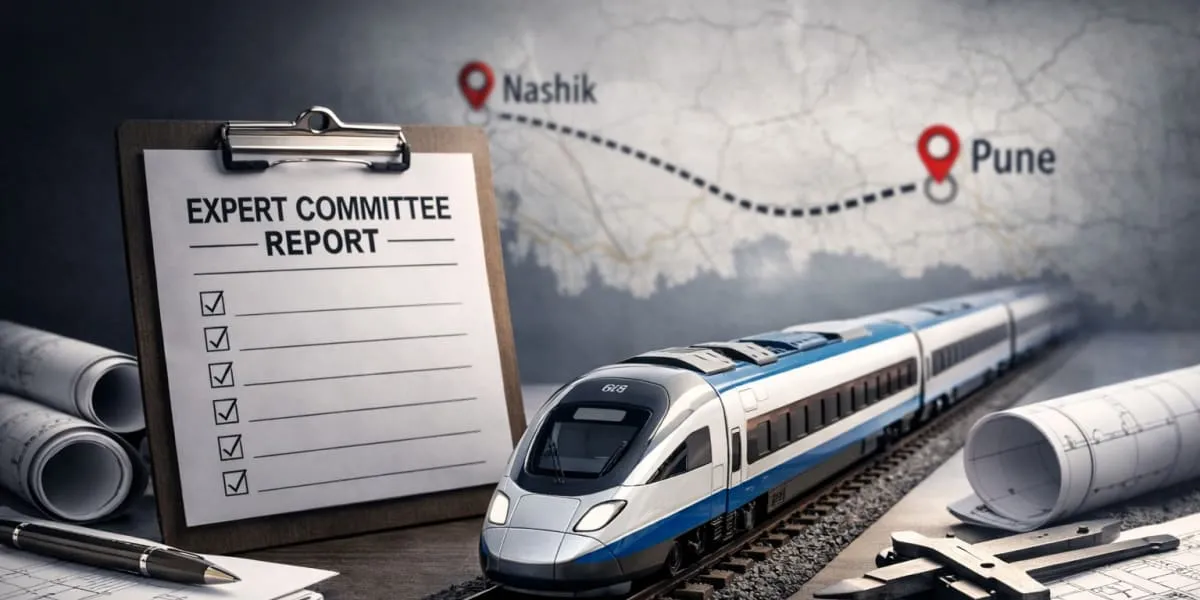
Maharashtra Chief Minister Devendra Fadnavis has said proposals for constructing a railway line between Nashik and Pune will be thoroughly studied and that an expert committee will be appointed to take the matter forward. He made the statement while replying to a question in the state legislative council and indicated that further technical and stakeholder consultations will be required. The announcement signals renewed focus on a long-pending plan to improve connectivity between the two cities.

Fadnavis said he had twice raised the proposal with the Union government and that one key constraint is the presence of the Giant Metrewave Radio Telescope (GMRT) on the most direct alignment. He noted that 32 countries are part of the GMRT project and that the facility cannot be relocated, adding a significant technical consideration to route planning. That constraint has shaped earlier responses from central authorities.

The Union government has suggested an alternative alignment via Shirdi, but that option was estimated to add 30 minutes to travel time and was reported to be unacceptable to some stakeholders. Fadnavis said he will again take up the matter with Railway Minister Ashwini Vaishnaw and that a consultant could be appointed to identify the nearest feasible route that still serves important villages. The focus will be on balancing travel time, technical feasibility and local interests.

The expert committee is expected to examine route maps, environmental and technical studies and stakeholder impact before making recommendations, and a consultant would provide detailed alignment options. Officials will need to reconcile national scientific infrastructure requirements with regional development goals. Any proposal will require coordination between state and central agencies.

The legislative council exchange highlighted the complexity of delivering new rail infrastructure in a densely used corridor and the need for careful study before commitments are made. The chief minister framed the step as a methodical approach aimed at finding a practicable solution rather than a rapid decision.

Maharashtra Chief Minister Devendra Fadnavis has said proposals for constructing a railway line between Nashik and Pune will be thoroughly studied and that an expert committee will be appointed to take the matter forward. He made the statement while replying to a question in the state legislative council and indicated that further technical and stakeholder consultations will be required. The announcement signals renewed focus on a long-pending plan to improve connectivity between the two cities. Fadnavis said he had twice raised the proposal with the Union government and that one key constraint is the presence of the Giant Metrewave Radio Telescope (GMRT) on the most direct alignment. He noted that 32 countries are part of the GMRT project and that the facility cannot be relocated, adding a significant technical consideration to route planning. That constraint has shaped earlier responses from central authorities. The Union government has suggested an alternative alignment via Shirdi, but that option was estimated to add 30 minutes to travel time and was reported to be unacceptable to some stakeholders. Fadnavis said he will again take up the matter with Railway Minister Ashwini Vaishnaw and that a consultant could be appointed to identify the nearest feasible route that still serves important villages. The focus will be on balancing travel time, technical feasibility and local interests. The expert committee is expected to examine route maps, environmental and technical studies and stakeholder impact before making recommendations, and a consultant would provide detailed alignment options. Officials will need to reconcile national scientific infrastructure requirements with regional development goals. Any proposal will require coordination between state and central agencies. The legislative council exchange highlighted the complexity of delivering new rail infrastructure in a densely used corridor and the need for careful study before commitments are made. The chief minister framed the step as a methodical approach aimed at finding a practicable solution rather than a rapid decision.

Related Stories

Gold Stories

Next Story
Infrastructure Urban

KONE Opens India's First Digital Experience Centre in Pune

KONE, a global elevator and escalator manufacturer, has inaugurated its first Digital Experience Centre (DEC) in India, located in Pune. The facility aims to showcase how artificial intelligence (AI), connectivity and data-driven technologies can enhance customer experiences and improve building operations.The centre was inaugurated by Jussi Herlin, Executive Vice Chair, KONE Corporation; Philippe Delorme, President and CEO, KONE; and Nandan Nilekani, Co-founder and Chairman of the Board, Infosys.Designed as an interactive customer environment, the facility demonstrates digital solutions cover..

Next Story
Infrastructure Urban

CII GreenCo Launches Circularity Guidelines for Indian Industry

The Confederation of Indian Industry (CII) GreenCo Council has launched the CII GreenCo Circularity Guidelines – Pilot Version at the 17th CII GreenCo Waste & Resource Management Summit 2026 in Chennai. The initiative aims to strengthen resource efficiency, waste reduction and circular economy practices across Indian manufacturing and process industries.The guidelines introduce a structured framework with circularity indices covering raw materials, consumables, packaging and other resource inputs. These indicators will help industries assess existing practices, identify opportunities to ..

Next Story
Infrastructure Energy

Global Electronics Association Launches IPC-1783-CO2E Standard

The Global Electronics Association has introduced IPC-1783-CO2E, a new international standard aimed at improving consistency, transparency and comparability in product carbon footprint reporting across the electronics manufacturing industry.The standard, titled International Standard for Data Collection and Reporting of CO2 Equivalent (CO2e) Emissions for the Electronics Manufacturing Supply Chain, provides industry-specific guidance for collecting, estimating and reporting carbon emissions data.With increasing regulatory requirements and customer expectations, electronics manufacturers face c..

Advertisement

Subscribe to Our Newsletter

Get daily newsletters around different themes from Construction world.

STAY CONNECTED

Advertisement

SPECIAL OFFER
QR Code