DMRC Submits DPR For Thiruvananthapuram Metro Project
RAILWAYS & METRO RAIL

DMRC Submits DPR For Thiruvananthapuram Metro Project

The Delhi Metro Rail Corporation (DMRC) has submitted the detailed project report for the Thiruvananthapuram metro project to the state government. The submission follows technical studies and preliminary designs prepared by the agency and marks a key milestone in the planning process. Officials will now undertake statutory reviews and a financial appraisal before decisions on approvals and funding are taken.

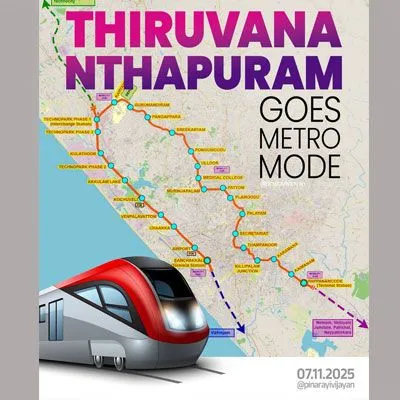
The report outlines alignment options, station locations, and proposals for elevated and underground sections where urban constraints dictate different construction methods. It also sets out ridership forecasts, integration with existing public transport and proposals for land acquisition, traffic management and utility relocation during construction. The DPR presents the project scope in a manner intended to inform detailed engineering, environmental clearances and budgetary allocations. The submission completes a phase of technical work and transfers responsibility for statutory clearances to the state administration.

The submission has triggered consultations between the state government, central agencies and financial stakeholders over project phasing and cost sharing arrangements. Planners will consider financing models that include central grants, state contributions and possible debt financing to meet capital requirements. The DMRC document is designed to support decision making on implementation timelines and procurement strategies. Detailed engineering and procurement schedules will be prepared following regulatory clearances and land acquisition processes.

Proponents emphasise that the project aims to strengthen urban mobility, reduce congestion and provide a reliable rapid transit option for commuters across the metropolitan area. Further steps include public consultations, environmental assessments and detailed designs ahead of construction readiness. Stakeholders will monitor progress as the report moves through statutory checks and budgetary planning stages. Officials will provide periodic updates as statutory milestones are cleared and implementation planning advances.

The Delhi Metro Rail Corporation (DMRC) has submitted the detailed project report for the Thiruvananthapuram metro project to the state government. The submission follows technical studies and preliminary designs prepared by the agency and marks a key milestone in the planning process. Officials will now undertake statutory reviews and a financial appraisal before decisions on approvals and funding are taken. The report outlines alignment options, station locations, and proposals for elevated and underground sections where urban constraints dictate different construction methods. It also sets out ridership forecasts, integration with existing public transport and proposals for land acquisition, traffic management and utility relocation during construction. The DPR presents the project scope in a manner intended to inform detailed engineering, environmental clearances and budgetary allocations. The submission completes a phase of technical work and transfers responsibility for statutory clearances to the state administration. The submission has triggered consultations between the state government, central agencies and financial stakeholders over project phasing and cost sharing arrangements. Planners will consider financing models that include central grants, state contributions and possible debt financing to meet capital requirements. The DMRC document is designed to support decision making on implementation timelines and procurement strategies. Detailed engineering and procurement schedules will be prepared following regulatory clearances and land acquisition processes. Proponents emphasise that the project aims to strengthen urban mobility, reduce congestion and provide a reliable rapid transit option for commuters across the metropolitan area. Further steps include public consultations, environmental assessments and detailed designs ahead of construction readiness. Stakeholders will monitor progress as the report moves through statutory checks and budgetary planning stages. Officials will provide periodic updates as statutory milestones are cleared and implementation planning advances.

Related Stories

Gold Stories

Next Story
Infrastructure Urban

KONE Opens India's First Digital Experience Centre in Pune

KONE, a global elevator and escalator manufacturer, has inaugurated its first Digital Experience Centre (DEC) in India, located in Pune. The facility aims to showcase how artificial intelligence (AI), connectivity and data-driven technologies can enhance customer experiences and improve building operations.The centre was inaugurated by Jussi Herlin, Executive Vice Chair, KONE Corporation; Philippe Delorme, President and CEO, KONE; and Nandan Nilekani, Co-founder and Chairman of the Board, Infosys.Designed as an interactive customer environment, the facility demonstrates digital solutions cover..

Next Story
Infrastructure Urban

CII GreenCo Launches Circularity Guidelines for Indian Industry

The Confederation of Indian Industry (CII) GreenCo Council has launched the CII GreenCo Circularity Guidelines – Pilot Version at the 17th CII GreenCo Waste & Resource Management Summit 2026 in Chennai. The initiative aims to strengthen resource efficiency, waste reduction and circular economy practices across Indian manufacturing and process industries.The guidelines introduce a structured framework with circularity indices covering raw materials, consumables, packaging and other resource inputs. These indicators will help industries assess existing practices, identify opportunities to ..

Next Story
Infrastructure Energy

Global Electronics Association Launches IPC-1783-CO2E Standard

The Global Electronics Association has introduced IPC-1783-CO2E, a new international standard aimed at improving consistency, transparency and comparability in product carbon footprint reporting across the electronics manufacturing industry.The standard, titled International Standard for Data Collection and Reporting of CO2 Equivalent (CO2e) Emissions for the Electronics Manufacturing Supply Chain, provides industry-specific guidance for collecting, estimating and reporting carbon emissions data.With increasing regulatory requirements and customer expectations, electronics manufacturers face c..

Advertisement

Subscribe to Our Newsletter

Get daily newsletters around different themes from Construction world.

STAY CONNECTED

Advertisement

SPECIAL OFFER
QR Code