+
Indian Railways Accelerates Modernisation Drive
RAILWAYS & METRO RAIL

Indian Railways Accelerates Modernisation Drive

Indian Railways utilised nearly 30 per cent of its capital expenditure budget for FY2026-27 within the first two months of the financial year, spending more than Rs 840 billion (bn) in April and May against a planned outlay of Rs 2.93 trillion (tn) for the year. The Union Budget allocated Rs 2.93 tn in total capex, comprising Rs 2.81 tn through gross budgetary support and Rs 120 bn from extra-budgetary resources. The early absorption indicates robust project execution and an aggressive infrastructure push.

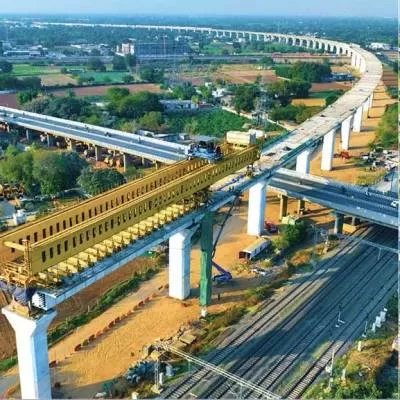
A significant share of the spending is being channelled towards track infrastructure, including new lines, doubling and gauge conversion, with more than Rs 790 bn earmarked for these segments in the current year. The expansion programme aims to reduce congestion, enhance freight movement and improve passenger services across the country, aligning with the broader national infrastructure strategy.

Safety and modernisation also account for a major portion of the capex, with roughly Rs 551.7 bn allocated for safety initiatives, including signalling upgrades and deployment of advanced train protection technology such as Kavach. Modernisation plans extend to station redevelopment, rolling stock upgrades, electrification and digital infrastructure, forming part of a long-term strategy to transform the network into a safer and more efficient transport system.

The rapid pace of spending follows full utilisation of the previous year's allocation and reflects continued emphasis on infrastructure-led growth, with railways remaining one of the largest recipients of public infrastructure investment. Officials indicated that spending remains on track to meet annual targets and that the strong start is expected to support faster project completion and significantly bolster economic activity, logistics efficiency and employment generation.

Indian Railways utilised nearly 30 per cent of its capital expenditure budget for FY2026-27 within the first two months of the financial year, spending more than Rs 840 billion (bn) in April and May against a planned outlay of Rs 2.93 trillion (tn) for the year. The Union Budget allocated Rs 2.93 tn in total capex, comprising Rs 2.81 tn through gross budgetary support and Rs 120 bn from extra-budgetary resources. The early absorption indicates robust project execution and an aggressive infrastructure push. A significant share of the spending is being channelled towards track infrastructure, including new lines, doubling and gauge conversion, with more than Rs 790 bn earmarked for these segments in the current year. The expansion programme aims to reduce congestion, enhance freight movement and improve passenger services across the country, aligning with the broader national infrastructure strategy. Safety and modernisation also account for a major portion of the capex, with roughly Rs 551.7 bn allocated for safety initiatives, including signalling upgrades and deployment of advanced train protection technology such as Kavach. Modernisation plans extend to station redevelopment, rolling stock upgrades, electrification and digital infrastructure, forming part of a long-term strategy to transform the network into a safer and more efficient transport system. The rapid pace of spending follows full utilisation of the previous year's allocation and reflects continued emphasis on infrastructure-led growth, with railways remaining one of the largest recipients of public infrastructure investment. Officials indicated that spending remains on track to meet annual targets and that the strong start is expected to support faster project completion and significantly bolster economic activity, logistics efficiency and employment generation.

Related Stories

Gold Stories

Next Story
Infrastructure Urban

KONE Opens India's First Digital Experience Centre in Pune

KONE, a global elevator and escalator manufacturer, has inaugurated its first Digital Experience Centre (DEC) in India, located in Pune. The facility aims to showcase how artificial intelligence (AI), connectivity and data-driven technologies can enhance customer experiences and improve building operations.The centre was inaugurated by Jussi Herlin, Executive Vice Chair, KONE Corporation; Philippe Delorme, President and CEO, KONE; and Nandan Nilekani, Co-founder and Chairman of the Board, Infosys.Designed as an interactive customer environment, the facility demonstrates digital solutions cover..

Next Story
Infrastructure Urban

CII GreenCo Launches Circularity Guidelines for Indian Industry

The Confederation of Indian Industry (CII) GreenCo Council has launched the CII GreenCo Circularity Guidelines – Pilot Version at the 17th CII GreenCo Waste & Resource Management Summit 2026 in Chennai. The initiative aims to strengthen resource efficiency, waste reduction and circular economy practices across Indian manufacturing and process industries.The guidelines introduce a structured framework with circularity indices covering raw materials, consumables, packaging and other resource inputs. These indicators will help industries assess existing practices, identify opportunities to ..

Next Story
Infrastructure Energy

Global Electronics Association Launches IPC-1783-CO2E Standard

The Global Electronics Association has introduced IPC-1783-CO2E, a new international standard aimed at improving consistency, transparency and comparability in product carbon footprint reporting across the electronics manufacturing industry.The standard, titled International Standard for Data Collection and Reporting of CO2 Equivalent (CO2e) Emissions for the Electronics Manufacturing Supply Chain, provides industry-specific guidance for collecting, estimating and reporting carbon emissions data.With increasing regulatory requirements and customer expectations, electronics manufacturers face c..

Advertisement

Subscribe to Our Newsletter

Get daily newsletters around different themes from Construction world.

STAY CONNECTED

Advertisement

SPECIAL OFFER
QR Code