NPG Reviews Rail Metro and Airport Projects Under PM GatiShakti
RAILWAYS & METRO RAIL

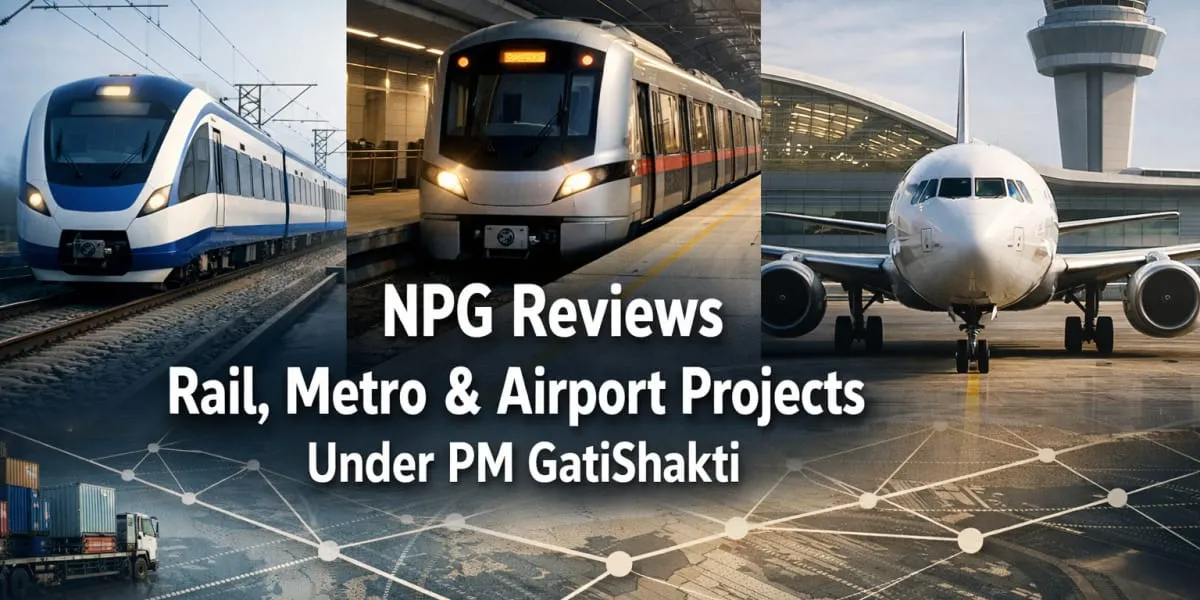
NPG Reviews Rail Metro and Airport Projects Under PM GatiShakti

The Network Planning Group held its 109th meeting at the Department for Promotion of Industry and Internal Trade to evaluate infrastructure projects under the PM GatiShakti National Master Plan (PMGS NMP).

The meeting assessed multimodal connectivity and logistics efficiency and examined two rail projects, one metro project and one airport project for alignment with integrated multimodal infrastructure, last-mile connectivity and a whole of government approach.

Officials said the evaluations were intended to boost logistics efficiency, reduce travel times and deliver socio-economic benefits to the catchment areas of the projects.

The Ministry of Railways proposed a third railway line between Jalandhar Cantt and Jammu Tawi covering a total length of 210.75 kilometre (km) across the states of Punjab, Himachal Pradesh and Jammu & Kashmir.

The alignment will include 27 stations and traverse districts such as Jalandhar, Hoshiarpur, Kangra, Pathankot, Kathua and Samba to augment capacity and strengthen connectivity along the corridor.

The project was described as strategically important for national security by enabling faster movement of defence personnel and equipment and as likely to enhance trade by improving transport of agricultural produce and essential goods.

The Ministry also proposed a third line between Manikpur and Itarsi covering 518.532 kilometre (km) across the states of Uttar Pradesh and Madhya Pradesh and passing through districts including Chitrakoot, Satna, Maihar, Katni, Jabalpur, Narsinghpur and Narmadapuram.

The section was noted as an essential component of the regional network that supports high volumes of passenger and freight traffic and as necessary to meet growing demand and reduce congestion.

Capacity enhancement would augment operational resilience, facilitate additional services and improve reliability to support regional economic growth and the overall efficiency of the transport system.

A Greenfield airport was proposed nearby.

The Ministry of Housing and Urban Affairs proposed a four point four km extension.

Regional benefits expected.

The Network Planning Group held its 109th meeting at the Department for Promotion of Industry and Internal Trade to evaluate infrastructure projects under the PM GatiShakti National Master Plan (PMGS NMP). The meeting assessed multimodal connectivity and logistics efficiency and examined two rail projects, one metro project and one airport project for alignment with integrated multimodal infrastructure, last-mile connectivity and a whole of government approach. Officials said the evaluations were intended to boost logistics efficiency, reduce travel times and deliver socio-economic benefits to the catchment areas of the projects. The Ministry of Railways proposed a third railway line between Jalandhar Cantt and Jammu Tawi covering a total length of 210.75 kilometre (km) across the states of Punjab, Himachal Pradesh and Jammu & Kashmir. The alignment will include 27 stations and traverse districts such as Jalandhar, Hoshiarpur, Kangra, Pathankot, Kathua and Samba to augment capacity and strengthen connectivity along the corridor. The project was described as strategically important for national security by enabling faster movement of defence personnel and equipment and as likely to enhance trade by improving transport of agricultural produce and essential goods. The Ministry also proposed a third line between Manikpur and Itarsi covering 518.532 kilometre (km) across the states of Uttar Pradesh and Madhya Pradesh and passing through districts including Chitrakoot, Satna, Maihar, Katni, Jabalpur, Narsinghpur and Narmadapuram. The section was noted as an essential component of the regional network that supports high volumes of passenger and freight traffic and as necessary to meet growing demand and reduce congestion. Capacity enhancement would augment operational resilience, facilitate additional services and improve reliability to support regional economic growth and the overall efficiency of the transport system. A Greenfield airport was proposed nearby. The Ministry of Housing and Urban Affairs proposed a four point four km extension. Regional benefits expected.

Related Stories

Gold Stories

Next Story
Infrastructure Urban

KONE Opens India's First Digital Experience Centre in Pune

KONE, a global elevator and escalator manufacturer, has inaugurated its first Digital Experience Centre (DEC) in India, located in Pune. The facility aims to showcase how artificial intelligence (AI), connectivity and data-driven technologies can enhance customer experiences and improve building operations.The centre was inaugurated by Jussi Herlin, Executive Vice Chair, KONE Corporation; Philippe Delorme, President and CEO, KONE; and Nandan Nilekani, Co-founder and Chairman of the Board, Infosys.Designed as an interactive customer environment, the facility demonstrates digital solutions cover..

Next Story
Infrastructure Urban

CII GreenCo Launches Circularity Guidelines for Indian Industry

The Confederation of Indian Industry (CII) GreenCo Council has launched the CII GreenCo Circularity Guidelines – Pilot Version at the 17th CII GreenCo Waste & Resource Management Summit 2026 in Chennai. The initiative aims to strengthen resource efficiency, waste reduction and circular economy practices across Indian manufacturing and process industries.The guidelines introduce a structured framework with circularity indices covering raw materials, consumables, packaging and other resource inputs. These indicators will help industries assess existing practices, identify opportunities to ..

Next Story
Infrastructure Energy

Global Electronics Association Launches IPC-1783-CO2E Standard

The Global Electronics Association has introduced IPC-1783-CO2E, a new international standard aimed at improving consistency, transparency and comparability in product carbon footprint reporting across the electronics manufacturing industry.The standard, titled International Standard for Data Collection and Reporting of CO2 Equivalent (CO2e) Emissions for the Electronics Manufacturing Supply Chain, provides industry-specific guidance for collecting, estimating and reporting carbon emissions data.With increasing regulatory requirements and customer expectations, electronics manufacturers face c..

Advertisement

Subscribe to Our Newsletter

Get daily newsletters around different themes from Construction world.

STAY CONNECTED

Advertisement

SPECIAL OFFER
QR Code