+
Pune Metro Phase Two Bhakti Shakti Chakan Corridor DPR Placed
RAILWAYS & METRO RAIL

Pune Metro Phase Two Bhakti Shakti Chakan Corridor DPR Placed

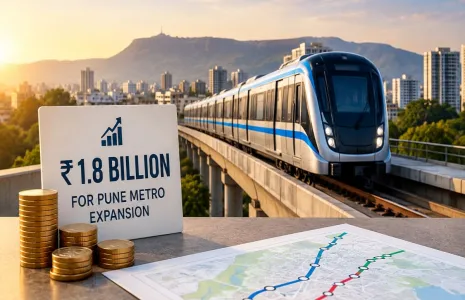
The Maharashtra Metro Rail Corporation Limited has submitted a revised detailed project report for the Bhakti Shakti–Wakad–Nashik Phata–Chakan metro corridor to the Pimpri Chinchwad Municipal Corporation for approval. The project cost is Rs 129.37 billion (Rs 129.37 bn), reflecting the revised financial estimates placed before the municipal authority. The DPR follows nearly two years of discussions and planning among regional stakeholders. The submission includes route maps, station lists and integration details prepared by technical teams.

The corridor spans 45.295 km and comprises 34 stations designed to serve Pimpri-Chinchwad and adjacent areas. Major nodes include Bhakti Shakti interchange at the northern end and Chakan at the periphery, with intermediate stops across residential and industrial belts. The alignment has been planned to improve access to industrial estates, academic institutions and new residential developments and is expected to relieve congestion on key arterial roads. The design accommodates future capacity enhancements and station accessibility provisions.

The DPR highlights three strategic integration points with existing and upcoming lines to ensure multimodal connectivity. Interchanges are planned with the Purple Line at Bhakti Shakti and Sant Tukaram Nagar, and with the Pink Line at Wakad Chowk, linking the corridor to the IT hub in Hinjewadi and to the Pune central spine. These connections aim to shorten travel times and to improve last?mile access for workers and students. Planners emphasised operational coordination with bus and suburban rail services to enable smooth transfers.

The revised DPR will require ratification at a PCMC general body meeting before it is forwarded for clearance by the Maharashtra State Government and the Central Government. Implementation phases and funding arrangements were outlined in the submission and will be refined during the approval process. Officials project that timely sanctioning and coordinated execution will transform daily commuting and support economic growth across Pimpri?Chinchwad and Pune. Stakeholder consultations will continue during the detailed design and procurement stages.

The Maharashtra Metro Rail Corporation Limited has submitted a revised detailed project report for the Bhakti Shakti–Wakad–Nashik Phata–Chakan metro corridor to the Pimpri Chinchwad Municipal Corporation for approval. The project cost is Rs 129.37 billion (Rs 129.37 bn), reflecting the revised financial estimates placed before the municipal authority. The DPR follows nearly two years of discussions and planning among regional stakeholders. The submission includes route maps, station lists and integration details prepared by technical teams. The corridor spans 45.295 km and comprises 34 stations designed to serve Pimpri-Chinchwad and adjacent areas. Major nodes include Bhakti Shakti interchange at the northern end and Chakan at the periphery, with intermediate stops across residential and industrial belts. The alignment has been planned to improve access to industrial estates, academic institutions and new residential developments and is expected to relieve congestion on key arterial roads. The design accommodates future capacity enhancements and station accessibility provisions. The DPR highlights three strategic integration points with existing and upcoming lines to ensure multimodal connectivity. Interchanges are planned with the Purple Line at Bhakti Shakti and Sant Tukaram Nagar, and with the Pink Line at Wakad Chowk, linking the corridor to the IT hub in Hinjewadi and to the Pune central spine. These connections aim to shorten travel times and to improve last?mile access for workers and students. Planners emphasised operational coordination with bus and suburban rail services to enable smooth transfers. The revised DPR will require ratification at a PCMC general body meeting before it is forwarded for clearance by the Maharashtra State Government and the Central Government. Implementation phases and funding arrangements were outlined in the submission and will be refined during the approval process. Officials project that timely sanctioning and coordinated execution will transform daily commuting and support economic growth across Pimpri?Chinchwad and Pune. Stakeholder consultations will continue during the detailed design and procurement stages.

Related Stories

Gold Stories

Next Story
Real Estate

BMC OC Amnesty Scheme Requires Key Approvals from Mumbai Societies

The Brihanmumbai Municipal Corporation (BMC) has clarified that housing societies applying under its Occupation Certificate (OC) amnesty scheme must possess key approvals linked to the original construction. The requirements include a valid Intimation of Disapproval (IOD), an approved building plan and a Commencement Certificate (CC), along with a No Objection Certificate (NOC) from the developer or original construction applicant. The Standard Operating Procedure (SOP) makes clear that the absence of an OC alone will not qualify a building for relief. Societies must establish that their build..

Next Story
Real Estate

Gurugram Emerges as Luxury Senior Living Hub

Gurugram is emerging as a potential hub for luxury senior living, supported by available land, healthcare infrastructure, connectivity and a concentration of affluent professionals, high-net-worth individuals and non-resident Indians. These factors could give the city an advantage over land-constrained metros such as Mumbai. A report by the Association of Senior Living India (ASLI) and JLL estimates that India’s organised senior living market could represent a $10.1 bn opportunity by 2030. The sector had about 25,050 organised units as of June 2026, while penetration stood at only 1.5 per ce..

Next Story
Real Estate

Corrosion Costs India’s Infrastructure Rs. 142 bn Annually

Corrosion costs India an estimated Rs. 1.42 tn annually, equivalent to 4.3 per cent of gross domestic product, according to a report by the Confederation of Indian Industry and the National Research Institute. Infrastructure accounts for Rs. 142 bn of the annual burden, making it the sector with the largest absolute cost among those examined. The report, presented at the CII Annual Infrastructure Summit 2026, said the infrastructure-sector cost equals about 2.9 per cent of the sector’s gross domestic product. It estimated that effective measures could generate maximum savings of Rs. 495.8 bn..

Advertisement

Subscribe to Our Newsletter

Get daily newsletters around different themes from Construction world.

STAY CONNECTED

Advertisement

SPECIAL OFFER
QR Code